QUESTION IMAGE
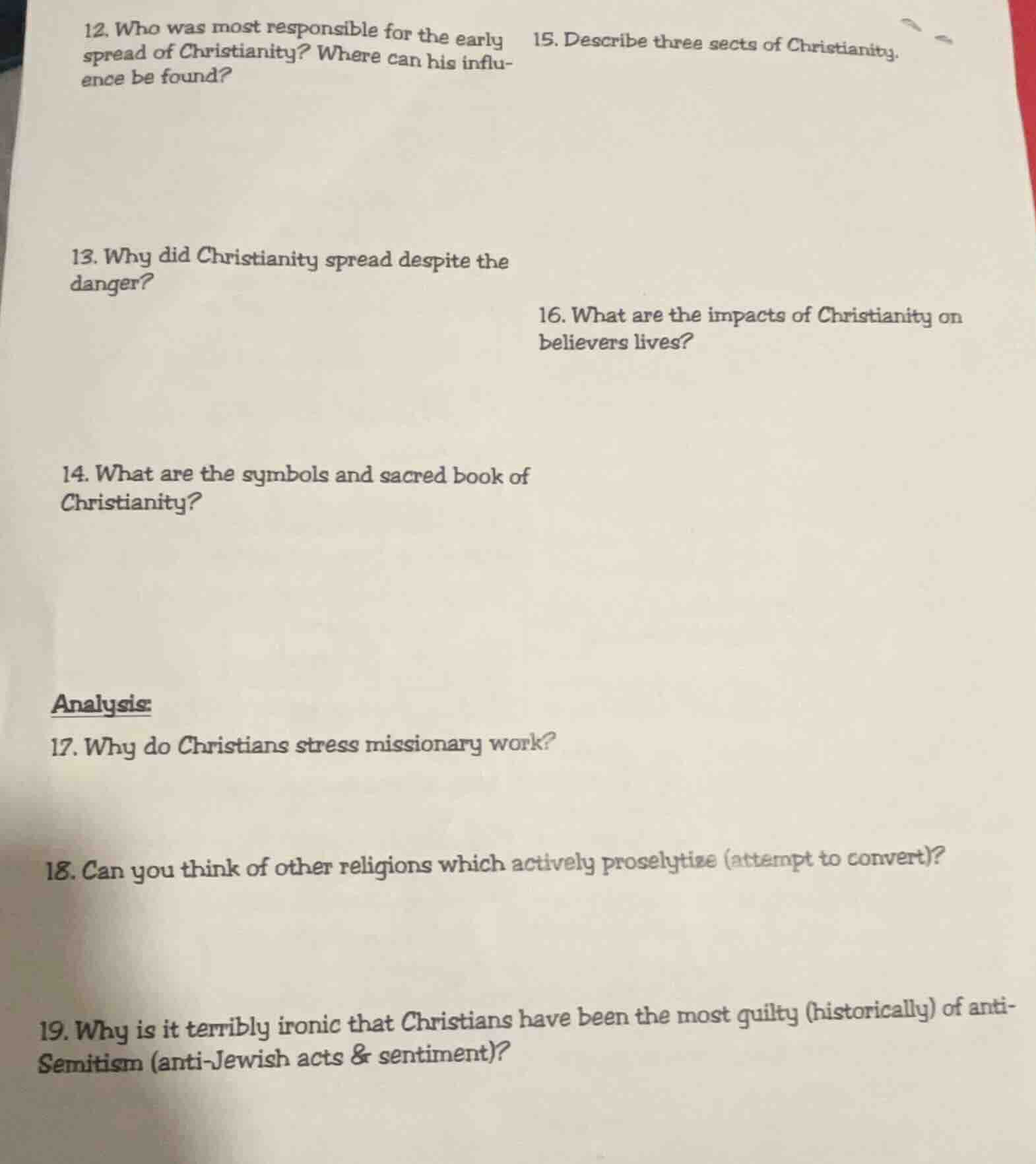
Question
- who was most responsible for the early spread of christianity? where can his influ- ence be found?
- why did christianity spread despite the danger?
- what are the symbols and sacred book of christianity?
- describe three sects of christianity.
- what are the impacts of christianity on believers lives?
analysis
- why do christians stress missionary work?
- can you think of other religions which actively proselytize (attempt to convert)?
- why is it terribly ironic that christians have been the most guilty (historically) of anti-semitism (anti-jewish acts & sentiment)?
Brief Explanations
- Q12: Paul the Apostle (Saul of Tarsus) traveled across the Mediterranean, wrote epistles, and converted non-Jews, forming early Christian communities.
- Q13: It offered hope to marginalized groups, had a unified message, and early believers shared resources, enduring persecution as a testament to their faith.
- Q14: The Bible (Old and New Testaments) is the sacred book; key symbols include the cross, fish (Ichthys), and dove.
- Q15: Roman Catholicism (led by the Pope, sacraments), Protestantism (reformed, Bible-focused), Eastern Orthodoxy (independent patriarchs, liturgical tradition).
- Q16: It shapes moral frameworks, community involvement, daily prayer/worship, and life milestones (baptism, marriage).
- Q17: Rooted in the "Great Commission" (Matthew 28:19-20), to spread Jesus' teachings globally.
- Q18: Islam (da'wah) and Mormonism (LDS Church) actively proselytize to new followers.
- Q19: Jesus and his disciples were Jewish; Christian teachings are rooted in Jewish scripture, making anti-Jewish actions contradictory to their faith's origins.

Snap & solve any problem in the app
Get step-by-step solutions on Sovi AI
Photo-based solutions with guided steps
Explore more problems and detailed explanations
- Q12: Paul the Apostle; his influence is found in the New Testament epistles and early Christian communities across the Eastern Mediterranean and Asia Minor.
- Q13: It offered inclusive hope, shared community support, and a compelling, unified spiritual message.
- Q14: Sacred book: The Christian Bible (Old Testament + New Testament). Symbols: Cross, Ichthys (fish), dove.
- Q15:
- Roman Catholicism: Hierarchical church led by the Pope, seven sacraments, traditional liturgy.
- Protestantism: Diverse denominations (e.g., Lutheran, Baptist) that reject papal authority, emphasize scripture alone.
- Eastern Orthodoxy: Independent regional patriarchates, ornate liturgy, focus on tradition and icons.
- Q16: It guides ethical behavior, fosters tight-knit religious communities, structures daily spiritual practices, and marks key life events with religious rituals.
- Q17: It stems from the biblical Great Commission, which calls believers to spread Jesus' teachings to all nations.
- Q18: Islam (through da'wah, inviting others to the faith) and the Church of Jesus Christ of Latter-day Saints (Mormonism) actively proselytize.
- Q19: Christianity originated within Judaism, with Jesus and all early followers being Jewish, so anti-Semitic actions contradict the faith's Jewish roots and core calls for love of neighbor.