QUESTION IMAGE
Question
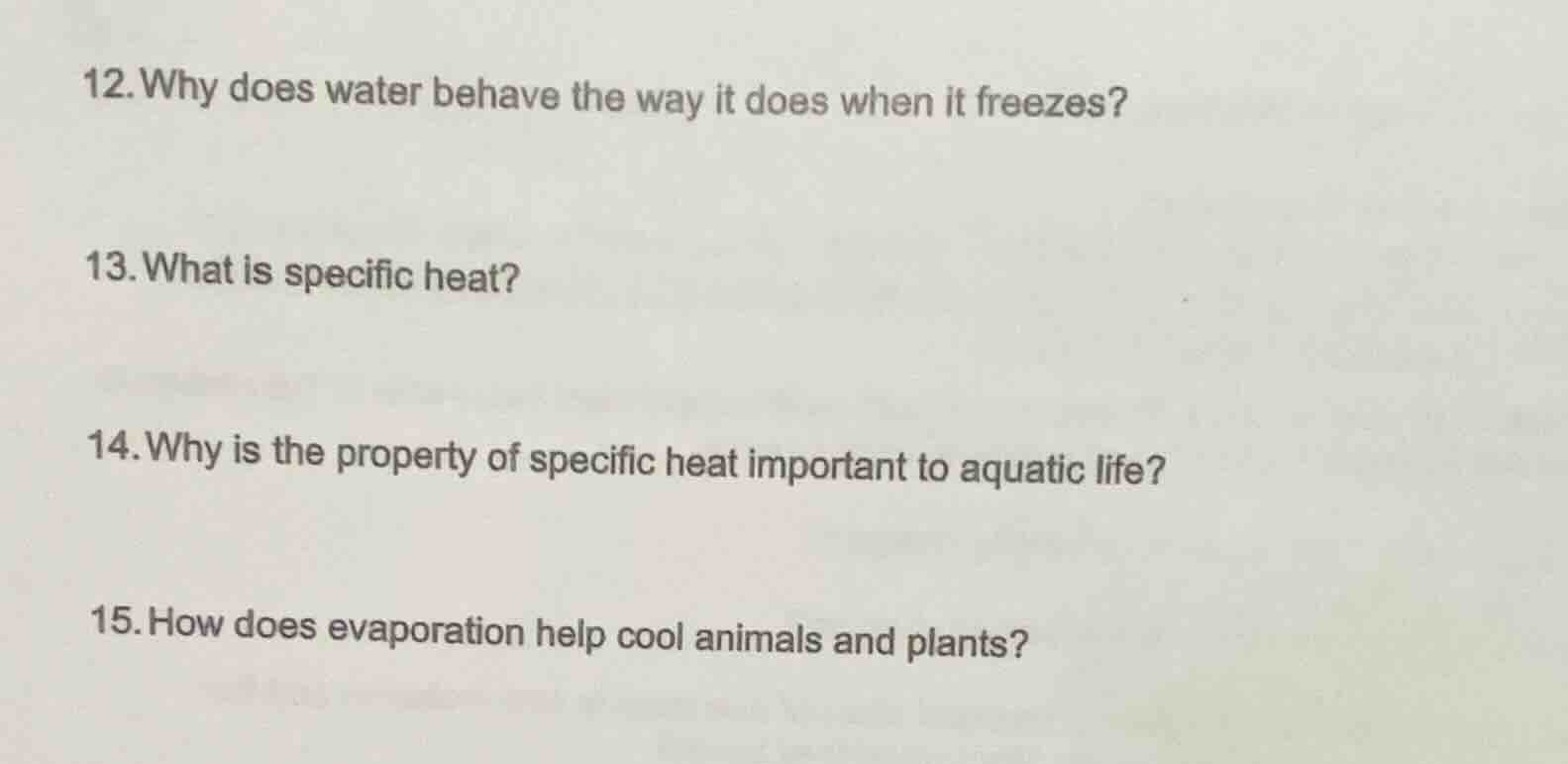
- why does water behave the way it does when it freezes?
- what is specific heat?
- why is the property of specific heat important to aquatic life?
- how does evaporation help cool animals and plants?
Question 12
Water expands when it freezes because of its molecular structure (hydrogen bonding). In liquid water, molecules are close; when freezing, hydrogen bonds form a hexagonal lattice, increasing space between molecules, so ice is less dense than liquid water.
Specific heat is the amount of heat energy (in joules or calories) required to raise the temperature of 1 gram (or 1 mole, depending on context) of a substance by 1 degree Celsius (or 1 Kelvin). It's a measure of a substance's thermal inertia.
Water has a high specific heat. This means aquatic environments (like lakes, oceans) resist temperature changes. So, water doesn't heat up or cool down too quickly. Aquatic organisms live in a stable thermal environment, which is vital for their metabolic processes, enzyme function, and overall survival.

Snap & solve any problem in the app
Get step-by-step solutions on Sovi AI
Photo-based solutions with guided steps
Explore more problems and detailed explanations
Water freezes into a less - dense (expanded) structure due to hydrogen bonding forming a hexagonal lattice, making ice less dense than liquid water.