QUESTION IMAGE
Question
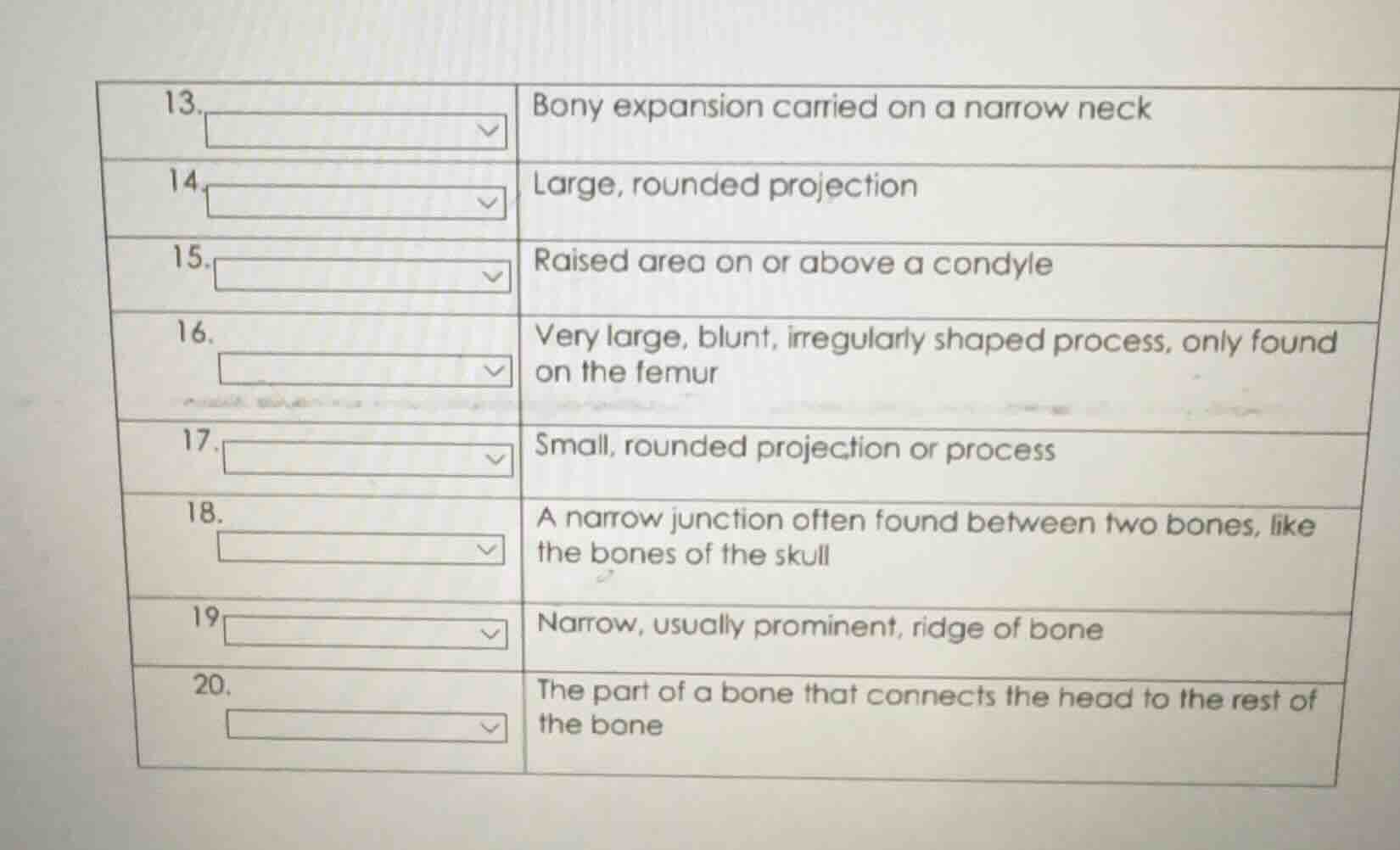
- bony expansion carried on a narrow neck
- large, rounded projection
- raised area on or above a condyle
- very large, blunt, irregularly shaped process, only found on the femur
- small, rounded projection or process
- a narrow junction often found between two bones, like the bones of the skull
19 narrow, usually prominent, ridge of bone
- the part of a bone that connects the head to the rest of the bone
To solve this, we identify the correct bone markings for each description:
13. Bony expansion carried on a narrow neck
This is a condyle? No, wait—"bony expansion on a narrow neck" is a head? No, correction: The term for a bony expansion carried on a narrow neck is condyle? Wait, no—let's recall:
- Head: Bony expansion carried on a narrow neck (articulates with another bone). Wait, no, "head" is the rounded end, but "bony expansion on a narrow neck" is actually the head? Wait, no, let's check standard bone markings:
- Head: Rounded, expanded end (carried on a neck). Wait, the description here is "bony expansion carried on a narrow neck"—so Head? No, maybe I mixed up. Wait, let's list standard bone markings:
- Condyle: Rounded projection (articulating).
- Tuberosity: Large, rounded projection.
- Epicondyle: Raised area on/above condyle.
- Trochanter: Very large, blunt, irregular (only on femur).
- Tubercle: Small, rounded projection.
- Suture: Narrow junction (skull bones).
- Crest: Narrow, prominent ridge.
- Neck: Connects head to rest of bone.
Wait, re-matching:
- Bony expansion carried on a narrow neck → Head (but wait, "neck" connects head to bone. Wait, no—"bony expansion (head) carried on a narrow neck (the neck of the bone)". So 13: Head? Wait, no, maybe the options (dropdowns) have these terms. Let's assume the dropdown options include: Head, Condyle, Epicondyle, Trochanter, Tubercle, Suture, Crest, Neck, etc.
14. Large, rounded projection → Tuberosity (large, rounded projection for muscle attachment).
15. Raised area on or above a condyle → Epicondyle (epi- means "above", so raised area above a condyle).
16. Very large, blunt, irregularly shaped process, only found on the femur → Trochanter (specific to femur, large irregular process).
17. Small, rounded projection or process → Tubercle (small, rounded, for muscle/tendon attachment).
18. A narrow junction often found between two bones, like the bones of the skull → Suture (fibrous joint between skull bones, narrow junction).
19. Narrow, usually prominent, ridge of bone → Crest (narrow, prominent ridge, e.g., iliac crest).
20. The part of a bone that connects the head to the rest of the bone → Neck (connects the head (rounded end) to the diaphysis/shaft).
Final Answers (matching each number):
- Head (or check dropdown; if options include "Head", that’s it)
- Tuberosity
- Epicondyle
- Trochanter
- Tubercle
- Suture
- Crest
- Neck
(Note: If dropdown options differ, adjust based on standard bone marking definitions.)
Step-by-Step Explanation for Each:
- 13: Define "bony expansion on narrow neck" → matches Head (rounded end connected by a neck).
- 14: "Large, rounded projection" → Tuberosity (large, rounded for muscle attachment).
- 15: "Raised area on/above condyle" → Epicondyle (epi- = above, so above condyle).
- 16: "Very large, blunt, irregular (femur only)" → Trochanter (unique to femur).
- 17: "Small, rounded projection" → Tubercle (small, rounded).
- 18: "Narrow junction (skull)" → Suture (fibrous joint between skull bones).
- 19: "Narrow, prominent ridge" → Crest (e.g., iliac crest).
- 20: "Connects head to bone" → Neck (the narrow part connecting head to diaphysis).
Final Answers (each number):
- Head
- Tuberosity
- Epicondyle
- Trochanter
- Tubercle
- Suture
- Crest
- Neck

Snap & solve any problem in the app
Get step-by-step solutions on Sovi AI
Photo-based solutions with guided steps
Explore more problems and detailed explanations
To solve this, we identify the correct bone markings for each description:
13. Bony expansion carried on a narrow neck
This is a condyle? No, wait—"bony expansion on a narrow neck" is a head? No, correction: The term for a bony expansion carried on a narrow neck is condyle? Wait, no—let's recall:
- Head: Bony expansion carried on a narrow neck (articulates with another bone). Wait, no, "head" is the rounded end, but "bony expansion on a narrow neck" is actually the head? Wait, no, let's check standard bone markings:
- Head: Rounded, expanded end (carried on a neck). Wait, the description here is "bony expansion carried on a narrow neck"—so Head? No, maybe I mixed up. Wait, let's list standard bone markings:
- Condyle: Rounded projection (articulating).
- Tuberosity: Large, rounded projection.
- Epicondyle: Raised area on/above condyle.
- Trochanter: Very large, blunt, irregular (only on femur).
- Tubercle: Small, rounded projection.
- Suture: Narrow junction (skull bones).
- Crest: Narrow, prominent ridge.
- Neck: Connects head to rest of bone.
Wait, re-matching:
- Bony expansion carried on a narrow neck → Head (but wait, "neck" connects head to bone. Wait, no—"bony expansion (head) carried on a narrow neck (the neck of the bone)". So 13: Head? Wait, no, maybe the options (dropdowns) have these terms. Let's assume the dropdown options include: Head, Condyle, Epicondyle, Trochanter, Tubercle, Suture, Crest, Neck, etc.
14. Large, rounded projection → Tuberosity (large, rounded projection for muscle attachment).
15. Raised area on or above a condyle → Epicondyle (epi- means "above", so raised area above a condyle).
16. Very large, blunt, irregularly shaped process, only found on the femur → Trochanter (specific to femur, large irregular process).
17. Small, rounded projection or process → Tubercle (small, rounded, for muscle/tendon attachment).
18. A narrow junction often found between two bones, like the bones of the skull → Suture (fibrous joint between skull bones, narrow junction).
19. Narrow, usually prominent, ridge of bone → Crest (narrow, prominent ridge, e.g., iliac crest).
20. The part of a bone that connects the head to the rest of the bone → Neck (connects the head (rounded end) to the diaphysis/shaft).
Final Answers (matching each number):
- Head (or check dropdown; if options include "Head", that’s it)
- Tuberosity
- Epicondyle
- Trochanter
- Tubercle
- Suture
- Crest
- Neck
(Note: If dropdown options differ, adjust based on standard bone marking definitions.)
Step-by-Step Explanation for Each:
- 13: Define "bony expansion on narrow neck" → matches Head (rounded end connected by a neck).
- 14: "Large, rounded projection" → Tuberosity (large, rounded for muscle attachment).
- 15: "Raised area on/above condyle" → Epicondyle (epi- = above, so above condyle).
- 16: "Very large, blunt, irregular (femur only)" → Trochanter (unique to femur).
- 17: "Small, rounded projection" → Tubercle (small, rounded).
- 18: "Narrow junction (skull)" → Suture (fibrous joint between skull bones).
- 19: "Narrow, prominent ridge" → Crest (e.g., iliac crest).
- 20: "Connects head to bone" → Neck (the narrow part connecting head to diaphysis).
Final Answers (each number):
- Head
- Tuberosity
- Epicondyle
- Trochanter
- Tubercle
- Suture
- Crest
- Neck