QUESTION IMAGE
Question
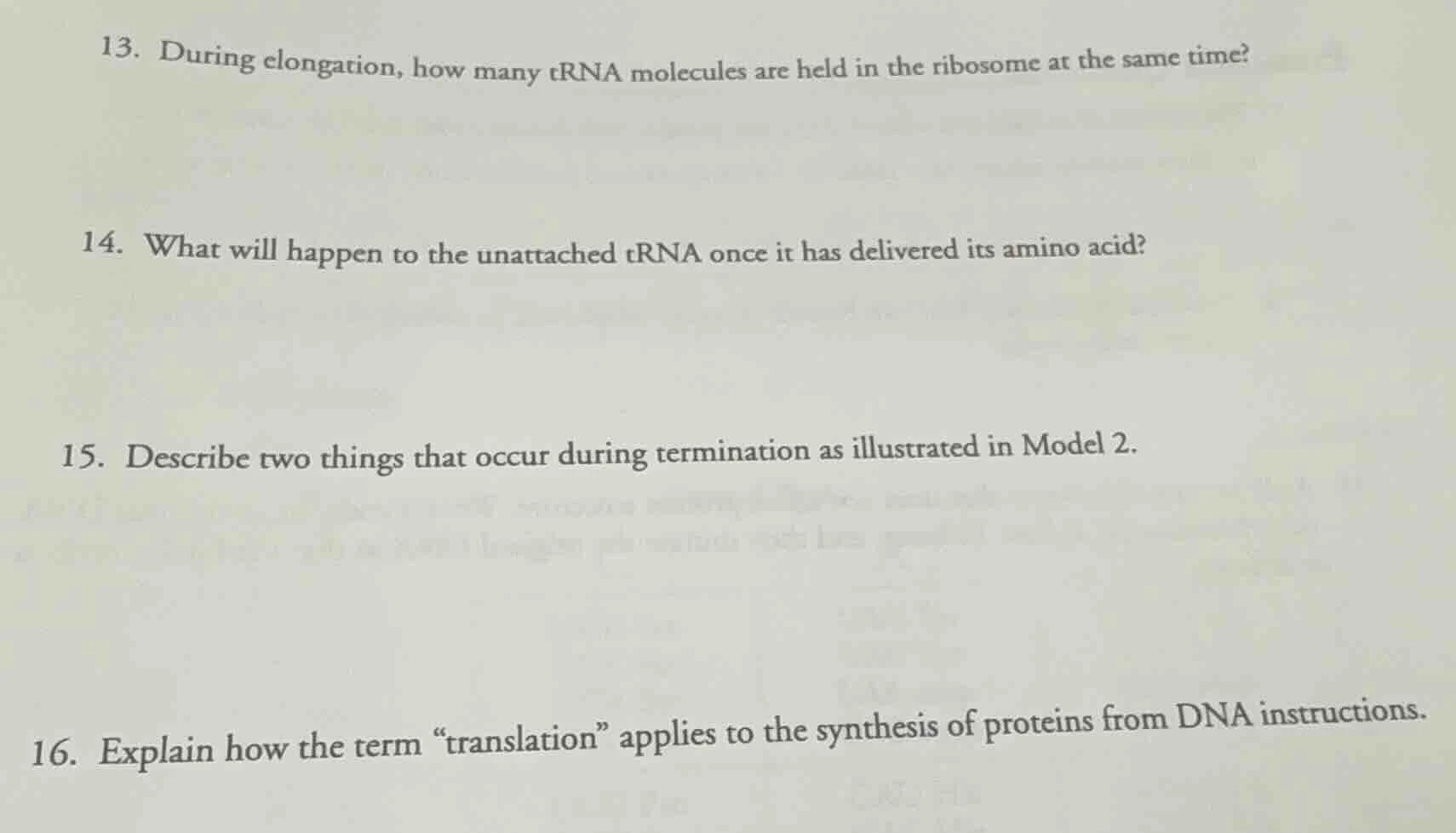
- during elongation, how many trna molecules are held in the ribosome at the same time?
- what will happen to the unattached trna once it has delivered its amino acid?
- describe two things that occur during termination as illustrated in model 2.
- explain how the term \translation\ applies to the synthesis of proteins from dna instructions.
Question 13
During the elongation phase of translation, the ribosome has three binding sites (A, P, and E). At any given time during elongation, two tRNA molecules are held in the ribosome: one in the P (peptidyl) site carrying the growing polypeptide chain and one in the A (aminoacyl) site carrying the next amino acid to be added.
Once a tRNA has delivered its amino acid during translation, it becomes uncharged (no amino acid attached) and is released from the ribosome. It then returns to the cytoplasm, where it can bind to its specific amino acid again (with the help of an aminoacyl - tRNA synthetase enzyme) and be reused in the translation process.
- When a stop codon (UAA, UAG, or UGA) enters the A site of the ribosome during termination, a release factor binds to the A site. This release factor causes the peptidyl transferase to catalyze the addition of a water molecule instead of an amino acid to the polypeptide chain, which hydrolyzes the bond between the completed polypeptide chain and the tRNA in the P site, releasing the polypeptide.
- After the polypeptide is released, the ribosomal subunits (large and small) dissociate from each other, and the mRNA is also released. The ribosome can then be reused for another round of translation.

Snap & solve any problem in the app
Get step-by-step solutions on Sovi AI
Photo-based solutions with guided steps
Explore more problems and detailed explanations
Two