QUESTION IMAGE
Question
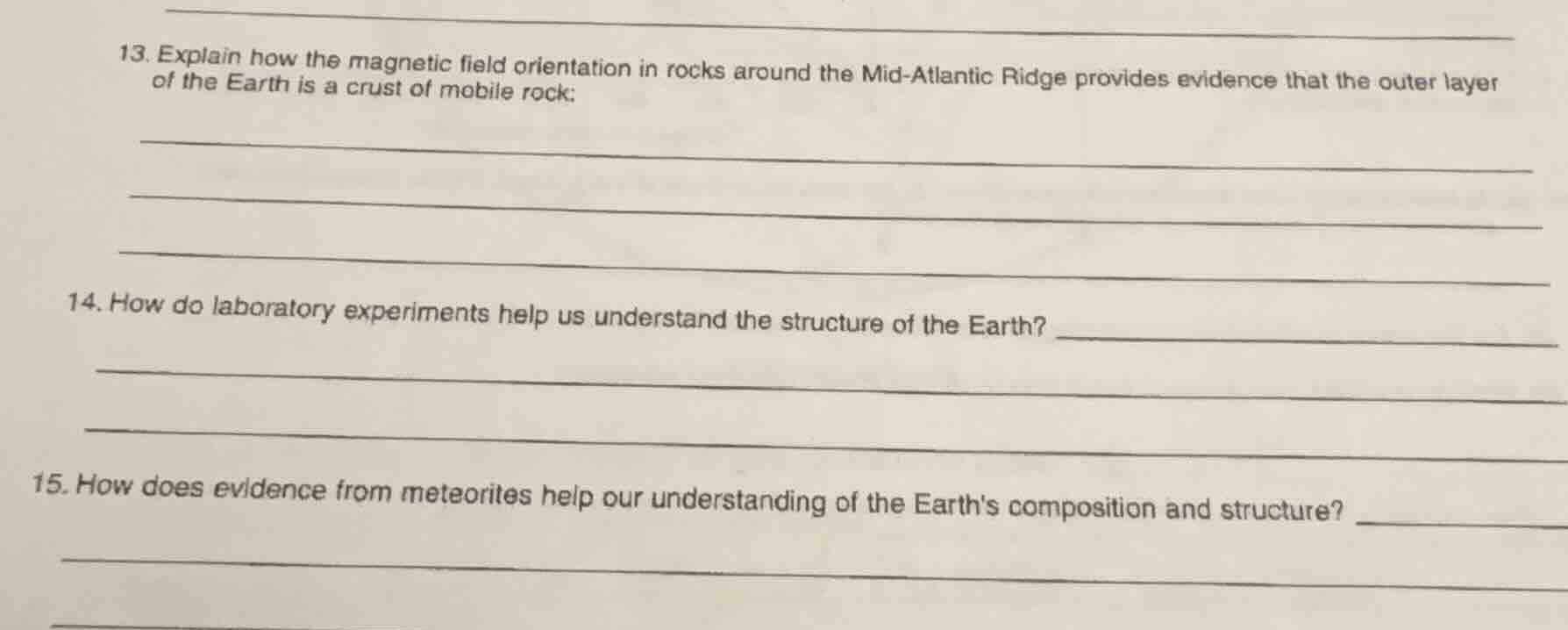
- explain how the magnetic field orientation in rocks around the mid-atlantic ridge provides evidence that the outer layer of the earth is a crust of mobile rock;
- how do laboratory experiments help us understand the structure of the earth?
- how does evidence from meteorites help our understanding of the earths composition and structure?
Response
Question 13
Brief Explanations
- Magnetic Reversals & Rock Formation: At the Mid - Atlantic Ridge, new oceanic crust forms as magma rises and solidifies. When the magma cools, magnetic minerals (like magnetite) in the rock align with the Earth's magnetic field at that time.
- Striped Pattern Observation: The Earth's magnetic field has reversed its polarity multiple times in the past. By studying the rocks around the Mid - Atlantic Ridge, scientists have found a striped pattern of magnetic orientations. Rocks on one side of the ridge have a magnetic orientation that matches the field at a certain time, and rocks on the other side (at the same distance from the ridge) have the same orientation. This is because the new crust is formed at the ridge and then moves away from it (like a conveyor belt). The symmetric pattern of magnetic stripes on either side of the ridge shows that the crust is moving away from the ridge, providing evidence for plate tectonics (and thus a mobile outer crust).
Brief Explanations
- Simulating Earth's Conditions: Laboratory experiments can recreate high - pressure and high - temperature conditions that exist deep within the Earth. For example, using devices like diamond anvil cells, scientists can subject materials (like rocks or minerals) to pressures similar to those in the Earth's mantle or core.
- Studying Material Behavior: By heating and pressurizing rocks and minerals in the lab, we can observe how they deform, melt, or change their structure. For instance, experiments on olivine (a common mantle mineral) under high pressure can show how it transitions to other mineral phases (like spinel or perovskite - like structures) at different depths. This helps us understand the layering and composition of the Earth's interior (e.g., the mantle's structure, the nature of the core - mantle boundary). Also, experiments on the electrical conductivity of materials can help us model the Earth's core (since the core is thought to generate the magnetic field, and conductivity plays a role in that).
Brief Explanations
- Meteorite Composition as a Sample: Meteorites are thought to be fragments of ancient asteroids, which formed around the same time as the Earth (from the solar nebula). There are different types of meteorites: chondrites (primitive, undifferentiated) and iron - nickel meteorites (from differentiated bodies).
- Comparing to Earth's Composition: Chondrites have a composition similar to the solar nebula and are considered to represent the “bulk” composition of the early solar system. By analyzing their chemical and isotopic composition, we can infer the composition of the Earth’s interior. For example, the abundance of elements like iron, nickel, and silicates in chondrites helps us model the Earth’s core - mantle composition (the core is rich in Fe - Ni, similar to iron - nickel meteorites, and the mantle has more silicate - rich material, like chondritic silicate components). Also, the age of meteorites (determined via radiometric dating) gives us the age of the Earth (since they formed at the same time), and their internal structure (e.g., differentiated meteorites with cores and mantles) provides a model for Earth’s layered structure (core, mantle, crust).

Snap & solve any problem in the app
Get step-by-step solutions on Sovi AI
Photo-based solutions with guided steps
Explore more problems and detailed explanations
The Mid - Atlantic Ridge is a spreading center. As magma rises, cools, and solidifies into rock, magnetic minerals in the rock align with the Earth’s magnetic field. The Earth’s magnetic field has reversed polarity over time. Rocks on either side of the ridge show a symmetric pattern of magnetic stripes (matching past field orientations). This symmetry implies the crust forms at the ridge and moves outward, proving the outer crust (lithospheric plates) is mobile (supporting plate tectonics).