QUESTION IMAGE
Question
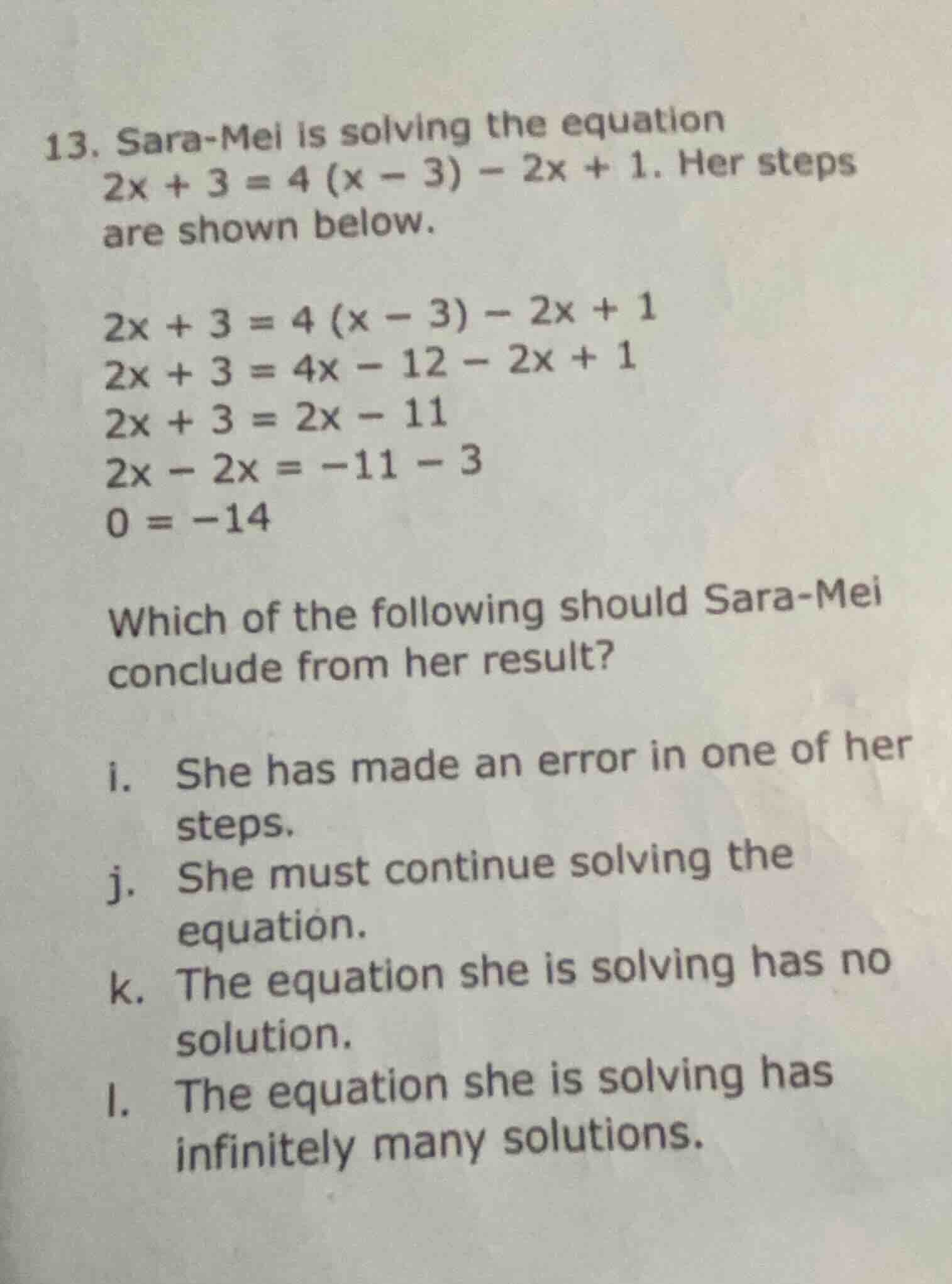
- sara-mei is solving the equation $2x + 3 = 4 (x - 3) - 2x + 1$. her steps are shown below.
$2x + 3 = 4 (x - 3) - 2x + 1$
$2x + 3 = 4x - 12 - 2x + 1$
$2x + 3 = 2x - 11$
$2x - 2x = -11 - 3$
$0 = -14$
which of the following should sara-mei conclude from her result?
i. she has made an error in one of her steps.
j. she must continue solving the equation.
k. the equation she is solving has no solution.
l. the equation she is solving has infinitely many solutions.
Step1: Analyze the equation solving steps
First, let's check Sara - Mei's steps. Starting with the equation \(2x + 3=4(x - 3)-2x + 1\).
- Distribute the 4 on the right - hand side: \(4(x - 3)=4x-12\), so the equation becomes \(2x + 3 = 4x-12-2x + 1\).
- Combine like terms on the right - hand side: \(4x-2x=2x\) and \(-12 + 1=-11\), so we get \(2x + 3=2x-11\).
- Subtract \(2x\) from both sides: \(2x-2x+3=2x - 2x-11\), which simplifies to \(3=-11\) (Wait, Sara - Mei made a mistake in the sign when moving 3 to the other side. But let's follow the general rule for linear equations:
For a linear equation in the form \(ax + b=cx + d\), if \(a = c\) and \(b
eq d\), the equation has no solution.
In our equation, after simplifying \(2x + 3=2x-11\), if we subtract \(2x\) from both sides, we get \(3=-11\), which is a false statement. A false statement at the end of solving a linear equation means that the equation has no solution. Also, let's check Sara - Mei's step where she did \(2x-2x=-11 - 3\). The correct operation when moving 3 from the left to the right is \(2x-2x=-11 - 3\) is wrong. The correct operation is \(3=-11\) (by subtracting \(2x\) from both sides). But the key point is that when we end up with a statement like \(0=-14\) (or \(3 = - 11\)) which is always false, the equation has no solution.
Step2: Evaluate each option
- Option i: Let's check the steps again. The first step of distributing 4 is correct (\(4(x - 3)=4x-12\)). Combining like terms \(4x-2x = 2x\) and \(-12 + 1=-11\) is correct. Then, when we have \(2x+3 = 2x-11\), subtracting \(2x\) from both sides gives \(3=-11\) (or in Sara - Mei's case \(0=-14\) because she moved 3 to the right as \(-3\) and - 11 to the left as + 11, which is a miscalculation of signs, but the end result is a false statement). However, the nature of the equation (having no solution) is determined by the fact that the coefficients of \(x\) are equal and the constants are not. So, actually, Sara - Mei's steps (even with a sign error in moving terms) lead to a false statement, which means the equation has no solution. But let's analyze the options:
- Option j: We can't continue solving because we already have a statement \(0=-14\) (or the equivalent \(3=-11\)) which is false. So we can't continue.
- Option k: For a linear equation \(ax + b=cx + d\), if \(a = c\) and \(b
eq d\), the equation has no solution. In our equation, after simplifying, we have \(2x+3 = 2x-11\), where \(a = c = 2\) and \(b = 3\), \(d=-11\) and \(b
eq d\). So the equation has no solution.
- Option l: An equation has infinitely many solutions when \(ax + b=cx + d\) with \(a = c\) and \(b = d\). Here \(b
eq d\), so it doesn't have infinitely many solutions.

Snap & solve any problem in the app
Get step-by-step solutions on Sovi AI
Photo-based solutions with guided steps
Explore more problems and detailed explanations
k. The equation she is solving has no solution.