QUESTION IMAGE
Question
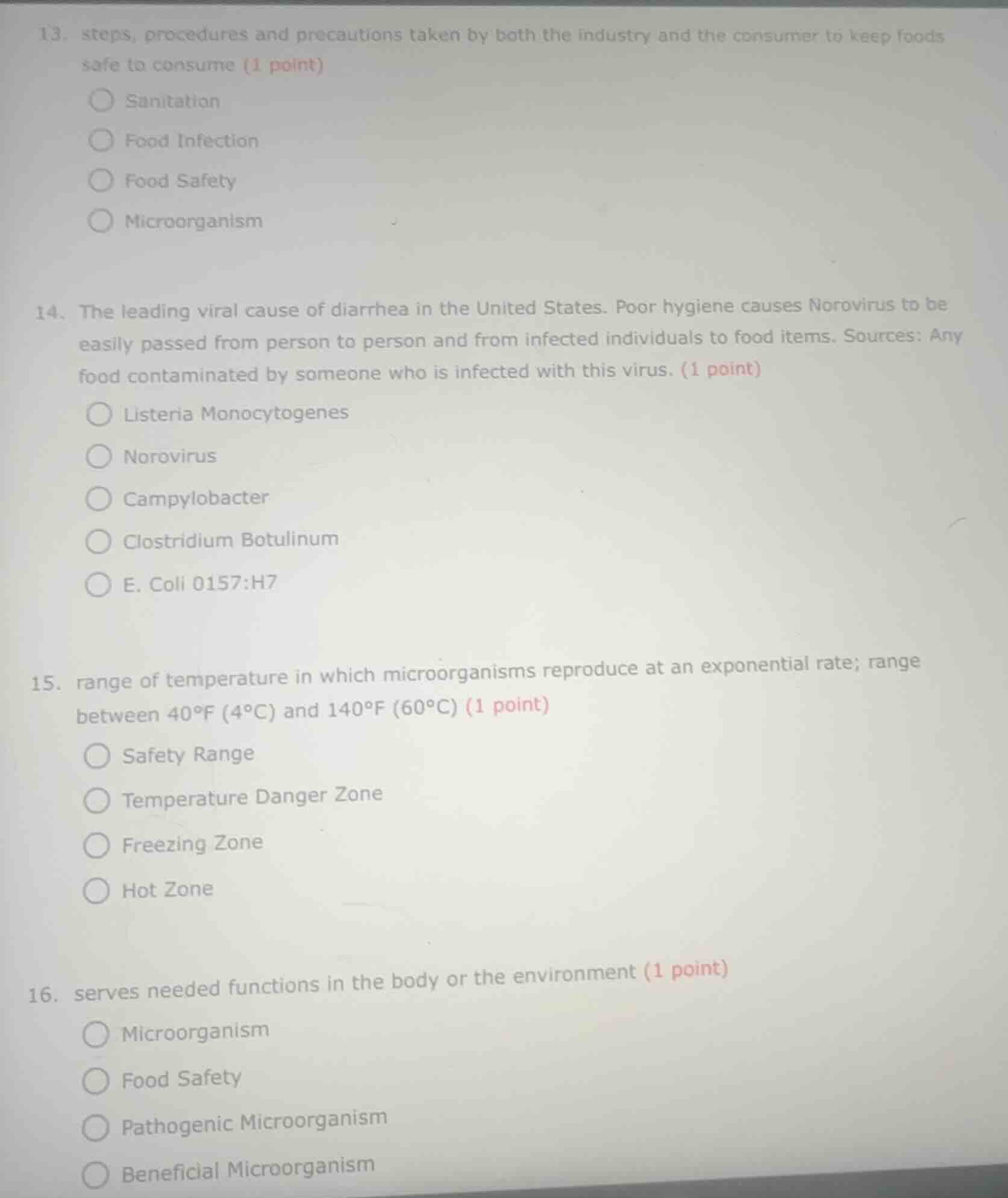
- steps, procedures and precautions taken by both the industry and the consumer to keep foods safe to consume (1 point)
sanitation
food infection
food safety
microorganism
- the leading viral cause of diarrhea in the united states. poor hygiene causes norovirus to be easily passed from person to person and from infected individuals to food items. sources: any food contaminated by someone who is infected with this virus. (1 point)
listeria monocytogenes
norovirus
campylobacter
clostridium botulinum
e. coli 0157:h7
- range of temperature in which microorganisms reproduce at an exponential rate; range between 40°f (4°c) and 140°f (60°c) (1 point)
safety range
temperature danger zone
freezing zone
hot zone
- serves needed functions in the body or the environment (1 point)
microorganism
food safety
pathogenic microorganism
beneficial microorganism
Brief Explanations
- For question 13: The definition matches the broad set of actions for safe food consumption, which is food safety. Sanitation is a subset, while the other options are unrelated to the described practices.
- For question 14: The question explicitly identifies Norovirus as the viral cause of diarrhea with the stated transmission and source details, so this is the correct match.
- For question 15: The specified temperature range of 40°F (4°C) to 140°F (60°C) is defined as the temperature danger zone where microbes grow rapidly.
- For question 16: Microorganisms that perform needed, helpful functions in bodies or environments are classified as beneficial microorganisms.

Snap & solve any problem in the app
Get step-by-step solutions on Sovi AI
Photo-based solutions with guided steps
Explore more problems and detailed explanations
- C. Food Safety
- B. Norovirus
- B. Temperature Danger Zone
- D. Beneficial Microorganism