QUESTION IMAGE
Question
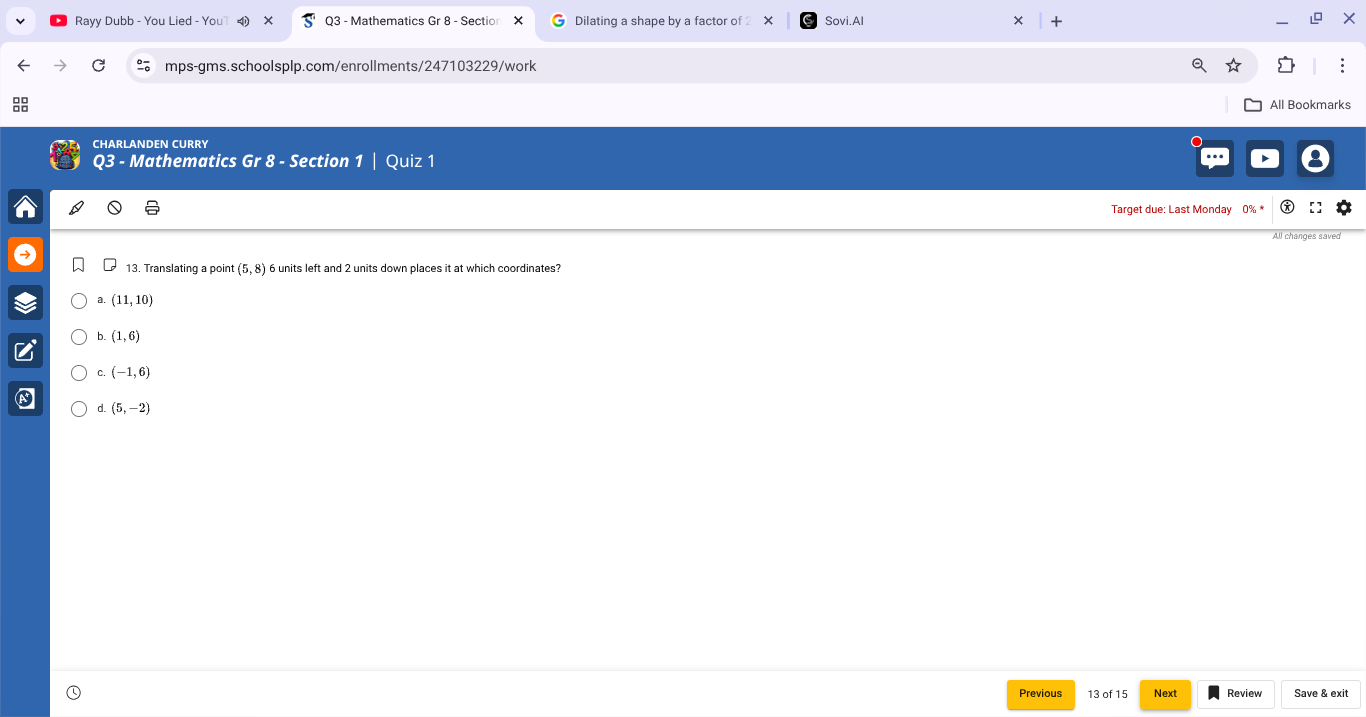
- translating a point (5, 8) 6 units left and 2 units down places it at which coordinates?
a. (11,10)
b. (1,6)
c. (-1,6)
d. (5,-2)
Step1: Recall translation rules
For a point \((x,y)\), moving left/right changes the \(x\)-coordinate (left: subtract, right: add), and moving up/down changes the \(y\)-coordinate (down: subtract, up: add).
Step2: Calculate new \(x\)-coordinate
Original \(x = 5\), moving 6 units left: \(5 - 6 = -1\)? Wait, no, wait the option b is \((1,6)\). Wait, maybe I miscalculated. Wait, original point \((5,8)\). Moving 6 units left: \(x = 5 - 6 = -1\)? No, that's not matching. Wait, maybe the question is 6 units left? Wait, no, maybe I made a mistake. Wait, no, let's recheck. Wait, the point is \((5,8)\). Translating 6 units left: \(x\)-coordinate: \(5 - 6 = -1\)? But option b is \(x = 1\). Wait, maybe the translation is 4 units left? No, the question says 6 units left. Wait, maybe the question is 4 units left? Wait, no, the user's question is: "Translating a point (5,8) 6 units left and 2 units down places it at which coordinates?" Let's recalculate:
\(x\)-coordinate: \(5 - 6 = -1\)
\(y\)-coordinate: \(8 - 2 = 6\)
So the new point should be \((-1, 6)\), which is option c. Wait, but option c is \((-1,6)\), option b is \((1,6)\). Wait, maybe I misread the number of units left. Wait, maybe it's 4 units left? No, the question says 6 units left. Wait, let's check the options again.
Options:
a. (11,10) – that's right and up, so wrong.
b. (1,6) – \(x = 5 - 4 = 1\), \(y = 8 - 2 = 6\). So maybe the question has a typo, or I misread. Wait, maybe the translation is 4 units left? But the question says 6 units left. Wait, no, let's do the calculation again.
Left translation: subtract from \(x\)-coordinate. So 5 - 6 = -1. Down translation: subtract from \(y\)-coordinate: 8 - 2 = 6. So the correct coordinate should be \((-1, 6)\), which is option c. But let's check the options:
c. (-1,6) – that's what we got.
Wait, but maybe the question was 4 units left? Then 5 - 4 = 1, 8 - 2 = 6, which is option b. But according to the question, it's 6 units left. So the correct answer should be c. (-1,6). But let's confirm the translation rules.
Translation rule: moving left by \(a\) units: \(x' = x - a\); moving down by \(b\) units: \(y' = y - b\).
So \(x' = 5 - 6 = -1\), \(y' = 8 - 2 = 6\). So the point is \((-1, 6)\), which is option c. But wait, the options are:
a. (11,10) – incorrect.
b. (1,6) – \(x = 5 - 4 = 1\), so if it's 4 units left, but question says 6.
c. (-1,6) – correct with 6 units left.
d. (5,-2) – only \(y\) changed, \(x\) same, so wrong.
So the correct answer is c. (-1,6). But wait, maybe I made a mistake. Wait, let's check again.
Original point: (5,8)
Left 6 units: \(x = 5 - 6 = -1\)
Down 2 units: \(y = 8 - 2 = 6\)
So new point: (-1, 6), which is option c.
But the user's options:
c. (-1,6)
So the answer is c. (-1,6).
Wait, but maybe the question was 4 units left. Then \(x = 5 - 4 = 1\), \(y = 8 - 2 = 6\), which is option b. But according to the question, it's 6 units left. So the correct answer is c. (-1,6).

Snap & solve any problem in the app
Get step-by-step solutions on Sovi AI
Photo-based solutions with guided steps
Explore more problems and detailed explanations
c. \((-1, 6)\)