QUESTION IMAGE
Question
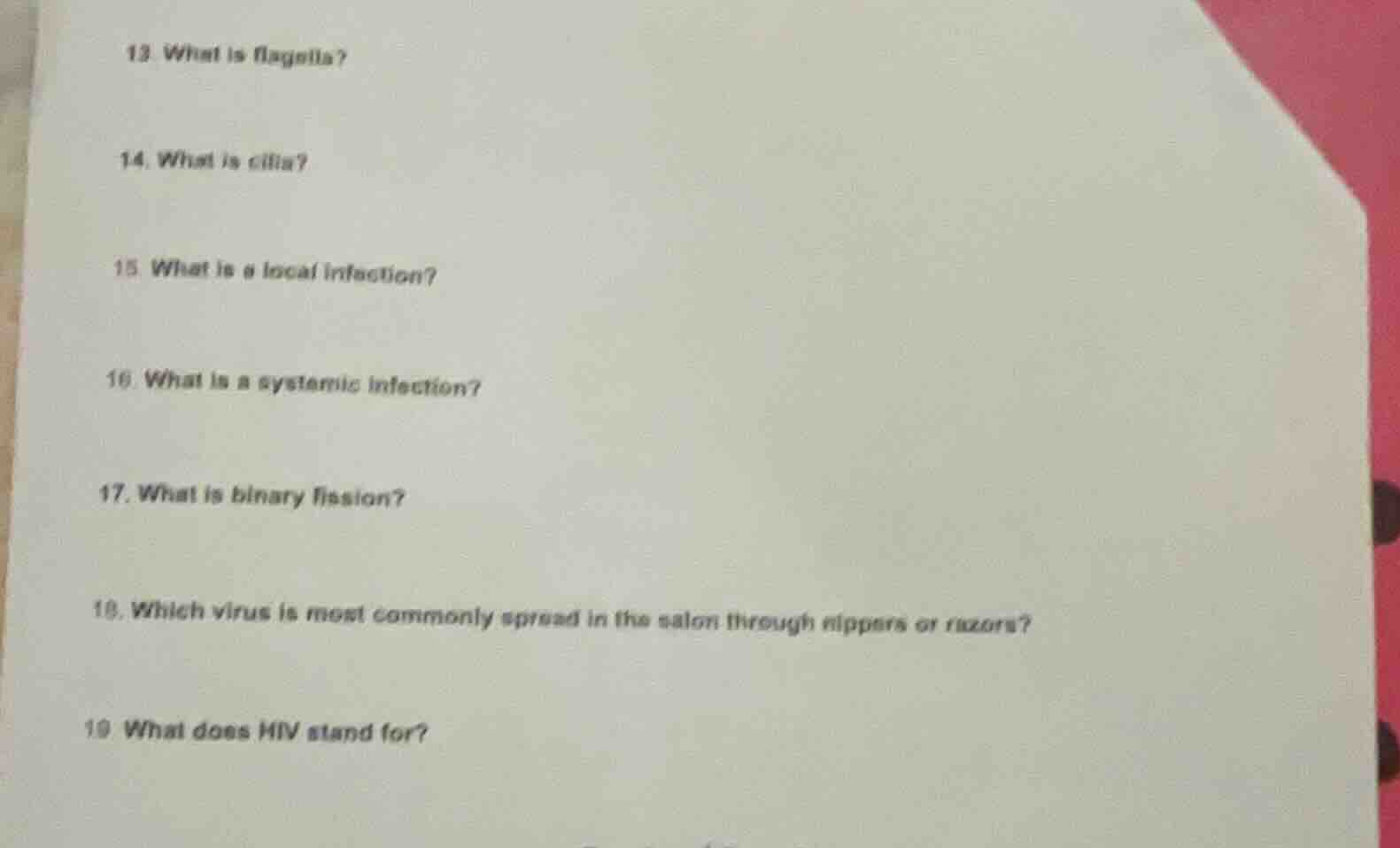
- what is flagella?
- what is cilia?
- what is a local infection?
- what is a systemic infection?
- what is binary fission?
- which virus is most commonly spread in the salon through nippers or razors?
- what does hiv stand for?
Question 12: What is flagella?
Flagella are long, whip - like appendages found on some cells (e.g., bacteria, sperm cells). They are used for locomotion, helping the cell move through its environment. In prokaryotes, bacterial flagella are made of flagellin and rotate like a propeller, while in eukaryotes, they have a more complex microtubule - based structure and move in a wave - like motion.
Cilia are short, hair - like structures that extend from the surface of many eukaryotic cells. They can be motile or non - motile. Motile cilia (e.g., in the respiratory tract) beat in a coordinated manner to move substances like mucus or to propel the cell. Non - motile cilia (primary cilia) act as sensory organelles, detecting signals from the cell's environment.
A local infection is an infection that is confined to a specific, limited area of the body. For example, a boil on the skin is a local infection. The pathogenic microorganisms and the associated inflammatory response are restricted to that particular region, and do not spread widely throughout the body.

Snap & solve any problem in the app
Get step-by-step solutions on Sovi AI
Photo-based solutions with guided steps
Explore more problems and detailed explanations
Flagella are long, whip - like cellular appendages that enable cell movement (e.g., in bacteria, sperm) through rotation (prokaryotes) or wave - like motion (eukaryotes).