QUESTION IMAGE
Question
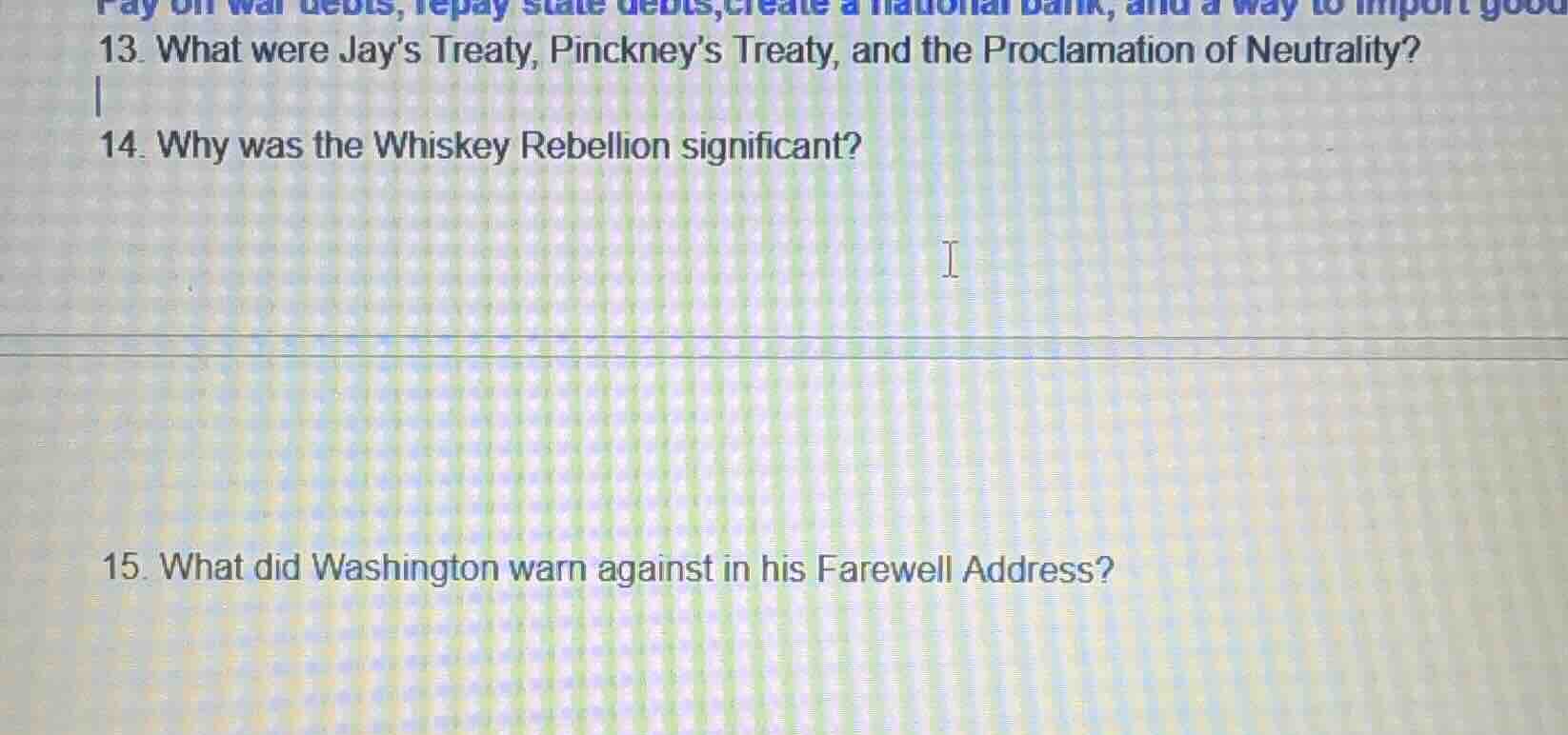
- what were jays treaty, pinckneys treaty, and the proclamation of neutrality?
- why was the whiskey rebellion significant?
- what did washington warn against in his farewell address?
- For question 13:
- Jay's Treaty (1794): A U.S.-Britain agreement that resolved post-Revolutionary War disputes, including British withdrawal from western U.S. forts, and established trade rules.
- Pinckney's Treaty (1795): A U.S.-Spain treaty that set the southern U.S. border at the 31st parallel, granted U.S. access to the Mississippi River and New Orleans port, and improved diplomatic relations.
- Proclamation of Neutrality (1793): A U.S. policy announced by George Washington that declared the nation neutral in the war between Britain and France, avoiding early entanglement in European conflicts.
- For question 14:
The Whiskey Rebellion (1794) was significant because it was the first major test of the U.S. federal government's authority to enforce its laws within state borders. The federal government's successful suppression of the rebellion (against farmers protesting a whiskey tax) demonstrated that the new federal system could maintain order, unlike the weak Articles of Confederation.
- For question 15:
In his 1796 Farewell Address, George Washington warned against two key threats to the U.S.: the danger of permanent foreign alliances that could draw the nation into European conflicts, and the divisive impact of political parties on national unity. He also emphasized the importance of fiscal responsibility and preserving the nation's democratic values.

Snap & solve any problem in the app
Get step-by-step solutions on Sovi AI
Photo-based solutions with guided steps
Explore more problems and detailed explanations
13.
- Jay's Treaty: A 1794 U.S.-Britain treaty resolving post-Revolutionary disputes, including British withdrawal from western U.S. forts and establishing trade terms.
- Pinckney's Treaty: A 1795 U.S.-Spain treaty setting the southern U.S. border at the 31st parallel, granting U.S. access to the Mississippi River and New Orleans port.
- Proclamation of Neutrality: A 1793 policy by George Washington declaring U.S. neutrality in the Britain-France war, avoiding European conflict entanglement.
- It was the first major test of the U.S. federal government's authority to enforce federal laws, proving the new federal system could maintain order (unlike the Articles of Confederation) when it suppressed farmers protesting a whiskey tax.
- Washington warned against permanent foreign alliances (to avoid European conflict entanglement) and the divisive nature of political parties, while also stressing fiscal responsibility and protection of democratic values.