QUESTION IMAGE
Question
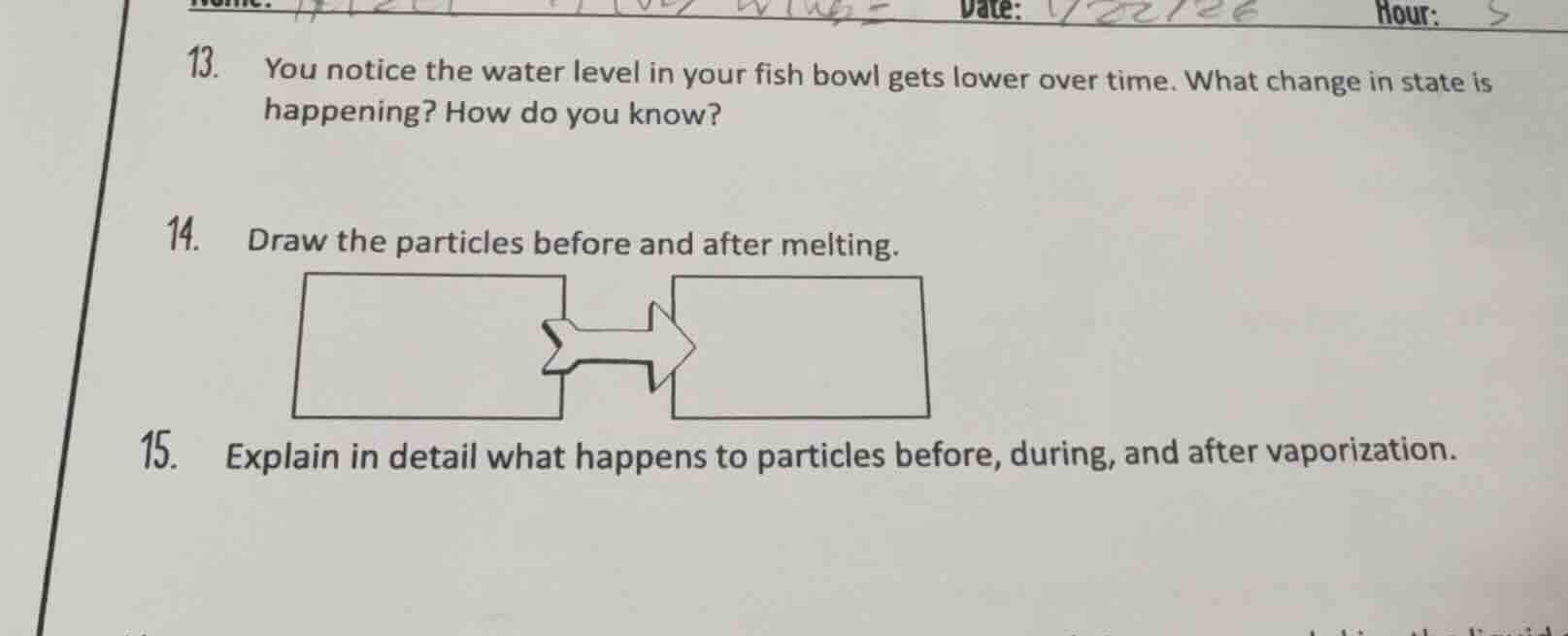
- you notice the water level in your fish bowl gets lower over time. what change in state is happening? how do you know?
- draw the particles before and after melting.
- explain in detail what happens to particles before, during, and after vaporization.
Question 13
The water level in the fishbowl decreasing over time is due to evaporation (a type of vaporization). In evaporation, liquid water particles gain enough energy to escape from the liquid surface into the air as water vapor. We know this because the water level drops, indicating the liquid water is turning into a gaseous state (water vapor) and leaving the fishbowl.
Before melting (solid state, e.g., ice), particles are closely packed in a regular, ordered arrangement with strong intermolecular forces, vibrating in fixed positions. After melting (liquid state, e.g., water), particles are still close but can move past each other, with weaker intermolecular forces than in the solid, and have more freedom of movement (less ordered arrangement). To draw:
- Before (solid): Draw small circles (particles) closely packed in a neat, repeating pattern (like a grid), with short lines between them to show strong forces.
- After (liquid): Draw the same - sized circles, but more spread out, in a random arrangement, with longer or fewer lines between them to show weaker forces.
- Before Vaporization: The substance is in a liquid (or sometimes solid, for sublimation, but vaporization from liquid is common) state. Liquid particles are close together, moving randomly, and have intermolecular forces holding them. They have kinetic energy (KE) - some particles have more KE than others (due to temperature - related energy distribution).
- During Vaporization: Particles at the liquid surface (or throughout, in boiling) gain enough energy (heat, e.g., from the environment or a heat source) to overcome intermolecular forces. High - KE particles escape from the liquid into the gas phase. In boiling, this happens throughout the liquid as the temperature reaches the boiling point, creating bubbles of vapor. In evaporation, it’s a slower process at the surface, at temperatures below the boiling point.
- After Vaporization: The particles are in the gaseous state. Gas particles are far apart, move freely and rapidly in all directions, with very weak (or negligible, in ideal gas models) intermolecular forces. They have much higher KE than in the liquid state and fill the available volume of their container.

Snap & solve any problem in the app
Get step-by-step solutions on Sovi AI
Photo-based solutions with guided steps
Explore more problems and detailed explanations
The change in state is evaporation (liquid to gas). We know because the water level lowers as liquid water becomes water vapor and escapes into the air.