QUESTION IMAGE
Question
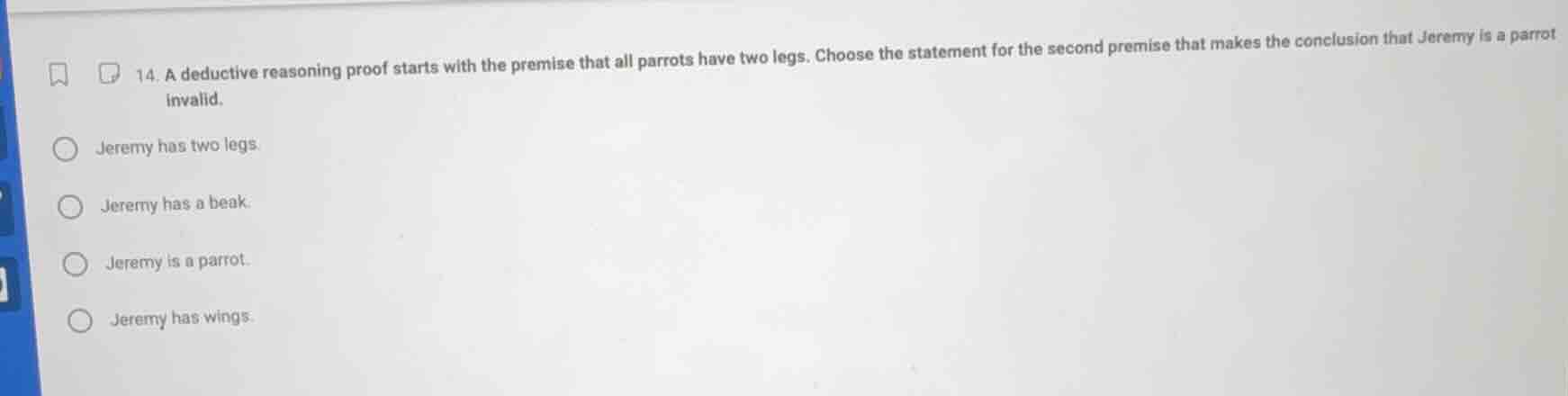
- a deductive reasoning proof starts with the premise that all parrots have two legs. choose the statement for the second premise that makes the conclusion that jeremy is a parrot invalid.
jeremy has two legs.
jeremy has a beak.
jeremy is a parrot.
jeremy has wings.
Brief Explanations
To determine which second premise makes the conclusion "Jeremy is a parrot" invalid, we analyze deductive reasoning. The first premise is "All parrots have two legs" (a general statement). For a deductive argument to be valid, the conclusion must follow necessarily from the premises.
- If the second premise is "Jeremy has two legs", the argument would be: "All parrots have two legs; Jeremy has two legs; therefore, Jeremy is a parrot." This is an invalid argument (affirming the consequent) because having two legs is a characteristic of parrots, but other creatures can also have two legs (e.g., humans, chickens). So this premise does not guarantee Jeremy is a parrot, making the conclusion invalid.
- "Jeremy has a beak" or "Jeremy has wings" are also characteristics of parrots but not unique to them, but the key here is the structure of the first premise (about two legs). The most direct invalidating premise related to the first premise's structure is "Jeremy has two legs" as it leads to an invalid syllogism.
- "Jeremy is a parrot" as a premise would make the conclusion valid (tautological, but the argument would be valid).

Snap & solve any problem in the app
Get step-by-step solutions on Sovi AI
Photo-based solutions with guided steps
Explore more problems and detailed explanations
A. Jeremy has two legs