QUESTION IMAGE
Question
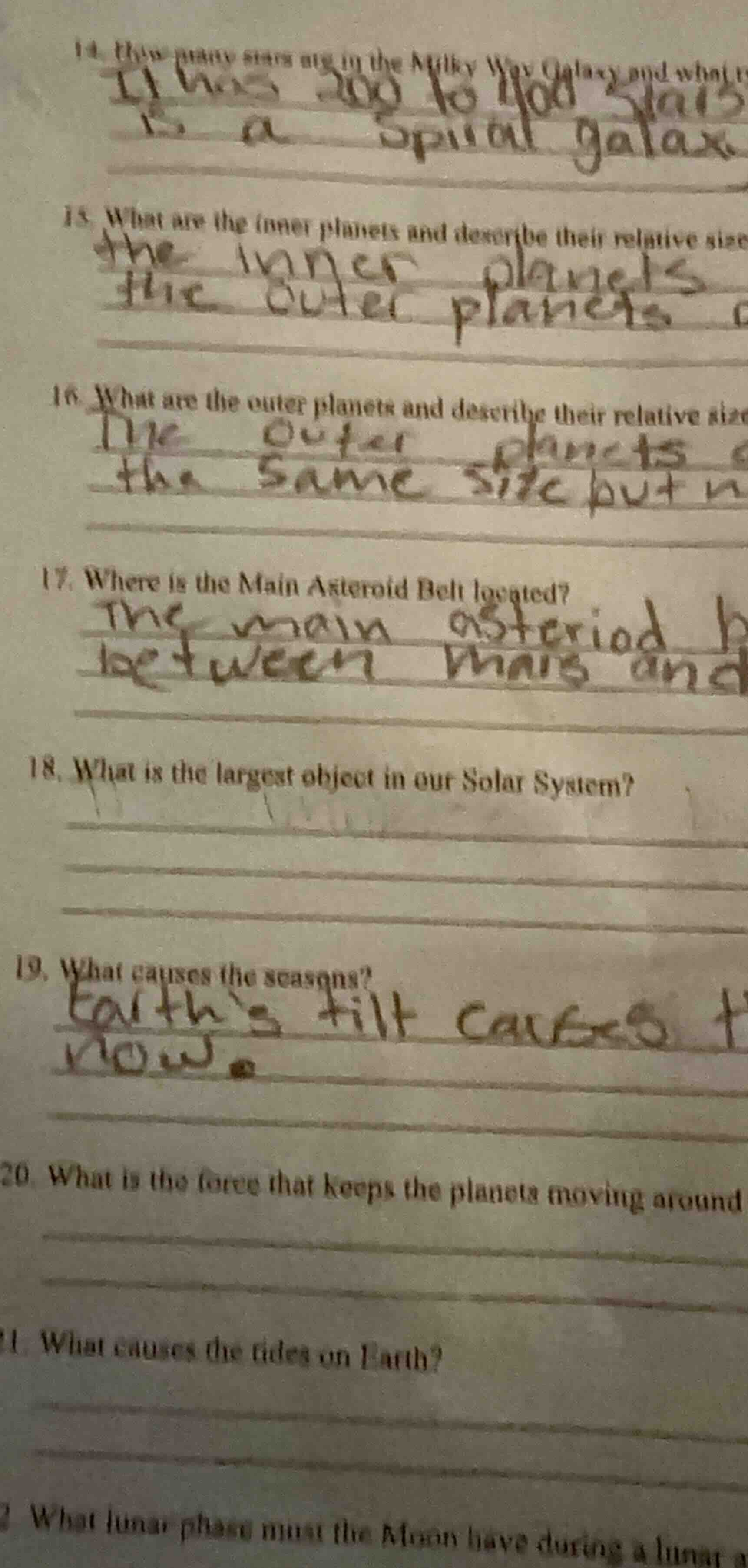
- how many stars are in the milky way galaxy and what
- what are the inner planets and describe their relative size
- what are the outer planets and describe their relative size
- where is the main asteroid belt located?
- what is the largest object in our solar system?
- what causes the seasons?
- what is the force that keeps the planets moving around
- what causes the tides on earth?
what lunar phase must the moon have during a lunar
Brief Explanations
- For question 18: The Sun contains over 99.8% of the total mass in our Solar System, making it the largest object.
- For question 20: Gravitational pull from the Sun provides the centripetal force that keeps planets in their orbital paths around it.
- For question 21: Tides are caused by the gravitational pull of the Moon (primary cause) and the Sun on Earth's oceans, combined with Earth's rotation.
- For question 15: The inner planets are Mercury, Venus, Earth, and Mars. They are small, rocky terrestrial planets, with sizes increasing from Mercury to Earth, then Mars being slightly smaller than Earth.
- For question 16: The outer planets are Jupiter, Saturn, Uranus, and Neptune. They are large gas/ice giants, with Jupiter being the largest, followed by Saturn, Uranus, then Neptune.
- For question 17: The Main Asteroid Belt is located in the gap between the orbits of Mars and Jupiter.
- For question 14: The Milky Way Galaxy has an estimated 100 to 400 billion stars, and it is a barred spiral galaxy.
- For question 19: Earth's 23.5-degree axial tilt, combined with its orbit around the Sun, causes varying amounts of sunlight to reach different parts of the planet throughout the year, creating seasons.

Snap & solve any problem in the app
Get step-by-step solutions on Sovi AI
Photo-based solutions with guided steps
Explore more problems and detailed explanations
- The Milky Way has 100–400 billion stars; it is a barred spiral galaxy.
- Inner planets: Mercury, Venus, Earth, Mars. They are small rocky worlds, sized from smallest (Mercury) to largest (Earth), with Mars slightly smaller than Earth.
- Outer planets: Jupiter, Saturn, Uranus, Neptune. They are large gas/ice giants, sized from largest (Jupiter) to smallest (Neptune).
- The Main Asteroid Belt is between Mars and Jupiter.
- The Sun
- Earth's 23.5° axial tilt and orbital motion around the Sun cause seasons.
- The Sun's gravitational force (combined with the planets' inertia) keeps planets orbiting it.
- The gravitational pull of the Moon (primary) and Sun on Earth's oceans, plus Earth's rotation, causes tides.