QUESTION IMAGE
Question
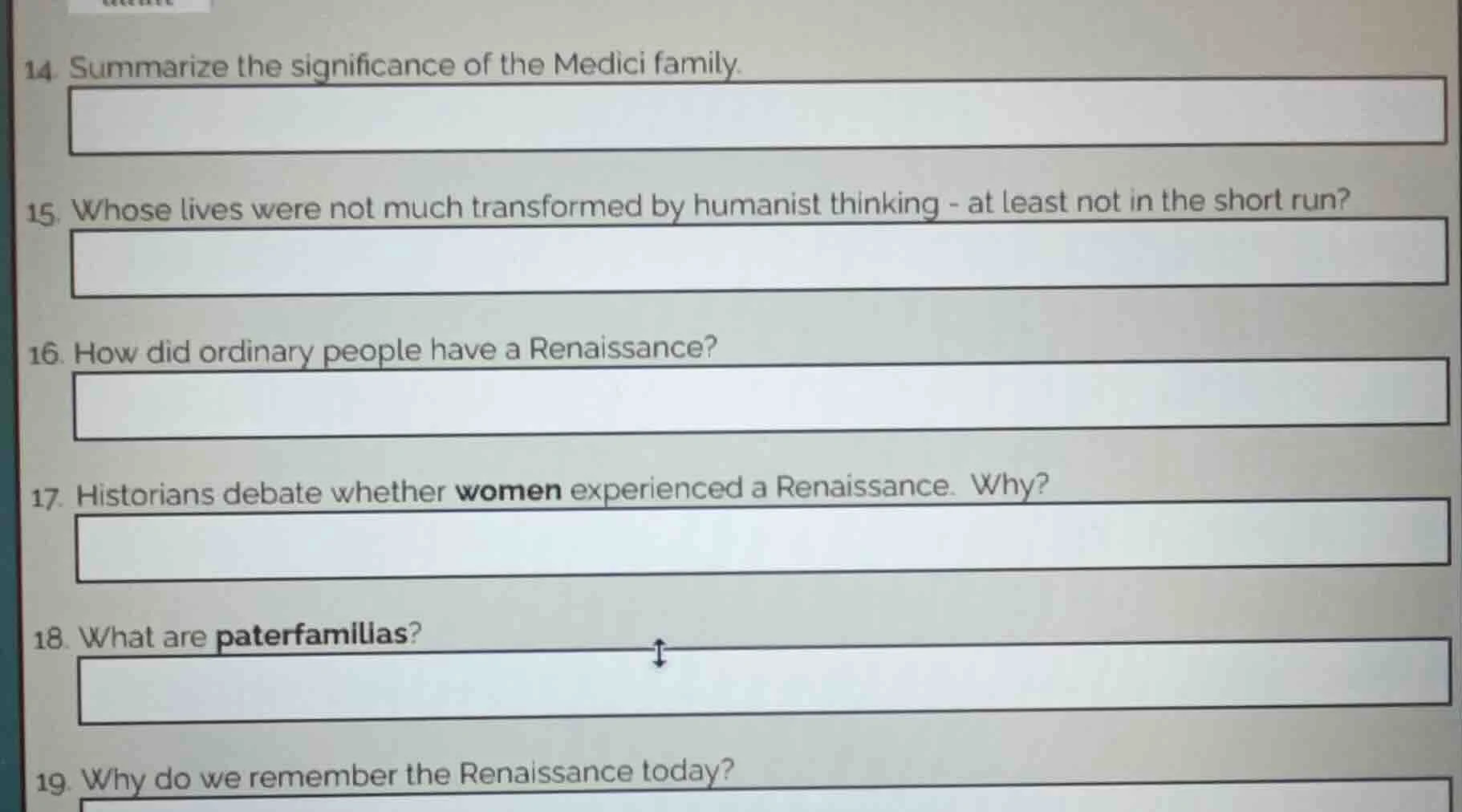
- summarize the significance of the medici family.
- whose lives were not much transformed by humanist thinking - at least not in the short run?
- how did ordinary people have a renaissance?
- historians debate whether women experienced a renaissance. why?
- what are paterfamilias?
- why do we remember the renaissance today?
Question 14
The Medici family was a powerful banking family in Florence during the Renaissance. They were major patrons of the arts, sponsoring artists like Michelangelo, Leonardo da Vinci, and Botticelli, which helped fuel the artistic and cultural flourishing of the Renaissance. Politically, they held significant power in Florence and influenced European politics. Economically, their banking network was extensive, impacting European finance. They also supported humanist scholars, contributing to intellectual growth.
Ordinary people, especially the lower classes (peasants, urban poor), and women (in the short run) were less transformed by humanist thinking. Humanist ideas focused on classical learning, individualism, and secularism, which were accessible mainly to the educated elite (nobility, wealthy merchants, scholars). Peasants' lives centered on survival (farming, manual labor), with little access to humanist education. Women, restricted by gender roles (domestic duties, limited education), also had limited exposure to humanist ideas in the short term.
Ordinary people had a Renaissance through changes in daily life, religion, and culture. Culturally, they experienced new art forms (e.g., religious art accessible in churches), folk traditions influenced by Renaissance themes. Economically, some urban workers (artisans) benefited from Renaissance - driven trade and art - related jobs. Religiously, the spread of vernacular Bibles (due to humanist emphasis on language) allowed them to engage with religion more directly. Socially, guilds and community life incorporated Renaissance - inspired values of skill and craftsmanship.

Snap & solve any problem in the app
Get step-by-step solutions on Sovi AI
Photo-based solutions with guided steps
Explore more problems and detailed explanations
The Medici family was significant as major art patrons (sponsoring Renaissance artists), powerful political figures in Florence, influential in European finance via their banking, and supporters of humanist scholarship, driving cultural, political, and intellectual Renaissance developments.