QUESTION IMAGE
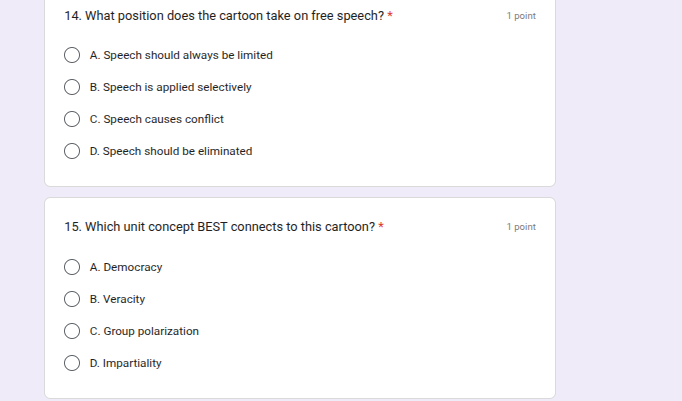
Question
- what position does the cartoon take on free speech? *
a. speech should always be limited
b. speech is applied selectively
c. speech causes conflict
d. speech should be eliminated
- which unit concept best connects to this cartoon? *
a. democracy
b. veracity
c. group polarization
d. impartiality
Response
Question 14
Brief Explanations
To determine the cartoon's position on free speech, we analyze each option:
- Option A ("Speech should always be limited") is extreme and not typical of nuanced free - speech takes.
- Option B ("Speech is applied selectively") is a common theme in discussions about free speech, where different types of speech (e.g., hate speech vs. political speech) are treated differently, so this is a plausible position.
- Option C ("Speech causes conflict") is more about the consequence of speech rather than a position on free speech itself.
- Option D ("Speech should be eliminated") is extremely radical and not a common or reasonable position on free speech.
Brief Explanations
- Option A: Democracy is related to the right to free speech as free speech is a cornerstone of democratic societies. If the cartoon is about free speech, democracy is a very relevant unit concept.
- Option B: Veracity refers to truthfulness. While truth in speech is important, it is not the most direct connection to free speech compared to democracy.
- Option C: Group polarization is about how groups make decisions and the shift in opinions within groups. It has little direct connection to free speech.
- Option D: Impartiality is about being neutral. It is not directly related to the concept of free speech.

Snap & solve any problem in the app
Get step-by-step solutions on Sovi AI
Photo-based solutions with guided steps
Explore more problems and detailed explanations
B. Speech is applied selectively