QUESTION IMAGE
Question
15.
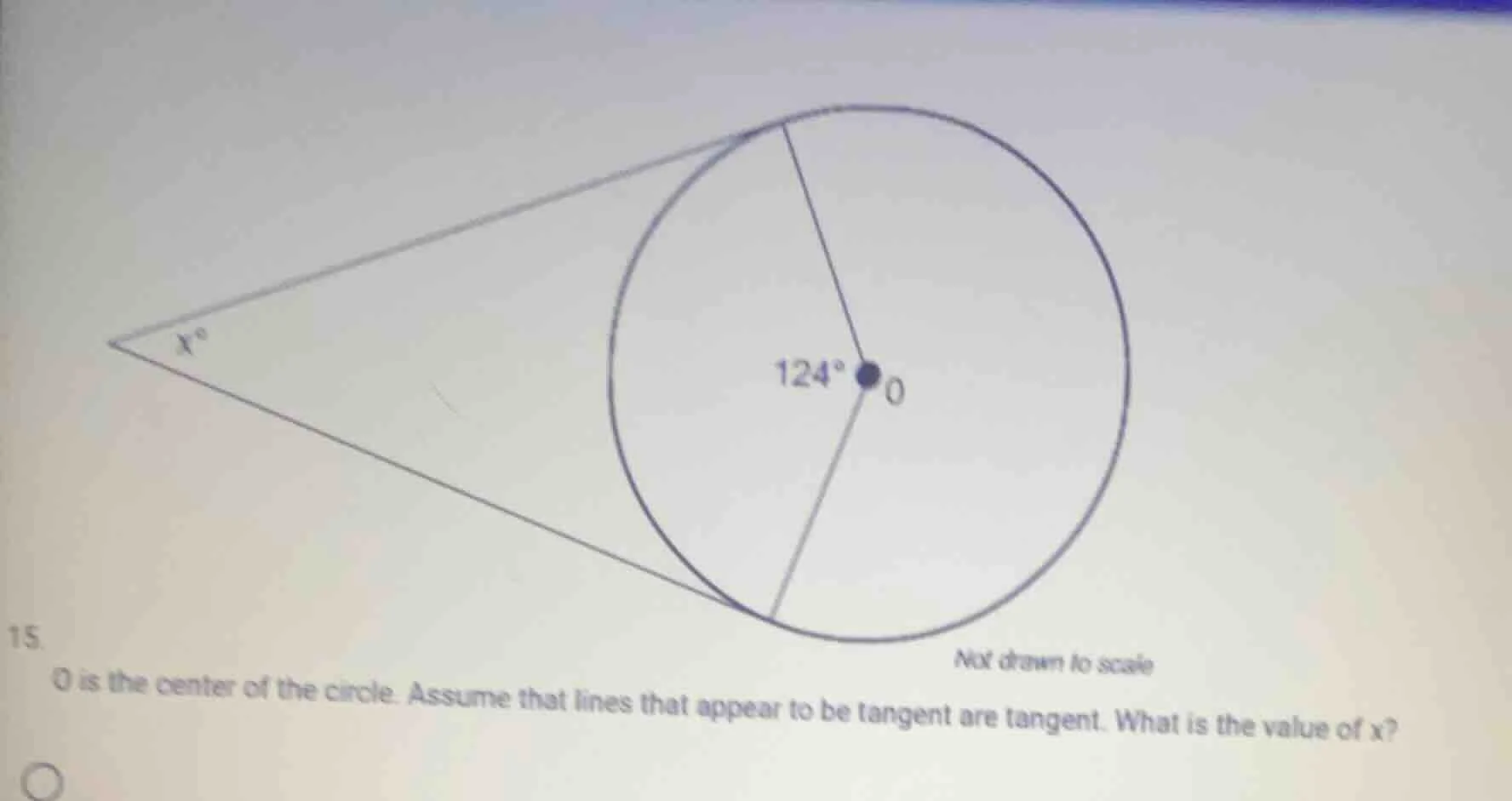
o is the center of the circle. assume that lines that appear to be tangent are tangent. what is the value of x?
(the image shows a circle with center o, a 124° central angle, and two tangent lines from a common external point forming an angle of x° with each other.)
Step1: Find the central angle supplementary to 124°
The sum of angles around a point (center of the circle) is 360°, but here we have a straight line (diameter - related) and the given 124° angle. Wait, actually, the tangent to a circle is perpendicular to the radius at the point of contact. So the two radii (from center O to the points of tangency) are perpendicular to the tangent lines. So the quadrilateral formed by the two tangent lines and the two radii has two right angles (90° each) at the points of tangency, one angle at the center (let's call it \( \theta \)) and the angle \( x \) at the external point. The sum of interior angles of a quadrilateral is 360°. First, find the central angle \( \theta \) that is supplementary to 124°? Wait, no. Wait, the given angle at the center is 124°, but actually, the two radii and the line through the center form a straight line? Wait, no, the angle between the two radii: wait, the total around the center is 360°, but the angle between the two radii (the ones to the points of tangency) and the given 124° angle: wait, the straight line through the center would be 180°, but here the given angle is 124°, so the angle between the two radii (let's call it \( \alpha \)) is \( 180° - 124° \)? No, wait, no. Wait, the two tangent lines from an external point to a circle are equal in length, and the line from the external point to the center bisects the angle between the tangents and the angle between the two radii. Also, the radius is perpendicular to the tangent, so each radius - tangent angle is 90°. So the quadrilateral has two right angles (90° each), one angle at the center (let's say \( \beta \)) and the angle \( x \) at the external point. So sum of angles in quadrilateral: \( 90° + 90° + \beta + x = 360° \), so \( \beta + x = 180° \). Now, what is \( \beta \)? The angle at the center between the two radii. The given angle is 124°, and since the total around the center is 360°, but actually, the angle \( \beta \) and 124° are supplementary? Wait, no, the straight line through the center: the angle on a straight line is 180°, so if one part is 124°, the other part (the angle between the two radii, \( \beta \)) is \( 180° - 124° = 56° \)? Wait, no, that's not right. Wait, the center O, the two radii are to the points of tangency, and the line from O to the external point. Wait, maybe I made a mistake. Let's start over.
The formula for the angle between two tangents from an external point: the measure of the angle between two tangents drawn from an external point to a circle is equal to the difference between 180° and the measure of the central angle between the two radii to the points of tangency. Wait, no, the correct formula is: if \( x \) is the angle between the tangents, and \( \theta \) is the central angle between the radii, then \( x + \theta = 180° \)? No, wait, the sum of the angle between the tangents (x) and the central angle (θ) is 180°? Wait, no, the two radii are perpendicular to the tangents, so each radius - tangent angle is 90°, so the quadrilateral has two 90° angles, one angle x (between tangents) and one angle θ (central angle between radii). So sum of angles in quadrilateral: 90 + 90 + θ + x = 360 ⇒ θ + x = 180. Now, what is θ? The central angle between the two radii. The given angle is 124°, and since the total around the center is 360°, but the angle θ and 124° are supplementary? Wait, no, the angle 124° and θ are on a straight line? Wait, the center O, the line through O: the angle on a straight line is 180°, so if one angle is 124°, the other angle (θ) is 180° - 12…

Snap & solve any problem in the app
Get step-by-step solutions on Sovi AI
Photo-based solutions with guided steps
Explore more problems and detailed explanations
\( 56 \)