QUESTION IMAGE
Question
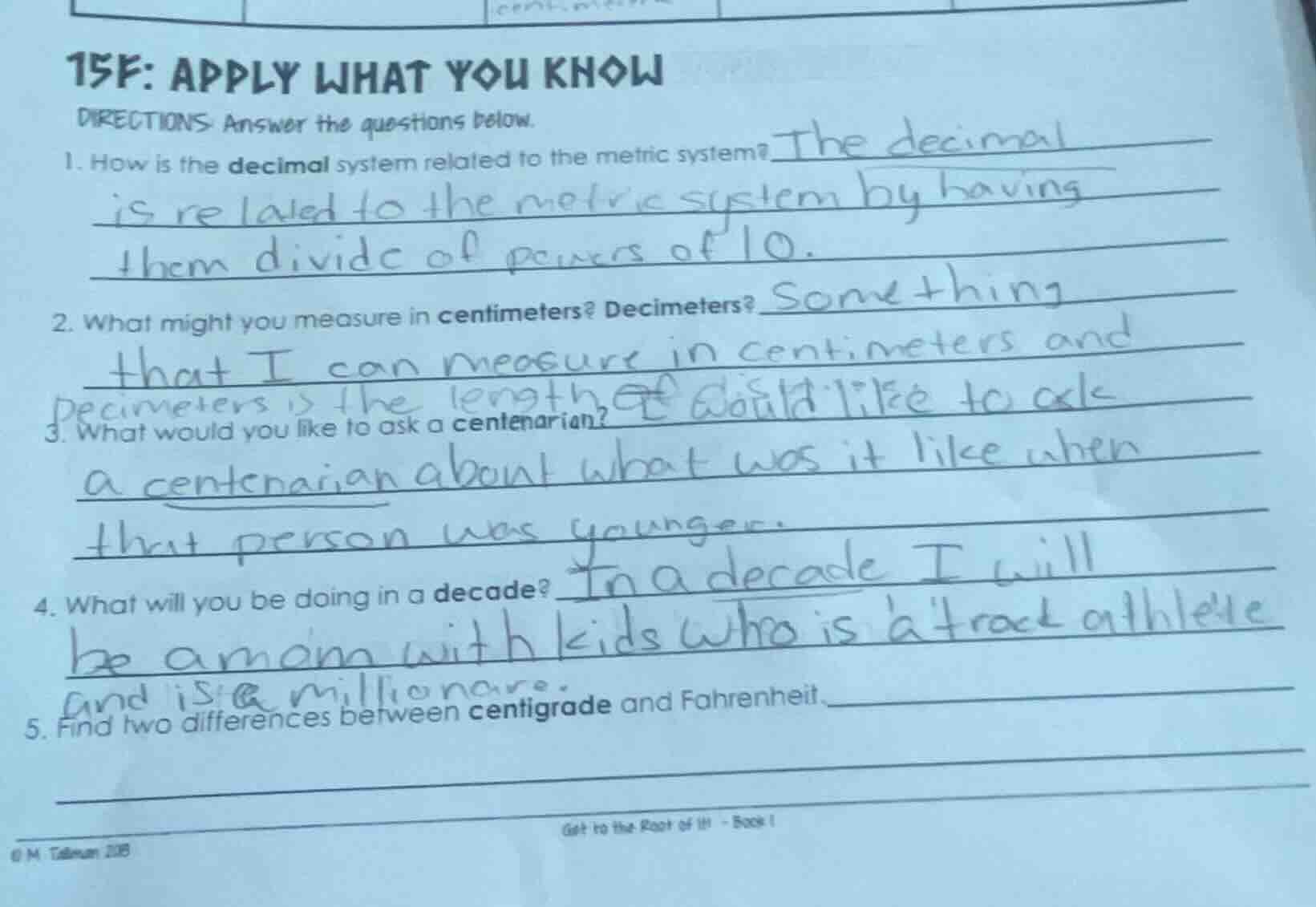
15f: apply what you know
directions: answer the questions below.
- how is the decimal system related to the metric system?
- what might you measure in centimeters? decimeters?
- what would you like to ask a centenarian?
- what will you be doing in a decade?
- find two differences between centigrade and fahrenheit.
Brief Explanations
- For question 1: Clarifies the core numerical link between the two systems.
- For question 2: Provides specific, practical examples of items for each unit.
- For question 3: Offers a focused, meaningful question for a centenarian.
- For question 4: Gives a clear, realistic long-term goal example.
- For question 5: Lists two distinct, factual differences between the temperature scales.

Snap & solve any problem in the app
Get step-by-step solutions on Sovi AI
Photo-based solutions with guided steps
Explore more problems and detailed explanations
- The decimal system (based on powers of 10) forms the numerical foundation of the metric system, so metric units use decimal prefixes (like centi-, kilo-) that represent powers of 10 to scale base units.
- Centimeters: The length of a pencil, the width of a phone screen. Decimeters: The length of a textbook, the height of a small plant pot.
- I would ask them, "What is the most important lesson you learned across your 100+ years of life?"
- In a decade, I hope to be working in a career I'm passionate about, possibly in environmental conservation, and continuing to learn new skills to grow personally and professionally.
- 1. Their freezing and boiling points for water differ: Centigrade (Celsius) sets freezing at $0^\circ$ and boiling at $100^\circ$, while Fahrenheit uses $32^\circ$ for freezing and $212^\circ$ for boiling.
- Their degree sizes are different: A 1-degree change in Celsius is equal to a $1.8^\circ$ change in Fahrenheit, making Celsius degrees larger.