QUESTION IMAGE
Question
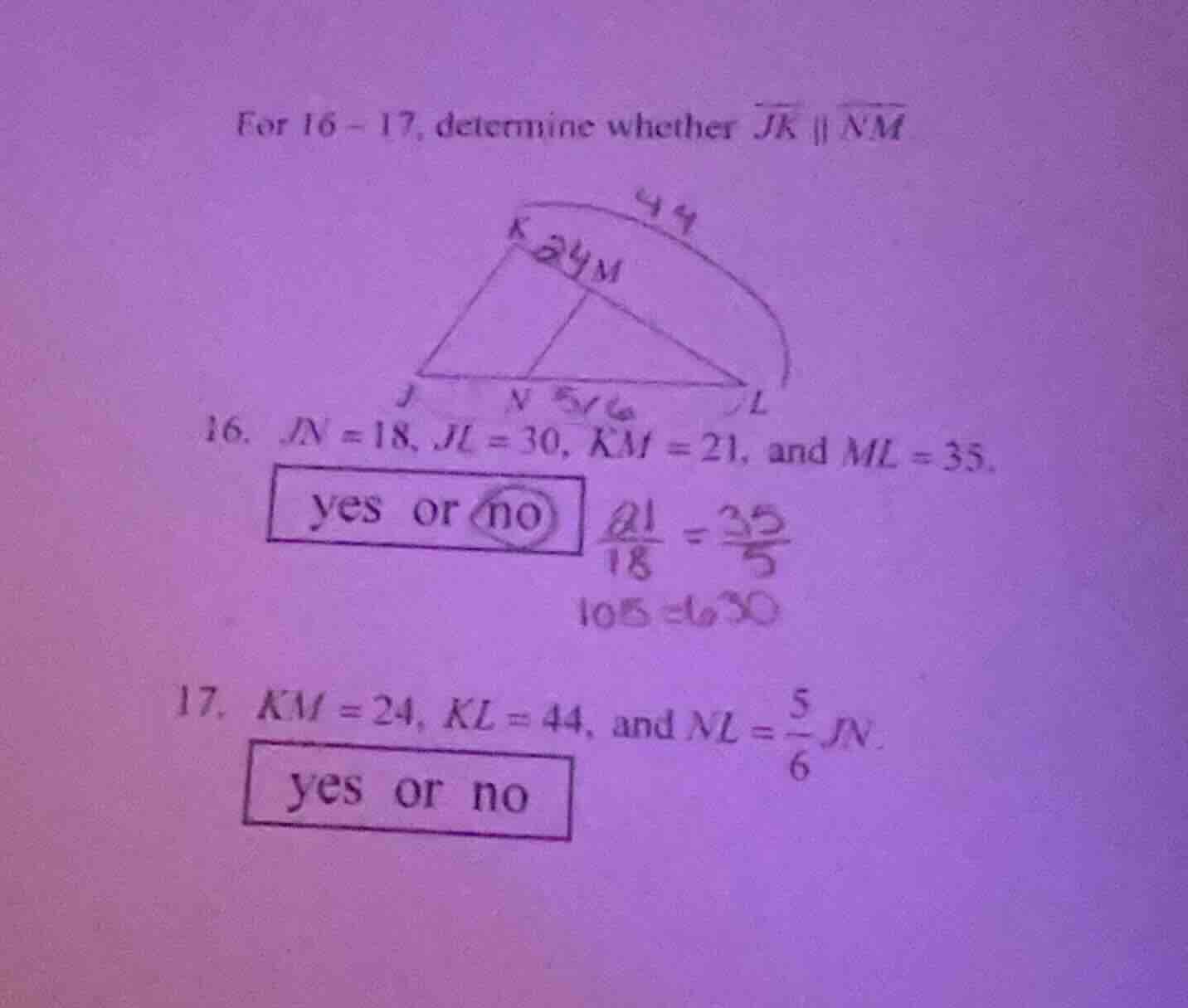
for 16 - 17, determine whether $overleftrightarrow{jk} parallel overleftrightarrow{nm}$
- $jn = 18$, $jl = 30$, $km = 21$, and $ml = 35$.
yes or no
- $km = 24$, $kl = 44$, and $nl = \frac{5}{6}jn$.
yes or no
Problem 16:
Step1: Find $NL$
$NL = JL - JN = 30 - 18 = 12$
Step2: Check proportional segments
We use the Converse of the Triangle Proportionality Theorem: if $\frac{JN}{NL} = \frac{KM}{ML}$, then $\overline{JK} \parallel \overline{NM}$.
Calculate $\frac{JN}{NL} = \frac{18}{12} = \frac{3}{2}$
Calculate $\frac{KM}{ML} = \frac{21}{35} = \frac{3}{5}$
Since $\frac{3}{2}
eq \frac{3}{5}$, the segments are not parallel.
Problem 17:
Step1: Find $ML$
$ML = KL - KM = 44 - 24 = 20$
Step2: Express $JL$ in terms of $JN$
$JL = JN + NL = JN + \frac{5}{6}JN = \frac{11}{6}JN$
Step3: Check proportional segments
Calculate $\frac{JN}{JL} = \frac{JN}{\frac{11}{6}JN} = \frac{6}{11}$
Calculate $\frac{KM}{KL} = \frac{24}{44} = \frac{6}{11}$
Since $\frac{JN}{JL} = \frac{KM}{KL}$, by the Converse of the Triangle Proportionality Theorem, the segments are parallel.

Snap & solve any problem in the app
Get step-by-step solutions on Sovi AI
Photo-based solutions with guided steps
Explore more problems and detailed explanations
- no
- yes