QUESTION IMAGE
Question
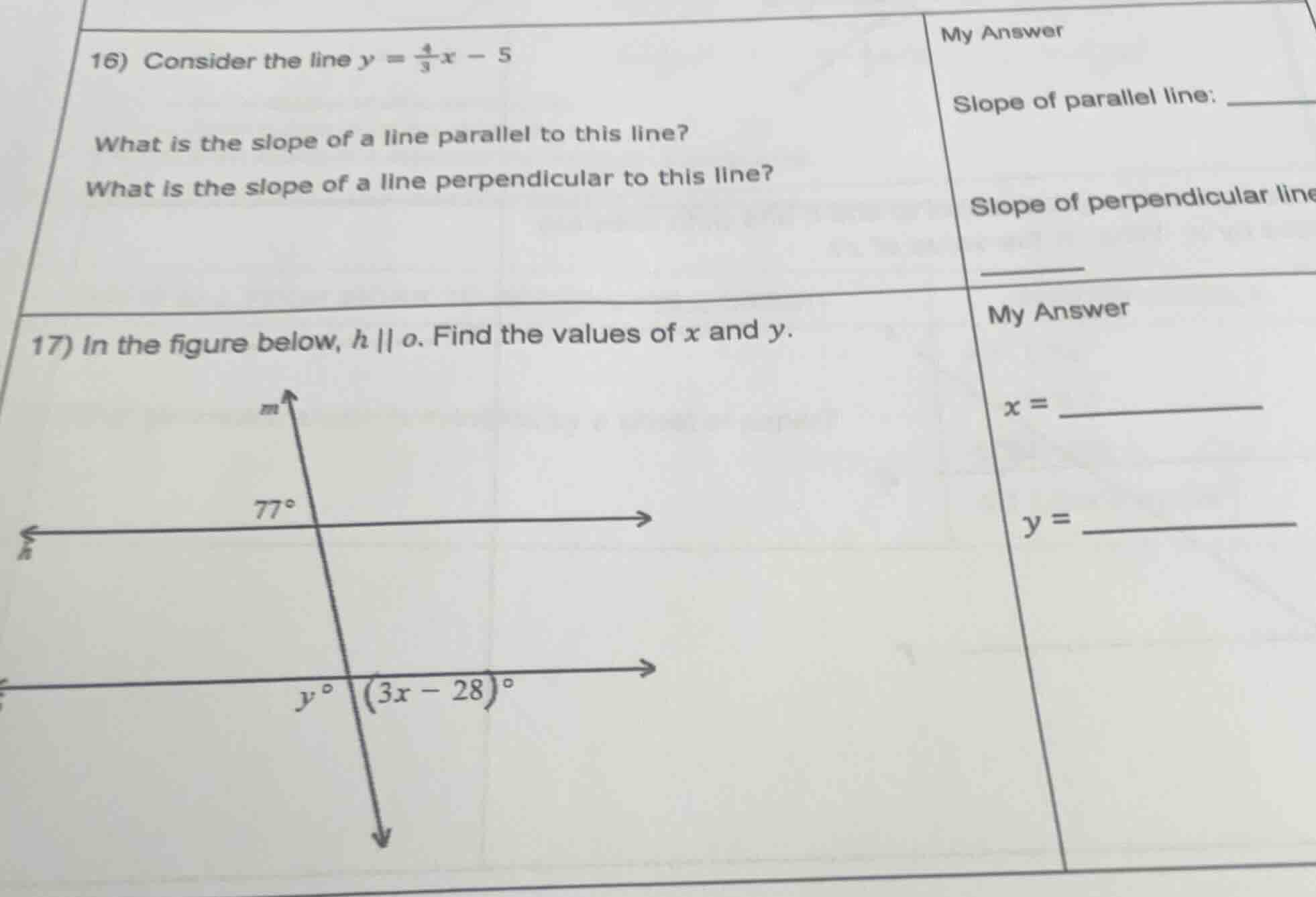
- consider the line $y = \frac{4}{3}x - 5$
what is the slope of a line parallel to this line?
what is the slope of a line perpendicular to this line?
- in the figure below, $h \parallel o$. find the values of $x$ and $y$.
Question 16
Step1: Recall slope of parallel lines
Parallel lines have equal slopes. The given line is \( y = \frac{4}{3}x - 5 \), which is in slope - intercept form \( y=mx + b \) where \( m \) is the slope. So the slope of the given line is \( \frac{4}{3} \). Thus, the slope of a line parallel to it is also \( \frac{4}{3} \).
Step2: Recall slope of perpendicular lines
The slope of a line perpendicular to a line with slope \( m \) is the negative reciprocal, i.e., \( m_{\perp}=-\frac{1}{m} \). For \( m = \frac{4}{3} \), the negative reciprocal is \( -\frac{3}{4} \).
Step1: Find the value of \( x \)
Since \( h\parallel o \), the corresponding angles are equal. The angle of \( 77^{\circ} \) and the angle \( (3x - 28)^{\circ} \) are corresponding angles. So we set up the equation:
\( 3x-28 = 77 \)
Add 28 to both sides: \( 3x=77 + 28=105 \)
Divide both sides by 3: \( x=\frac{105}{3}=35 \)
Step2: Find the value of \( y \)
The angle \( y^{\circ} \) and the angle \( 77^{\circ} \) are alternate - interior angles (or we can also use the fact that \( y \) and \( (3x - 28) \) are supplementary? No, actually, since \( h\parallel o \), the angle \( y \) and the \( 77^{\circ} \) angle are equal? Wait, no. Wait, the angle \( y \) and the angle adjacent to \( (3x - 28) \) (linear pair) or wait, looking at the diagram, the angle of \( 77^{\circ} \) and \( y^{\circ} \): since \( h\parallel o \), the angle \( y \) and the \( 77^{\circ} \) angle are equal? Wait, no, actually, the angle \( y \) and the angle \( (3x - 28) \) are supplementary? Wait, no, let's re - examine. The angle \( 77^{\circ} \) and \( y^{\circ} \): since \( h\parallel o \), and the transversal is line \( m \), the angle \( y \) and the \( 77^{\circ} \) angle are equal (corresponding angles). Wait, when \( x = 35 \), \( 3x-28=3\times35 - 28 = 105 - 28 = 77 \). So the angle \( y \) and the \( 77^{\circ} \) angle: since \( y \) and \( (3x - 28) \) are a linear pair? No, wait, the angle \( y \) and the angle \( 77^{\circ} \): actually, \( y = 77 \)? Wait, no, wait, the angle \( y \) and the angle \( (3x - 28) \) are supplementary? Wait, no, let's think again. The angle \( 77^{\circ} \) and \( y \): since \( h\parallel o \), the angle \( y \) and the \( 77^{\circ} \) angle are equal because they are alternate - interior angles. Wait, when \( x = 35 \), \( 3x - 28=77 \), so the angle \( y \) and \( 77^{\circ} \) are equal? Wait, no, the angle \( y \) and the angle \( (3x - 28) \) are vertical angles? No, the angle \( y \) and the \( 77^{\circ} \) angle: since \( h\parallel o \), the angle \( y \) is equal to \( 77^{\circ} \)? Wait, no, actually, the angle \( y \) and the angle \( (3x - 28) \) are supplementary? Wait, no, let's calculate \( y \). Since \( y \) and \( (3x - 28) \) are a linear pair? No, the sum of \( y \) and \( (3x - 28) \) is \( 180^{\circ} \)? Wait, no, when \( x = 35 \), \( 3x - 28 = 77 \), so if \( y \) and \( 77^{\circ} \) are supplementary, \( y=180 - 77 = 103 \)? Wait, I made a mistake. Let's correct. The angle of \( 77^{\circ} \) and the angle \( (3x - 28) \) are equal (corresponding angles). Then the angle \( y \) and \( (3x - 28) \) are supplementary (linear pair). So \( y+77 = 180 \), so \( y = 180 - 77=103 \). Wait, but when \( x = 35 \), \( 3x - 28 = 77 \), so \( y = 180 - 77 = 103 \).
Wait, let's start over.
- Corresponding angles: Since \( h\parallel o \), the angle with measure \( 77^{\circ} \) and the angle with measure \( (3x - 28)^{\circ} \) are corresponding angles. So \( 3x-28 = 77 \)
- Solve for \( x \):
- Add 28 to both sides: \( 3x=77 + 28 = 105 \)
- Divide by 3: \( x = 35 \)
- Linear pair: The angle \( y^{\circ} \) and the angle \( (3x - 28)^{\circ} \) form a linear pair, so their sum is \( 180^{\circ} \). Since \( 3x - 28=77 \) (when \( x = 35 \)), then \( y+77 = 180 \)
- Subtract 77 from both sides: \( y=180 - 77 = 103 \)

Snap & solve any problem in the app
Get step-by-step solutions on Sovi AI
Photo-based solutions with guided steps
Explore more problems and detailed explanations
Slope of parallel line: \( \frac{4}{3} \)
Slope of perpendicular line: \( -\frac{3}{4} \)