QUESTION IMAGE
Question
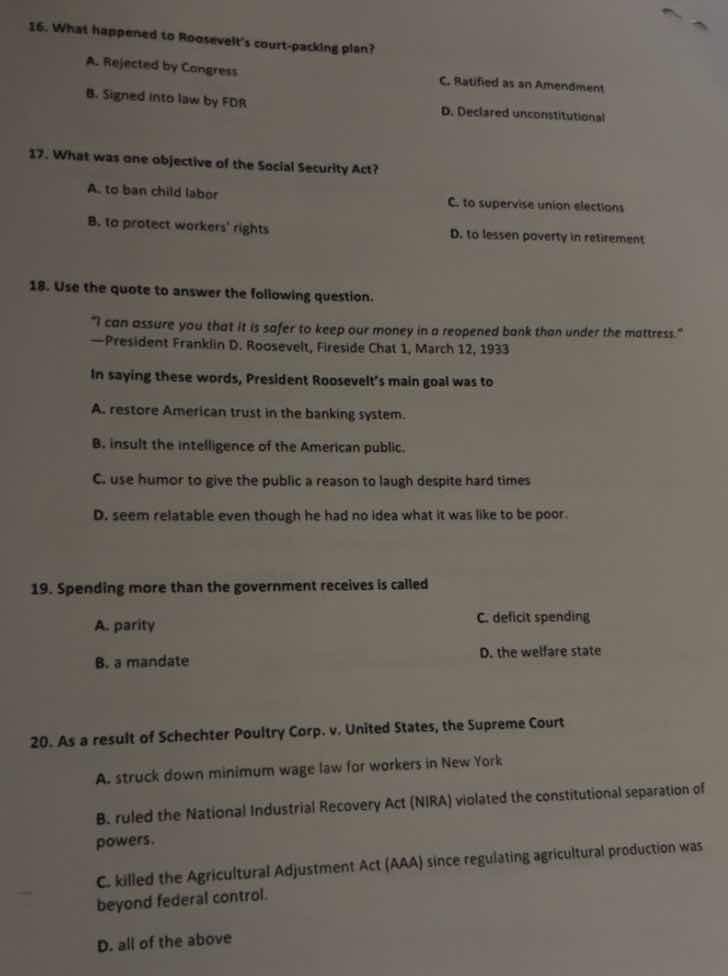
- what happened to roosevelts court - packing plan?
a. rejected by congress
b. signed into law by fdr
c. ratified as an amendment
d. declared unconstitutional
- what was one objective of the social security act?
a. to ban child labor
b. to protect workers rights
c. to supervise union elections
d. to lessen poverty in retirement
- use the quote to answer the following question.
\i can assure you that it is safer to keep our money in a reopened bank than under the mattress.\
—president franklin d. roosevelt, fireside chat 1, march 12, 1933
in saying these words, president roosevelts main goal was to
a. restore american trust in the banking system.
b. insult the intelligence of the american public.
c. use humor to give the public a reason to laugh despite hard times
d. seem relatable even though he had no idea what it was like to be poor.
- spending more than the government receives is called
a. parity
b. a mandate
c. deficit spending
d. the welfare state
- as a result of schechter poultry corp. v. united states, the supreme court
a. struck down minimum wage law for workers in new york
b. ruled the national industrial recovery act (nira) violated the constitutional separation of powers.
c. killed the agricultural adjustment act (aaa) since regulating agricultural production was beyond federal control.
d. all of the above
- Roosevelt's court-packing plan, which aimed to expand the Supreme Court to secure support for his New Deal policies, was ultimately rejected by Congress due to bipartisan opposition.
- The Social Security Act of 1935 established a system of old-age benefits, unemployment insurance, and aid to dependent children, with a core goal of reducing poverty among retired Americans.
- In his first Fireside Chat, Roosevelt sought to calm public fears after bank failures during the Great Depression, aiming to rebuild trust so people would deposit money back into banks.
- Deficit spending is defined as a government spending an amount greater than the revenue it collects in a given period.
- In Schechter Poultry Corp. v. United States (1935), the Supreme Court ruled the National Industrial Recovery Act (NIRA) unconstitutional, stating it violated the separation of powers by delegating too much authority to the executive branch.

Snap & solve any problem in the app
Get step-by-step solutions on Sovi AI
Photo-based solutions with guided steps
Explore more problems and detailed explanations
- A. Rejected by Congress
- D. to lessen poverty in retirement
- A. restore American trust in the banking system
- C. deficit spending
- B. ruled the National Industrial Recovery Act (NIRA) violated the constitutional separation of powers.