QUESTION IMAGE
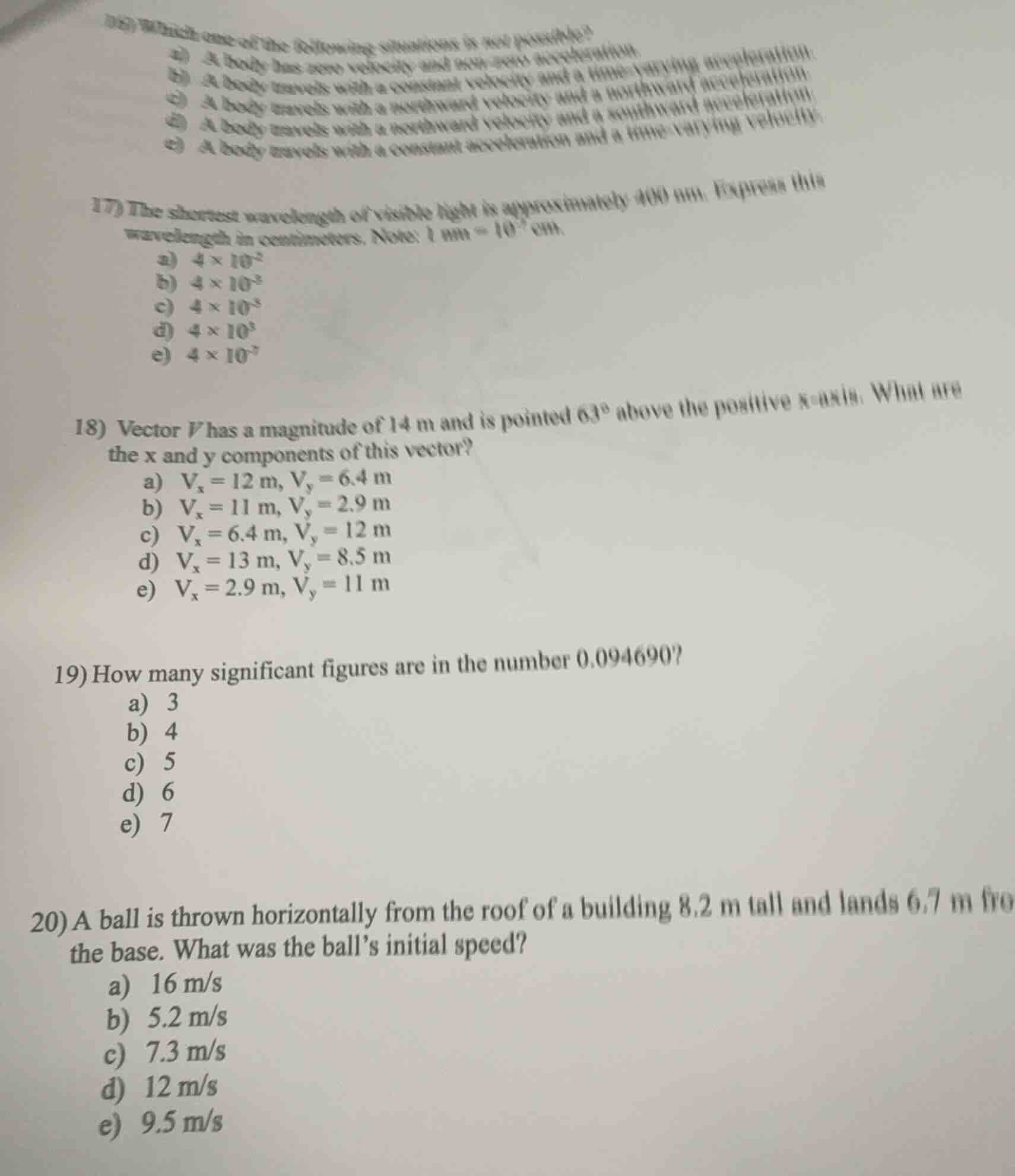
Question
- which one of the following situations is not possible?
a) a body has zero velocity and non-zero acceleration.
b) a body travels with a constant velocity and a time-varying acceleration.
c) a body travels with a northward velocity and a northward acceleration.
d) a body travels with a northward velocity and a southward acceleration.
e) a body travels with a constant acceleration and a time-varying velocity.
- the shortest wavelength of visible light is approximately 400 nm. express this wavelength in centimeters. note: $1\\ \text{nm}=10^{-7}\\ \text{cm}$.
a) $4 \times 10^{-2}$
b) $4 \times 10^{-3}$
c) $4 \times 10^{-5}$
d) $4 \times 10^{5}$
e) $4 \times 10^{-7}$
- vector $v$ has a magnitude of 14 m and is pointed $63^\circ$ above the positive x-axis. what are the x and y components of this vector?
a) $v_x=12\\ \text{m}, v_y=6.4\\ \text{m}$
b) $v_x=11\\ \text{m}, v_y=2.9\\ \text{m}$
c) $v_x=6.4\\ \text{m}, v_y=12\\ \text{m}$
d) $v_x=13\\ \text{m}, v_y=8.5\\ \text{m}$
e) $v_x=2.9\\ \text{m}, v_y=11\\ \text{m}$
- how many significant figures are in the number 0.094690?
a) 3
b) 4
c) 5
d) 6
e) 7
- a ball is thrown horizontally from the roof of a building 8.2 m tall and lands 6.7 m from the base. what was the balls initial speed?
a) 16 m/s
b) 5.2 m/s
c) 7.3 m/s
d) 12 m/s
e) 9.5 m/s
Question 16
Step1: Analyze each motion scenario
- a) Possible: E.g., object at max height in free fall has $v=0$, $a=g
eq0$.
- b) Impossible: Constant velocity means $a=0$, can't have time-varying $a$.
- c) Possible: Object speeding up north, $v$ and $a$ same direction.
- d) Possible: Object slowing down north, $v$ and $a$ opposite directions.
- e) Possible: Constant acceleration causes changing velocity ($v = v_0 + at$).
Step1: Convert nm to cm using given factor
Given $1\ \text{nm}=10^{-7}\ \text{cm}$, so:
$$400\ \text{nm} = 400 \times 10^{-7}\ \text{cm}$$
Step2: Simplify the expression
$$400 \times 10^{-7} = 4 \times 10^{2} \times 10^{-7} = 4 \times 10^{-5}\ \text{cm}$$
Step1: Calculate x-component of vector
Use $V_x = V\cos\theta$:
$$V_x = 14\cos(63^\circ) \approx 14 \times 0.454 = 6.36 \approx 6.4\ \text{m}$$
Step2: Calculate y-component of vector
Use $V_y = V\sin\theta$:
$$V_y = 14\sin(63^\circ) \approx 14 \times 0.891 = 12.47 \approx 12\ \text{m}$$

Snap & solve any problem in the app
Get step-by-step solutions on Sovi AI
Photo-based solutions with guided steps
Explore more problems and detailed explanations
b) A body travels with a constant velocity and a time-varying acceleration.
---