QUESTION IMAGE
Question
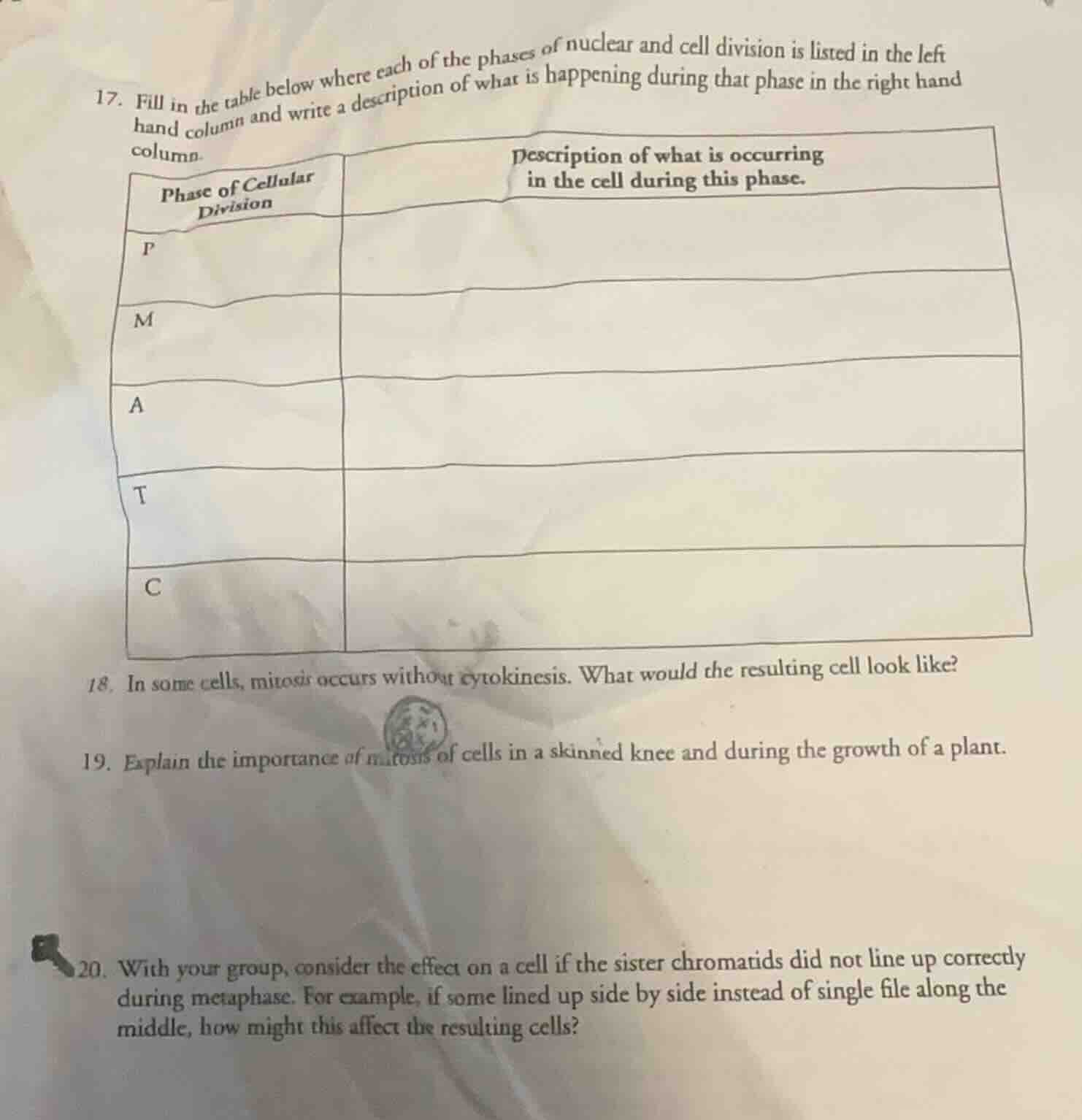
- fill in the table below where each of the phases of nuclear and cell division is listed in the left hand column and write a description of what is happening during that phase in the right hand column.
| phase of cellular division | description of what is occurring in the cell during this phase. |
|---|---|
| m | |
| a | |
| t | |
| c |
- in some cells, mitosis occurs without cytokinesis. what would the resulting cell look like?
- explain the importance of mitosis of cells in a skinned knee and during the growth of a plant.
- with your group, consider the effect on a cell if the sister chromatids did not line up correctly during metaphase. for example, if some lined up side by side instead of single file along the middle, how might this affect the resulting cells?
Response
Question 17 (Filling the table for phases of cellular division)
Brief Explanations
- Phase P (Prophase): Chromosomes condense, nuclear envelope breaks down, spindle fibers form.
- Phase M (Metaphase): Chromosomes line up along the equator (metaphase plate) of the cell, spindle fibers attach to centromeres.
- Phase A (Anaphase): Sister chromatids separate and are pulled to opposite poles of the cell by spindle fibers.
- Phase T (Telophase): Chromosomes de - condense, nuclear envelopes reform around each set of chromosomes, spindle fibers break down.
- Phase C (Cytokinesis): The cytoplasm divides, resulting in two daughter cells (in animal cells, a cleavage furrow forms; in plant cells, a cell plate forms).
Brief Explanations
Mitosis is the division of the nucleus, and cytokinesis is the division of the cytoplasm. If mitosis occurs without cytokinesis, the cell will have multiple nuclei (a multinucleated cell). For example, in some muscle cells and fungal hyphae, this process occurs, resulting in a single cell with more than one nucleus.
Brief Explanations
- In a skinned knee: Mitosis is important for the repair of damaged tissue. The cells at the site of the injury undergo mitosis to produce new cells that replace the damaged cells, helping to close the wound and restore the normal structure and function of the skin.
- During plant growth: Mitosis is essential for the growth of the plant. In the meristematic regions (e.g., apical meristems, lateral meristems), cells undergo mitosis to produce new cells. These new cells can then differentiate into various types of plant cells (e.g., epidermal cells, vascular cells, ground tissue cells) that are needed for the plant to increase in size, develop new organs (like leaves, roots, stems), and maintain its structure.

Snap & solve any problem in the app
Get step-by-step solutions on Sovi AI
Photo-based solutions with guided steps
Explore more problems and detailed explanations
(Table):
| Phase of Cellular Division | Description of what is occurring in the cell during this phase. |
|---|---|
| M (Metaphase) | Chromosomes align at the metaphase plate, spindle fibers attach to centromeres. |
| A (Anaphase) | Sister chromatids separate and move to opposite poles. |
| T (Telophase) | Chromosomes de - condense, nuclear envelopes reform, spindle fibers break down. |
| C (Cytokinesis) | Cytoplasm divides, two daughter cells form (cleavage furrow in animals, cell plate in plants). |