QUESTION IMAGE
Question
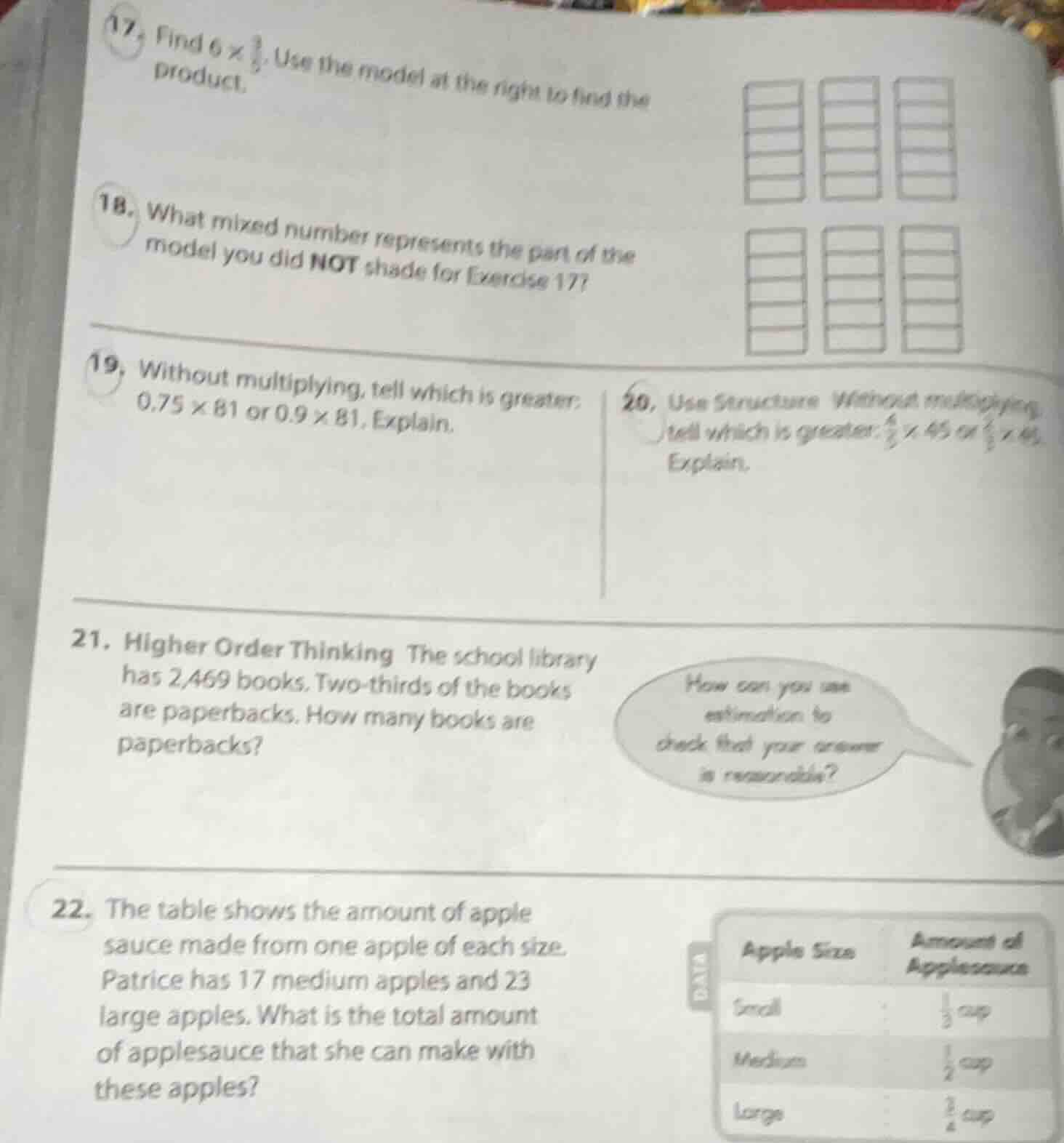
- find ( 6 \times \frac{3}{5} ). use the model at the right to find the product.
- what mixed number represents the part of the model you did not shade for exercise 17?
- without multiplying, tell which is greater: ( 0.75 \times 81 ) or ( 0.9 \times 81 ). explain.
- use structure without multiplying, tell which is greater: ( \frac{4}{5} \times 45 ) or ( \frac{5}{5} \times 45 ). explain.
- higher order thinking the school library has 2,469 books. two - thirds of the books are paperbacks. how many books are paperbacks?
how can you use estimation to check that your answer is reasonable?
- the table shows the amount of apple sauce made from one apple of each size.
patrice has 17 medium apples and 23 large apples. what is the total amount of applesauce that she can make with these apples?
data
| apple size | amount of applesauce |
|---|---|
| medium | ( \frac{1}{2} ) cup |
| large | ( \frac{3}{4} ) cup |
Question 17
Step1: Recall multiplication of integer and fraction
To find \(6\times\frac{3}{5}\), we multiply the integer with the numerator: \(6\times3 = 18\), so the product is \(\frac{18}{5}\).
Step2: Convert to mixed number (optional for model)
\(\frac{18}{5}=3\frac{3}{5}\). From the model, each rectangle has 5 parts, 6 rectangles. Shading \(\frac{3}{5}\) of each, for 6 rectangles, total shaded is \(6\times\frac{3}{5}=\frac{18}{5}=3\frac{3}{5}\).
Step1: Find total parts in model
There are 6 rectangles, each with 5 parts, so total parts: \(6\times5 = 30\) parts (or 6 wholes, each whole is 5 parts).
Step2: Find shaded parts from Q17
From Q17, shaded is \(\frac{18}{5}=3\frac{3}{5}\) (or 18 fifths). Total parts as fifths: \(6=\frac{30}{5}\).
Step3: Find unshaded parts
Unshaded parts: \(\frac{30}{5}-\frac{18}{5}=\frac{12}{5}\). Convert to mixed number: \(\frac{12}{5}=2\frac{2}{5}\).
Step1: Recall multiplication property
When multiplying a number by two different factors, the larger factor gives a larger product (since 81 is positive).
Step2: Compare the factors
Compare \(0.75\) and \(0.9\). Since \(0.9>0.75\), then \(0.9\times81>0.75\times81\).

Snap & solve any problem in the app
Get step-by-step solutions on Sovi AI
Photo-based solutions with guided steps
Explore more problems and detailed explanations
\(\frac{18}{5}\) (or \(3\frac{3}{5}\))