QUESTION IMAGE
Question
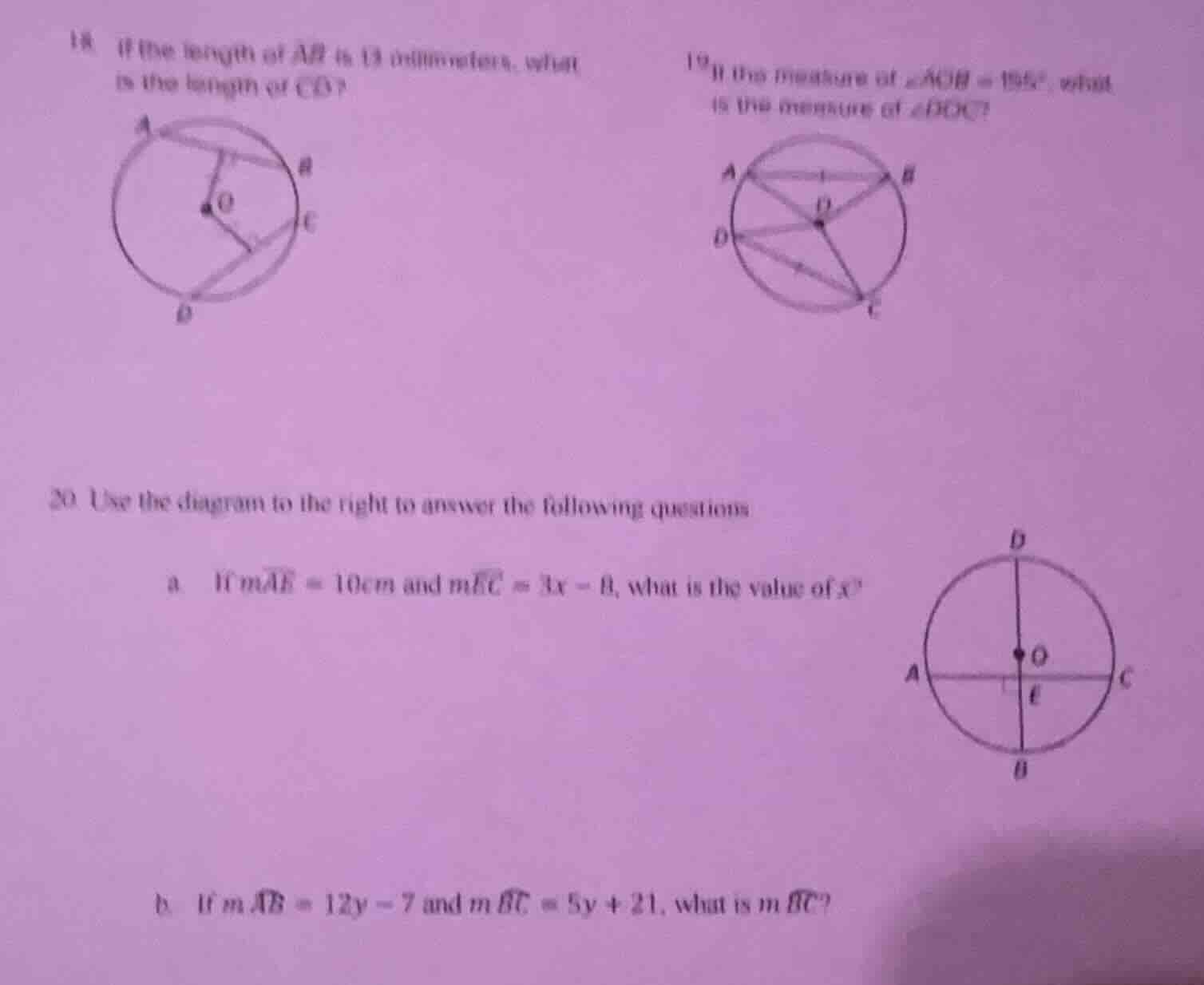
18 if the length of \\( \overline{ab} \\) is 13 millimeters, what is the length of \\( \overline{cd} \\)?
19 if the measure of \\( \angle aob = 105^\circ \\), what is the measure of \\( \angle doc \\)?
20 use the diagram to the right to answer the following questions
a if \\( m\overline{ae} = 10 \text{cm} \\) and \\( m\overline{ec} = 3x - 8 \\), what is the value of \\( x \\)?
b if \\( m\overline{ab} = 12y - 7 \\) and \\( m\overline{bc} = 5y + 21 \\), what is \\( m\overline{bc} \\)?
20a Solution:
Step1: Identify equal segments
Since \( AB \) and \( CD \) are diameters, and \( OE \perp AC \), \( AE = EC \) (perpendicular from center to chord bisects the chord). Given \( m\overline{AE}=10 \, \text{cm} \), so \( m\overline{EC}=10 \, \text{cm} \).
Step2: Set up equation
We know \( m\overline{EC}=3x - 8 \), and \( m\overline{EC}=10 \). So:
\( 3x - 8 = 10 \)
Step3: Solve for \( x \)
Add 8 to both sides: \( 3x = 10 + 8 = 18 \)
Divide by 3: \( x=\frac{18}{3}=6 \)
Step1: Identify equal arcs
Since \( AB \) and \( CD \) are perpendicular diameters, \( \overset{\frown}{AB}=\overset{\frown}{BC}=\overset{\frown}{CD}=\overset{\frown}{DA} \)? Wait, no, actually, \( AB \) and \( CD \) are perpendicular, so \( \angle AOB=\angle BOC = 90^\circ \)? Wait, no, the diagram shows \( AB \) and \( CD \) as perpendicular diameters, so arcs \( AB \) and \( BC \)? Wait, no, the problem says \( m\overset{\frown}{AB}=12y - 7 \) and \( m\overset{\frown}{BC}=5y + 21 \). Wait, actually, since \( AB \) and \( CD \) are perpendicular diameters, \( \overset{\frown}{AB}=\overset{\frown}{BC} \)? Wait, no, maybe \( AB \) and \( BC \) are arcs such that \( AB = BC \) (if the diameters are perpendicular, each arc is \( 90^\circ \), but here it's length? Wait, no, maybe the arcs are equal. Wait, the problem might have \( AB \) and \( BC \) as arcs with equal measure (since \( OE \perp AC \) and \( CD \) is diameter, maybe \( AB = BC \)). So set \( 12y - 7 = 5y + 21 \)
Step2: Solve for \( y \)
Subtract \( 5y \) from both sides: \( 12y - 5y - 7 = 21 \)
\( 7y - 7 = 21 \)
Add 7: \( 7y = 21 + 7 = 28 \)
Divide by 7: \( y = 4 \)
Step3: Find \( m\overset{\frown}{BC} \)
Substitute \( y = 4 \) into \( 5y + 21 \):
\( 5(4)+21 = 20 + 21 = 41 \)
Wait, that can't be, because if they are perpendicular diameters, arcs should be \( 90^\circ \). Wait, maybe the problem is that \( AB \) and \( BC \) are arcs such that \( AB = BC \) (since the diameters are perpendicular, so \( \angle AOB=\angle BOC = 90^\circ \), so arcs \( AB \) and \( BC \) have equal measure). So the equation is \( 12y - 7 = 5y + 21 \)
Wait, solving:
\( 12y - 5y = 21 + 7 \)
\( 7y = 28 \)
\( y = 4 \)
Then \( m\overset{\frown}{BC}=5(4)+21 = 20 + 21 = 41 \). But that contradicts the perpendicular diameter. Wait, maybe the diagram is different. Alternatively, maybe \( AB \) and \( BC \) are chords, but the problem says \( m\overset{\frown}{AB} \) and \( m\overset{\frown}{BC} \). Anyway, following the problem's equation:
Step1: Set arcs equal (assuming \( \overset{\frown}{AB}=\overset{\frown}{BC} \))
\( 12y - 7 = 5y + 21 \)
Step2: Solve for \( y \)
\( 12y - 5y = 21 + 7 \)
\( 7y = 28 \)
\( y = 4 \)
Step3: Calculate \( m\overset{\frown}{BC} \)
Substitute \( y = 4 \) into \( 5y + 21 \):
\( 5(4)+21 = 20 + 21 = 41 \)

Snap & solve any problem in the app
Get step-by-step solutions on Sovi AI
Photo-based solutions with guided steps
Explore more problems and detailed explanations
\( x = 6 \)