QUESTION IMAGE
Question
- use b for body fossils of t for trace fossils to answer the following.
a) petrified poop _ b) petrified wood _ c) dinosaur tracks _ d) dinosaur bones _
(bonus) tondo petrified wood ___
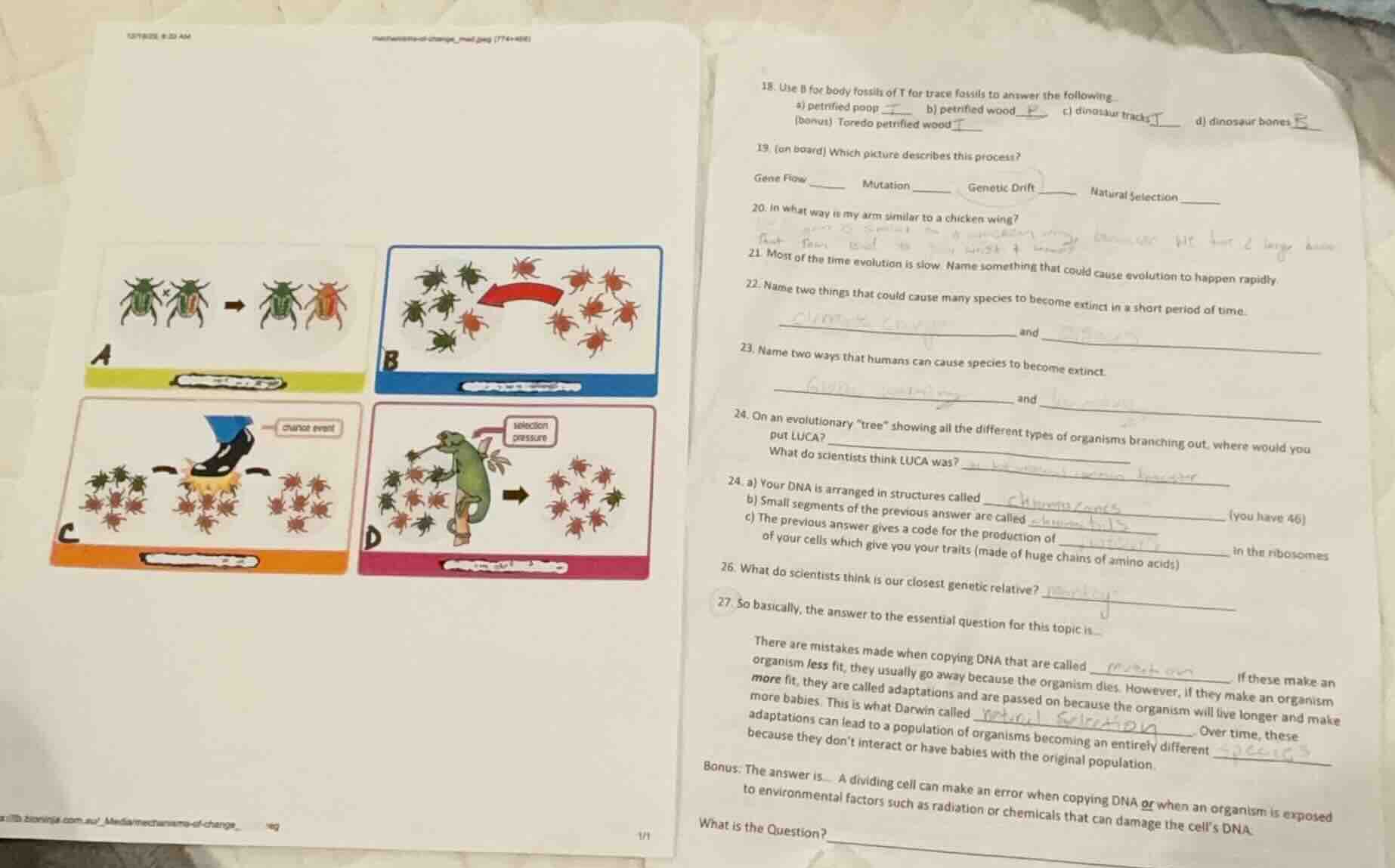
- (on board) which picture describes this process?
gene flow _ mutation _ genetic drift _ natural selection _
- in what way is my arm similar to a chicken wing?
- most of the time evolution is slow. name something that could cause evolution to happen rapidly
- name two things that could cause many species to become extinct in a short period of time.
__________________ and __________________
- name two ways that humans can cause species to become extinct.
__________________ and __________________
- on an evolutionary \tree\ showing all the different types of organisms branching out, where would you put luca? ____________________
what do scientists think luca was? ____________________
- a) your dna is arranged in structures called ____________________ (you have 46)
b) small segments of the previous answer are called ____________________
c) the previous answer gives a code for the production of ____________________ in the ribosomes of your cells which give you your traits (made of huge chains of amino acids)
- what do scientists think is our closest genetic relative? ____________________
- so basically, the answer to the essential question for this topic is...
there are mistakes made when copying dna that are called __________________, if these make an organism less fit, they usually go away because the organism dies. however, if they make an organism more fit, they are called adaptations and are passed on because the organism will live longer and make more babies. this is what darwin called ________________, over time, these adaptations can lead to a population of organisms becoming an entirely different __________________ because they dont interact or have babies with the original population.
bonus: the answer is... a dividing cell can make an error when copying dna or when an organism is exposed to environmental factors such as radiation or chemicals that can damage the cell’s dna.
what is the question? ____________________
- Body fossils are actual remains of organisms; trace fossils are signs of their activity.
- Match each evolutionary process to its visual:
- Gene Flow: Movement of genes between populations (Image A: interbreeding of two beetle groups)
- Mutation: Random genetic change (no direct image here, but the process introduces new traits)
- Genetic Drift: Random change in allele frequency (Image B: random shift in beetle color ratios)
- Natural Selection: Survival of fittest (Image D: predator selects for camouflaged beetles)
- They are homologous structures: same embryonic origin, different functions.
- Examples include sudden environmental change, mass mutation events, or invasive species.
- Examples include asteroid impacts, massive volcanic eruptions, or rapid climate change.
- Examples include habitat destruction and overhunting/overfishing.
- LUCA (Last Universal Common Ancestor) is at the base/root of the evolutionary tree; scientists think it was a simple, single-celled prokaryotic organism.
24a) Chromosomes; b) Genes; c) Proteins
- Chimpanzees (bonobos are also extremely close genetic relatives)
- Mistakes in DNA copying are mutations; Darwin called the survival of fit organisms natural selection; over time this can lead to new species.
Bonus: What causes mutations?

Snap & solve any problem in the app
Get step-by-step solutions on Sovi AI
Photo-based solutions with guided steps
Explore more problems and detailed explanations
- a) T; b) B; c) T; d) B; (bonus) T
- Gene Flow: A; Genetic Drift: B; Natural Selection: D; Mutation: [no matching image shown]
- They are homologous structures (shared evolutionary origin).
- Sudden climate change (example)
- Asteroid impact and massive volcanic eruption (examples)
- Habitat destruction and overhunting (examples)
- At the root/base of the evolutionary tree; a simple single-celled prokaryote.
- a) Chromosomes; b) Genes; c) Proteins
- Chimpanzee
- mutations; natural selection; species
Bonus: What causes mutations?