QUESTION IMAGE
Question
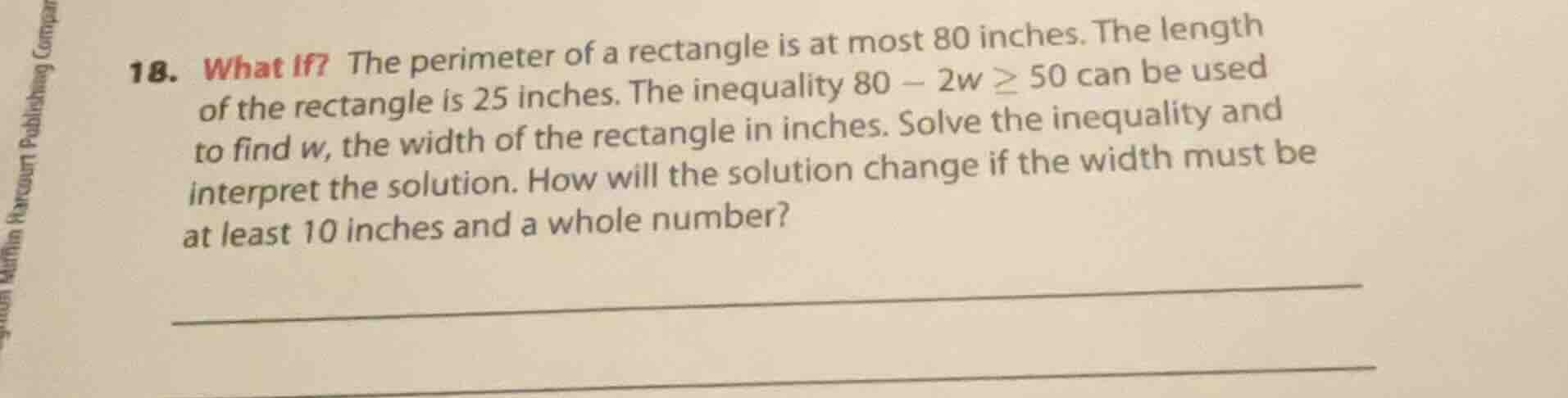
- what if? the perimeter of a rectangle is at most 80 inches. the length of the rectangle is 25 inches. the inequality $80 - 2w \geq 50$ can be used to find $w$, the width of the rectangle in inches. solve the inequality and interpret the solution. how will the solution change if the width must be at least 10 inches and a whole number?
Step1: Isolate the term with $w$
Subtract 80 from both sides:
$80 - 2w - 80 \geq 50 - 80$
$-2w \geq -30$
Step2: Solve for $w$
Divide by -2 (reverse inequality sign):
$\frac{-2w}{-2} \leq \frac{-30}{-2}$
$w \leq 15$
Step3: Interpret initial solution
The width $w$ must be positive (since it's a length) and $w \leq 15$, so $0 < w \leq 15$. This means the rectangle's width can be any positive number up to 15 inches to keep the perimeter at most 80 inches with length 25 inches.
Step4: Apply new constraints
If $w$ is at least 10 inches and a whole number, combine with $w \leq 15$:
$10 \leq w \leq 15$, where $w$ is an integer.

Snap & solve any problem in the app
Get step-by-step solutions on Sovi AI
Photo-based solutions with guided steps
Explore more problems and detailed explanations
- Solution to the original inequality: $w \leq 15$
Interpretation: The width of the rectangle can be any positive value up to and including 15 inches, so that the perimeter is at most 80 inches with a fixed length of 25 inches.
- With the new constraints: The possible widths are the whole numbers 10, 11, 12, 13, 14, 15 inches.