QUESTION IMAGE
Question
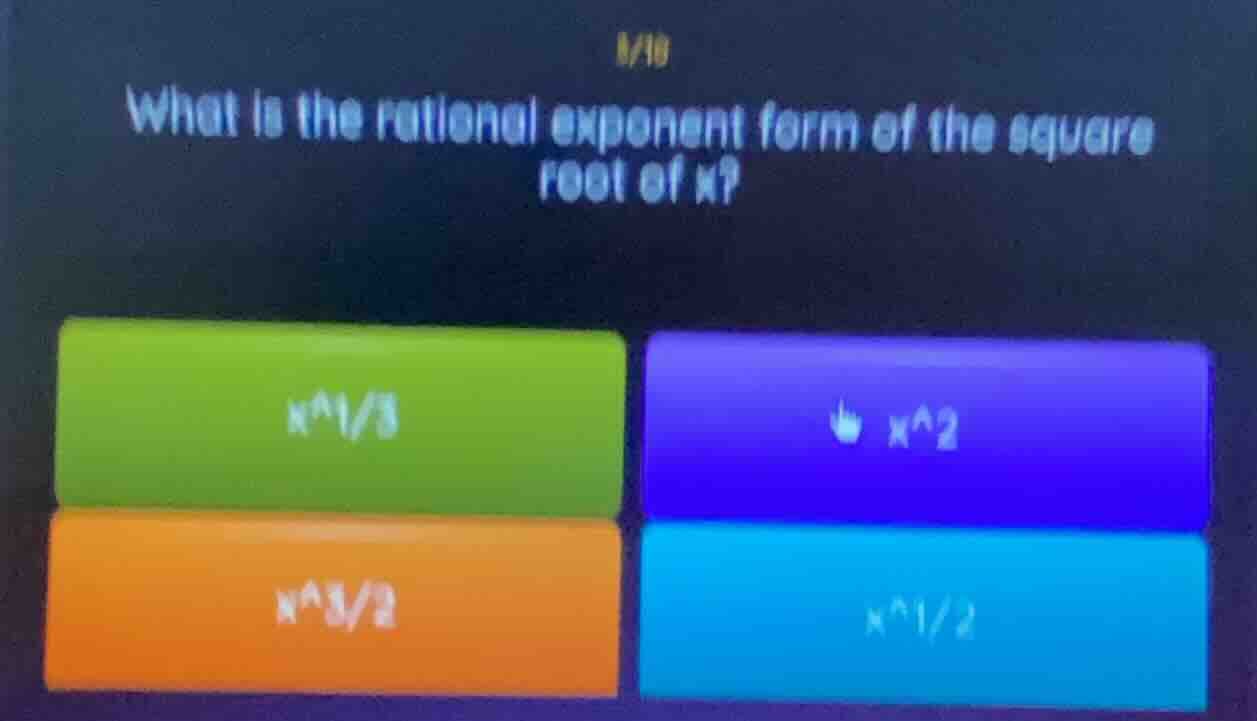
1/18 what is the rational exponent form of the square root of x? x^1/3 x^2 x^3/2 x^1/2
Step1: Recall the rule of rational exponents
The rule for converting a radical to a rational exponent is that the \(n\)-th root of a number \(a\) can be written as \(a^{\frac{1}{n}}\), where \(n\) is the index of the root. For a square root, the index \(n = 2\) (since the square root is the second root, and the index of a square root is usually not written, but it is 2). So, for the square root of \(x\), which is \(\sqrt{x}\) (or \(\sqrt[2]{x}\)), we can apply the rule.
Step2: Apply the rule to \(\sqrt{x}\)
Using the rule \(a^{\frac{1}{n}}\) for the \(n\)-th root of \(a\), here \(a = x\) and \(n = 2\). So, \(\sqrt{x}=\sqrt[2]{x}=x^{\frac{1}{2}}\).

Snap & solve any problem in the app
Get step-by-step solutions on Sovi AI
Photo-based solutions with guided steps
Explore more problems and detailed explanations
D. \(x^{1/2}\) (assuming the blue option is D, if the options are labeled as A: \(x^{1/3}\), B: \(x^{2}\), C: \(x^{3/2}\), D: \(x^{1/2}\))