QUESTION IMAGE
Question
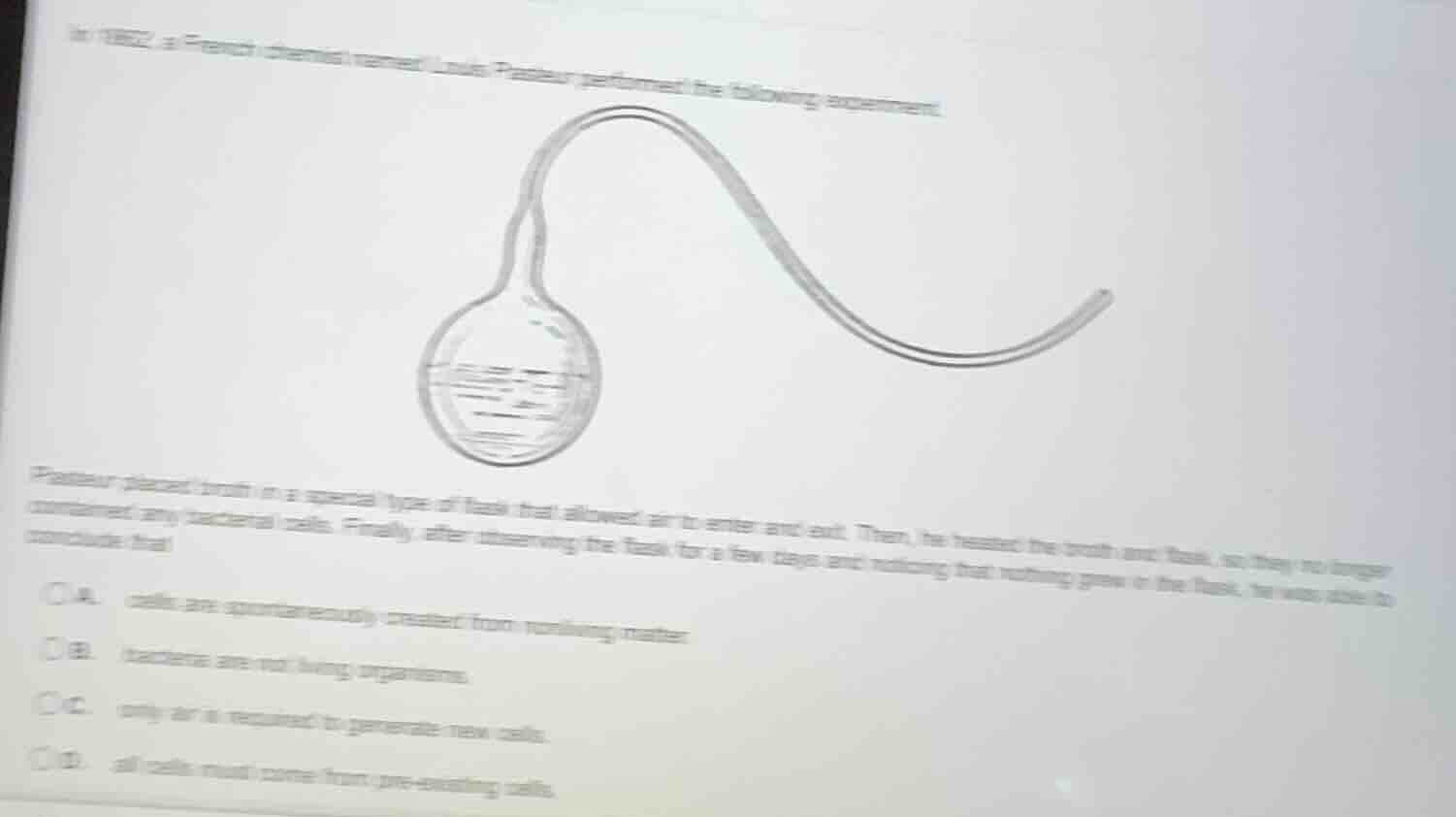
in 1862, a french chemist named louis pasteur performed the following experiment.
pasteur placed broth in a special type of flask that allowed air to enter and exit. then, he heated the broth and flask, so they no longer contained any bacterial cells. finally, after observing the flask for a few days and noticing that nothing grew in the flask, he was able to conclude that
a. cells are spontaneously created from nonliving matter
b. bacteria are not living organisms
c. only air is required to generate new cells
d. all cells must come from pre - existing cells
Pasteur's experiment (swan - neck flask experiment) was designed to test the theory of spontaneous generation. In this experiment, the broth was heated to kill existing microbes, and the special flask design prevented microbial entry from the air. Since no growth occurred, it showed that life (cells) doesn't arise spontaneously from non - living matter. Instead, cells must come from pre - existing cells. Option A is wrong as the experiment disproves spontaneous generation. Option B is wrong because bacteria are living organisms. Option C is wrong as the experiment shows air alone isn't enough (and actually, the key is about the source of cells, not just air).

Snap & solve any problem in the app
Get step-by-step solutions on Sovi AI
Photo-based solutions with guided steps
Explore more problems and detailed explanations
D. all cells must come from pre - existing cells