QUESTION IMAGE
Question
- what goes on the x - axis on a speed - distance graph? what goes on the y - axis?
x - axis: ________________________ y - axis: ________________________
- fill out the chart based on the correct units for each scenario. place a check if the example would be used to describe time, distance, or average speed.
| unit example | time | distance | average speed | did not fit into any of the other categories |
|---|---|---|---|---|
| meters/minutes | ||||
| kilometers | ||||
| grams | ||||
| hours | ||||
| miles | ||||
| miles/hour | ||||
| kilometers/hour | ||||
| newtons |
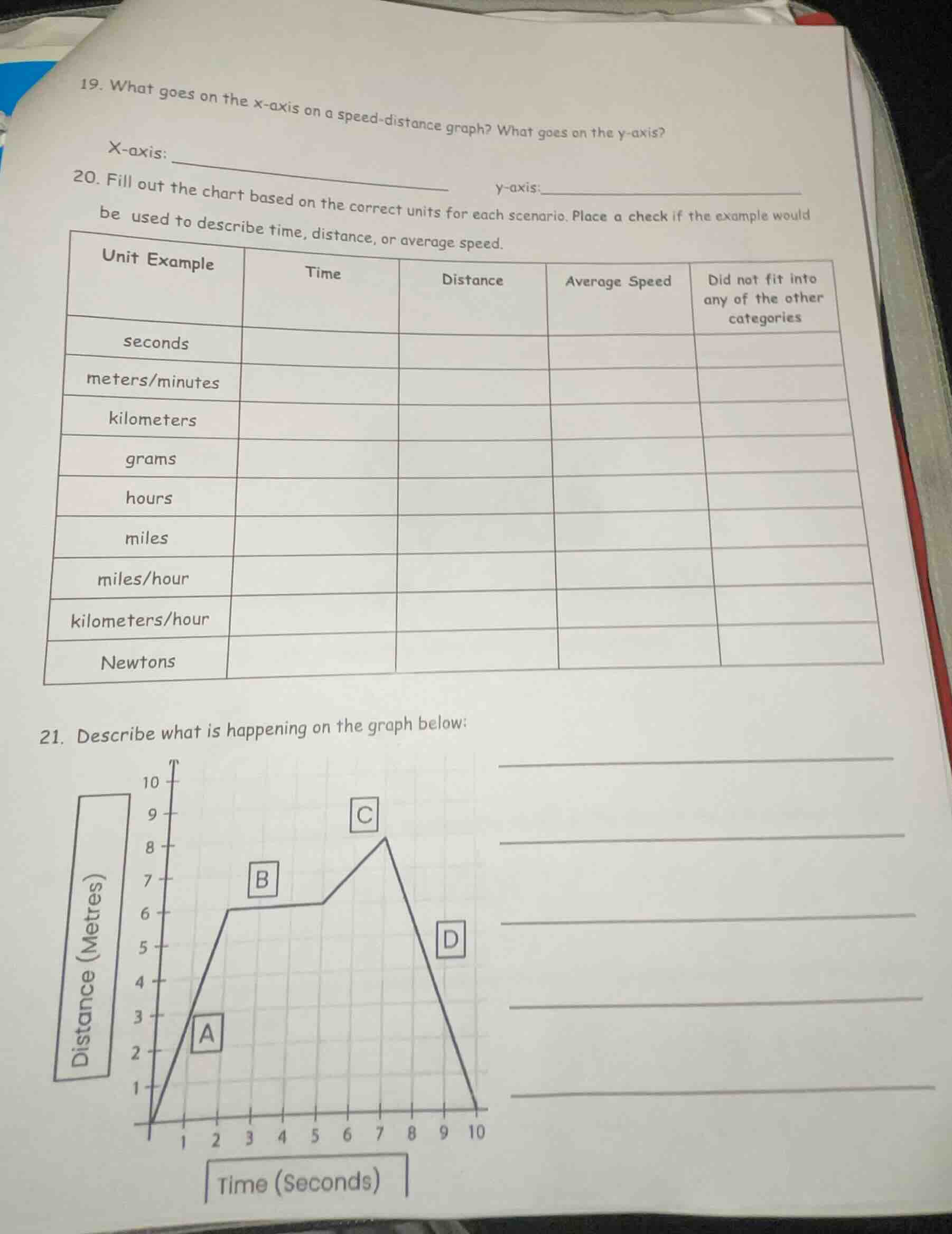
- describe what is happening on the graph below:
Step1: Answer graph axis question
For a speed-distance graph, the independent variable (distance) is on the x-axis, and the dependent variable (speed) is on the y-axis.
Step2: Categorize units for the chart
Match each unit to time, distance, speed, or the "did not fit" category using unit definitions:
- Time: units measure duration
- Distance: units measure length
- Average Speed: units are distance/time
- Did not fit: units for mass/force
Step3: Analyze distance-time graph segments
Interpret each segment by slope (slope = speed):
- Segment A: Positive slope = constant speed
- Segment B: Zero slope = no movement
- Segment C: Positive slope = constant speed
- Segment D: Negative slope = constant return speed

Snap & solve any problem in the app
Get step-by-step solutions on Sovi AI
Photo-based solutions with guided steps
Explore more problems and detailed explanations
Question 19
X-axis: Distance
y-axis: Speed
Question 20
| Unit Example | Time | Distance | Average Speed | Did not fit into any of the other categories |
|---|---|---|---|---|
| meters/minutes | ✓ | |||
| kilometers | ✓ | |||
| grams | ✓ | |||
| hours | ✓ | |||
| miles | ✓ | |||
| miles/hour | ✓ | |||
| kilometers/hour | ✓ | |||
| Newtons | ✓ |
Question 21
- Segment A (0-3 seconds): The object travels at a constant speed, moving 6 meters away from the starting point.
- Segment B (3-6 seconds): The object is stationary; its distance from the start does not change.
- Segment C (6-8 seconds): The object resumes moving at a constant, slower speed than segment A, traveling an additional 2 meters.
- Segment D (8-10 seconds): The object travels back to the starting point at a constant speed, covering 8 meters in 2 seconds.