QUESTION IMAGE
Question
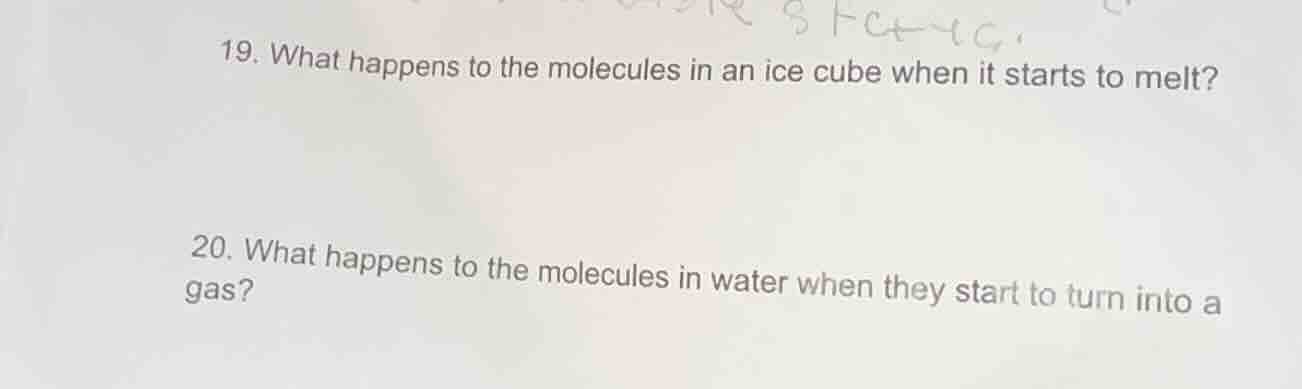
- what happens to the molecules in an ice cube when it starts to melt?
- what happens to the molecules in water when they start to turn into a gas?
Question 19
When an ice cube melts (a phase change from solid to liquid), heat is absorbed. In ice (solid water), molecules are in a fixed, ordered lattice structure with relatively low kinetic energy, vibrating in place. As it melts, the heat energy increases the kinetic energy of the water molecules. The intermolecular forces (like hydrogen bonds) that held them in the rigid lattice start to weaken, and the molecules gain enough energy to break free from their fixed positions. They begin to move more freely and slide past one another, transitioning from the solid's ordered structure to the liquid's more disordered, fluid state (where molecules can move around but are still relatively close together compared to a gas).
When water turns into a gas (vaporization, either evaporation or boiling), heat is absorbed, increasing the kinetic energy of water molecules. In liquid water, molecules are close together and move randomly but are still held by intermolecular forces (like hydrogen bonds). As they gain enough energy (to overcome these intermolecular forces), the molecules move much more rapidly and spread out significantly. They break free from the liquid - phase intermolecular attractions and move independently in all directions, filling the available space (characteristic of a gas), with large distances between individual molecules.

Snap & solve any problem in the app
Get step-by-step solutions on Sovi AI
Photo-based solutions with guided steps
Explore more problems and detailed explanations
When an ice cube starts to melt, the water molecules gain kinetic energy (from heat absorption). The intermolecular forces weakens, and the molecules move from a fixed, ordered lattice (solid) to a more free - moving, disordered arrangement (liquid), sliding past one another while remaining relatively close.