QUESTION IMAGE
Question
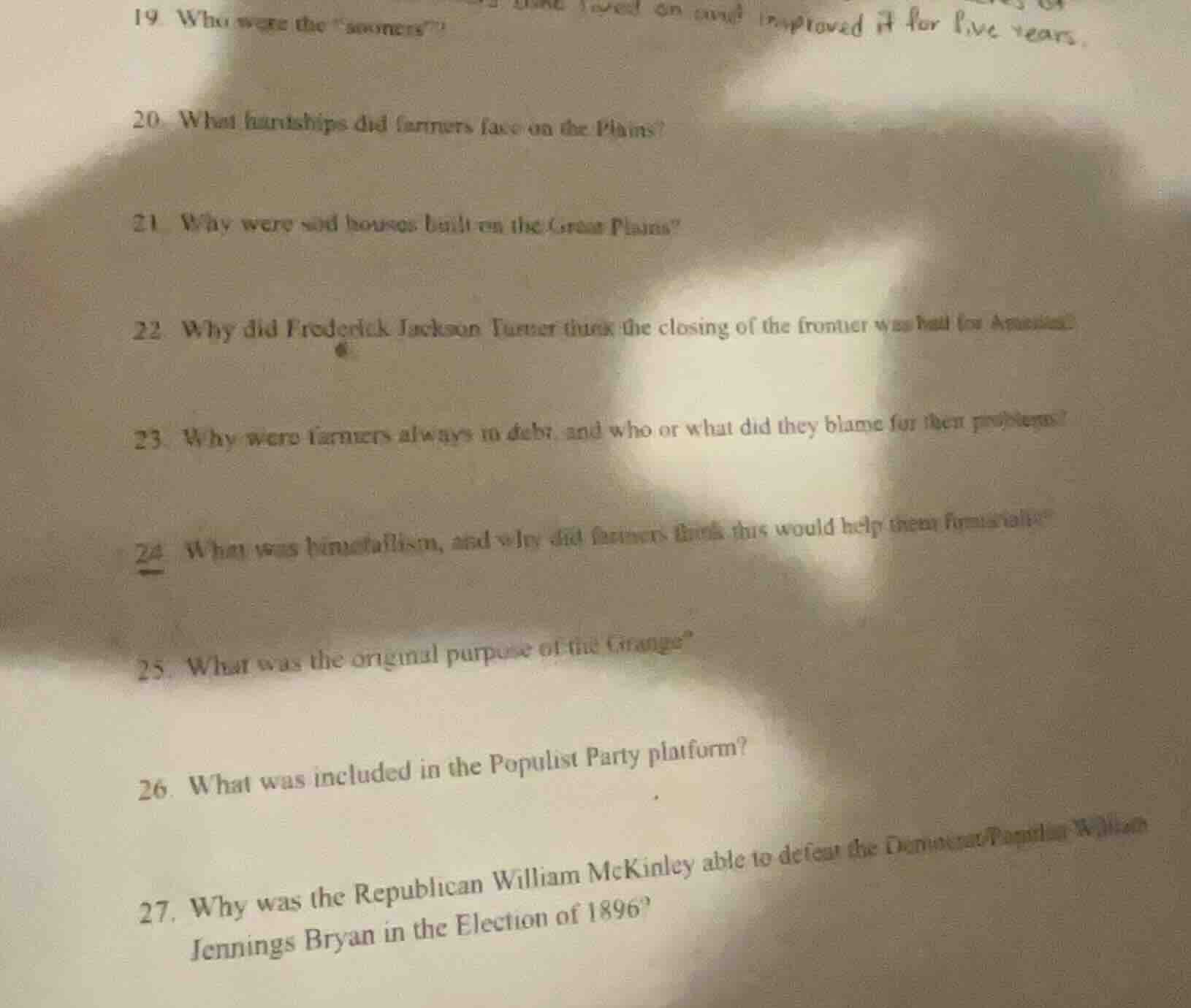
- who were the \sooners\?
- what hardships did farmers face on the plains?
- why were sod houses built on the great plains?
- why did frederick jackson turner think the closing of the frontier was bad for america?
- why were farmers always in debt, and who or what did they blame for their problems?
- what was bimetallism, and why did farmers think this would help them financially?
- what was the original purpose of the grange?
- what was included in the populist party platform?
- why was the republican william mckinley able to defeat the democrat/populist william jennings bryan in the election of 1896?
Brief Explanations
- Q19: The "sooners" were settlers who entered the Unassigned Lands in what is now Oklahoma before the official opening of the territory for settlement in 1889, sneaking in early to claim the best land.
- Q20: Farmers on the Plains faced extreme weather (droughts, blizzards, dust storms), lack of trees for building/fuel, poor soil quality in some areas, insect infestations (like grasshoppers), and isolation from markets and social centers.
- Q21: Sod houses were built on the Great Plains because there was a severe shortage of wood for building. The thick, dense sod from the prairie was readily available, affordable, and provided good insulation against the region's extreme temperatures.
- Q22: Frederick Jackson Turner argued the closing of the frontier (declared in 1890) was bad for America because he believed the frontier had fostered key American traits like individualism, self-reliance, and democratic innovation. Without it, he feared these core values would decline, and the nation would lose its dynamic, pioneering spirit.
- Q23: Farmers were often in debt due to falling crop prices, high costs for transportation, equipment, and supplies, and reliance on credit to cover expenses between harvests. They blamed banks (high interest rates), railroads (exorbitant shipping fees), big businesses, and government policies that favored industrialists over agricultural workers.
- Q24: Bimetallism was a monetary system that allowed the use of both gold and silver as legal tender, with a fixed ratio between their values. Farmers supported it because they believed it would increase the money supply, causing inflation. This would make it easier for them to pay off their debts with cheaper dollars and raise the prices of their crops.
- Q25: (Assuming "Grange" is the intended term) The original purpose of the National Grange of the Order of Patrons of Husbandry (the Grange) was to provide social and educational support for rural farmers, and later to advocate for their economic interests, such as regulating railroad and grain elevator rates.
- Q26: The Populist Party (People's Party) platform included: bimetallism (free silver), a graduated income tax, government ownership of railroads and telegraph/telephone systems, an 8-hour workday, direct election of U.S. Senators, and farm relief measures like storage facilities for crops at government expense.
- Q27: William McKinley defeated William Jennings Bryan in 1896 because he had strong support from industrialists, bankers, and urban voters who feared Bryan's free silver policy would cause economic chaos. McKinley ran a well-funded campaign focused on maintaining the gold standard and promoting economic stability, while Bryan's rural-focused campaign lacked the same financial and institutional backing.

Snap & solve any problem in the app
Get step-by-step solutions on Sovi AI
Photo-based solutions with guided steps
Explore more problems and detailed explanations
- The "sooners" were settlers who illegally entered Oklahoma's Unassigned Lands early (before 1889) to claim prime land.
- Farmers faced droughts, blizzards, dust storms, lack of wood, insect infestations, and market isolation.
- Sod houses were built because wood was scarce on the Plains; sod was abundant and insulating.
- Turner thought the frontier fostered American individualism and democracy; its loss would erode these core traits.
- Farmers were in debt from low crop prices, high supply/transport costs, and credit reliance. They blamed banks, railroads, big business, and pro-industry government policies.
- Bimetallism allowed gold and silver as legal tender. Farmers believed it would expand the money supply, cause inflation, ease debt repayment, and raise crop prices.
- (Assuming "Grange") The Grange was originally a social/educational group for farmers, later advocating for their economic rights.
- The Populist platform included free silver, graduated income tax, government ownership of railroads/telecom, 8-hour workday, direct Senate elections, and farm relief.
- McKinley won with support from industrialists/bankers/urban voters who feared Bryan's free silver policy; his well-funded campaign emphasized economic stability via the gold standard.