QUESTION IMAGE
Question
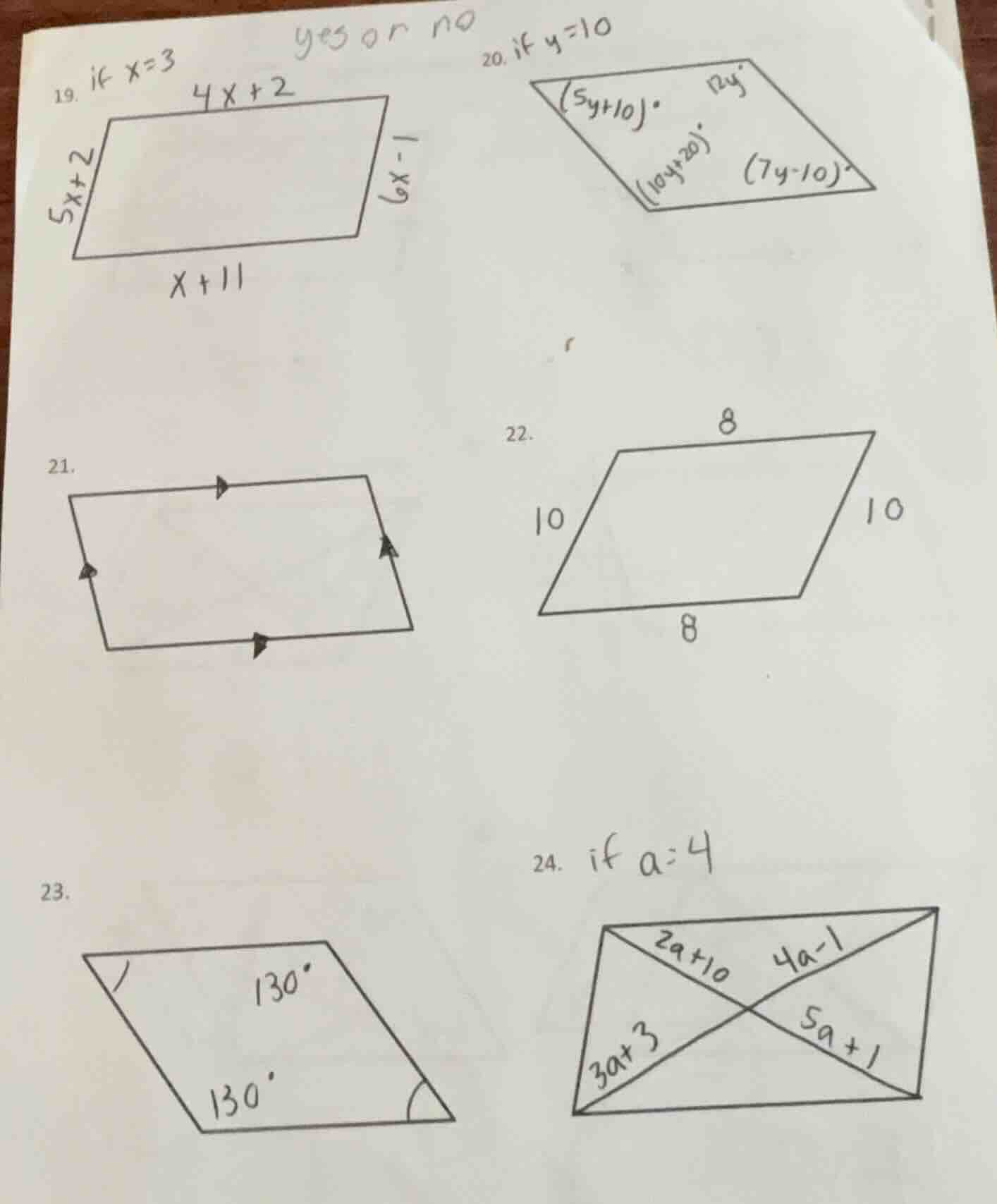
- if x=3 yes or no
4x+2
5x+2
6x-1
x+11
- if y=10
(5y+10)° 12y°
(10y+20)° (7y-10)°
21.
22.
8
10 10
8
23.
130°
130°
- if a=4
2a+10 4a-1
3a+3 5a+1
Problem 19: Check if the figure is a parallelogram when \( x = 3 \)
Step 1: Recall the property of a parallelogram
In a parallelogram, opposite sides are equal in length. So we need to check if \( 5x + 2 = 6x - 1 \) and \( 4x + 2 = x + 11 \) when \( x = 3 \).
Step 2: Check the first pair of sides (\( 5x + 2 \) and \( 6x - 1 \))
Substitute \( x = 3 \) into \( 5x + 2 \):
\( 5(3) + 2 = 15 + 2 = 17 \)
Substitute \( x = 3 \) into \( 6x - 1 \):
\( 6(3) - 1 = 18 - 1 = 17 \)
So \( 5x + 2 = 6x - 1 \) when \( x = 3 \).
Step 3: Check the second pair of sides (\( 4x + 2 \) and \( x + 11 \))
Substitute \( x = 3 \) into \( 4x + 2 \):
\( 4(3) + 2 = 12 + 2 = 14 \)
Substitute \( x = 3 \) into \( x + 11 \):
\( 3 + 11 = 14 \)
So \( 4x + 2 = x + 11 \) when \( x = 3 \).
Since both pairs of opposite sides are equal, the figure is a parallelogram.
Step 1: Recall the property of a parallelogram
In a parallelogram, opposite angles are equal, and consecutive angles are supplementary (sum to \( 180^\circ \)). Let's first find the measure of each angle by substituting \( y = 10 \).
Step 2: Calculate each angle
- For \( (5y + 10)^\circ \): Substitute \( y = 10 \), we get \( 5(10) + 10 = 50 + 10 = 60^\circ \)
- For \( 12y^\circ \): Substitute \( y = 10 \), we get \( 12(10) = 120^\circ \)
- For \( (10y + 20)^\circ \): Substitute \( y = 10 \), we get \( 10(10) + 20 = 100 + 20 = 120^\circ \)
- For \( (7y - 10)^\circ \): Substitute \( y = 10 \), we get \( 7(10) - 10 = 70 - 10 = 60^\circ \)
Step 3: Check opposite angles and consecutive angles
- Opposite angles: \( 60^\circ \) (from \( 5y + 10 \)) and \( 60^\circ \) (from \( 7y - 10 \)) are equal; \( 120^\circ \) (from \( 12y \)) and \( 120^\circ \) (from \( 10y + 20 \)) are equal.
- Consecutive angles: \( 60^\circ + 120^\circ = 180^\circ \), so they are supplementary.
Since opposite angles are equal and consecutive angles are supplementary, the figure is a parallelogram.
Step 1: Recall the property of a parallelogram (based on sides)
The figure has arrows on the sides, indicating that opposite sides are parallel. In a quadrilateral, if both pairs of opposite sides are parallel, then it is a parallelogram (by the definition of a parallelogram).
Since the diagram shows both pairs of opposite sides with parallel arrows, the figure satisfies the definition of a parallelogram.

Snap & solve any problem in the app
Get step-by-step solutions on Sovi AI
Photo-based solutions with guided steps
Explore more problems and detailed explanations
Yes