QUESTION IMAGE
Question
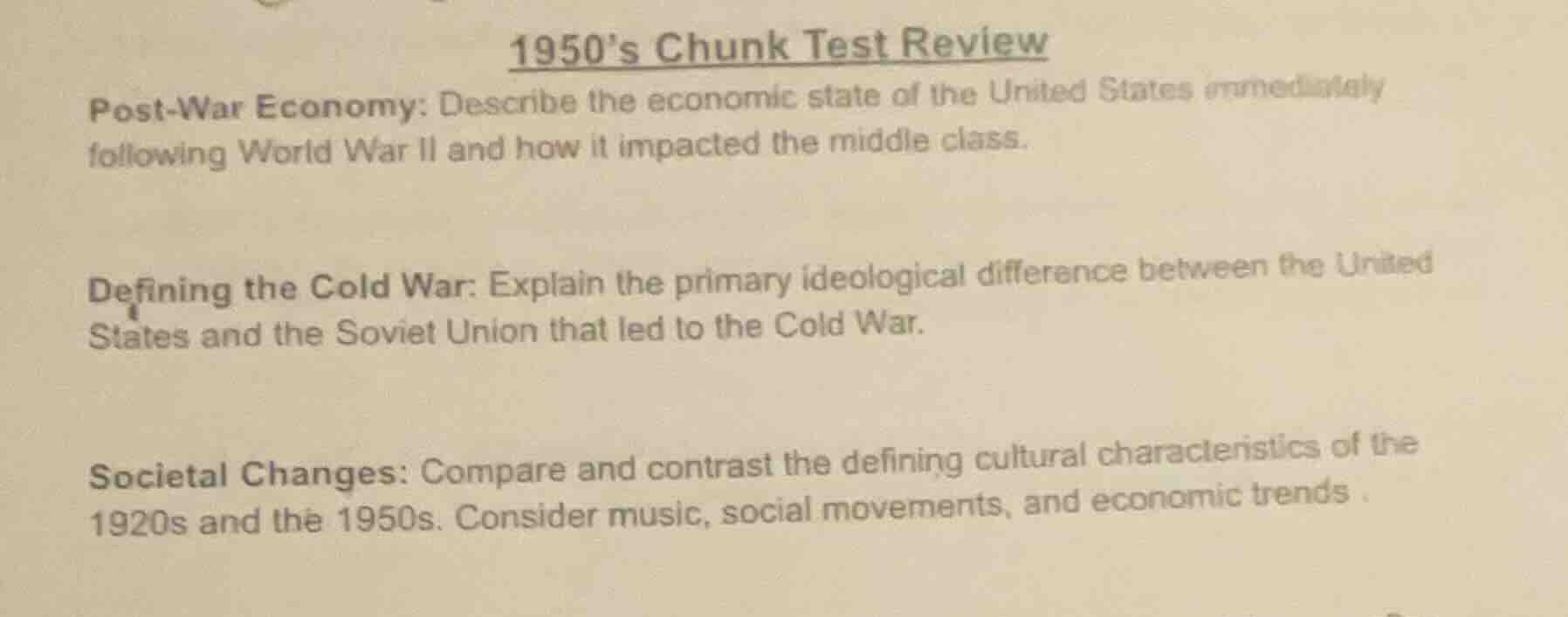
1950s chunk test review
post - war economy: describe the economic state of the united states immediately following world war ii and how it impacted the middle class.
defining the cold war: explain the primary ideological difference between the united states and the soviet union that led to the cold war.
societal changes: compare and contrast the defining cultural characteristics of the 1920s and the 1950s. consider music, social movements, and economic trends.
Brief Explanations
- Post-War Economy: After WWII, U.S. wartime production shifted to consumer goods, spurring rapid economic growth (the "post-war boom"). Government policies like the GI Bill, low-interest mortgages, and suburban expansion enabled middle-class growth: homeownership rose, college access increased, and disposable income supported consumer culture, expanding the size and prosperity of the middle class.
- Defining the Cold War: The core ideological split was between U.S.-led capitalism (emphasizing private property, free markets, and democratic governance) and Soviet-led communism (emphasizing state-owned property, central economic planning, and one-party authoritarian rule). These competing systems, and their global influence struggles, triggered the Cold War.
- Societal Changes:
- 1920s: Known as the "Roaring Twenties," it featured jazz music, the rise of consumer culture, women's suffrage (19th Amendment) and flapper culture challenging gender norms, and economic growth driven by credit. It ended with the 1929 stock market crash.
- 1950s: A period of post-war conformity, with rock 'n' roll emerging as new popular music. Suburbanization and a focus on traditional family structures dominated, while economic stability (post-war boom) supported consumerism. Unlike the 1920s' more fragmented social rebellion, the 1950s had undercurrents of discontent (e.g., early civil rights stirrings) beneath a facade of uniformity.

Snap & solve any problem in the app
Get step-by-step solutions on Sovi AI
Photo-based solutions with guided steps
Explore more problems and detailed explanations
- Post-War Economy: The U.S. experienced a massive economic boom post-WWII, with wartime production converted to consumer goods, and government programs (GI Bill, suburban housing initiatives) expanded the middle class by enabling homeownership, college education, and increased disposable income, creating a large, prosperous suburban middle class.
- Defining the Cold War: The primary ideological difference was the U.S.'s commitment to capitalism, free markets, and liberal democracy, versus the Soviet Union's commitment to communism, state-controlled economies, and one-party authoritarian rule; these competing systems and their global power struggles sparked the Cold War.
- Societal Changes:
- 1920s: Jazz-centric music, rebellious gender norms (flappers), early consumer credit culture, post-WWI social liberation, ended with economic collapse.
- 1950s: Rock 'n' roll as a new musical force, emphasis on traditional suburban family structures, post-war economic stability and consumerism, with understated social unrest (early civil rights efforts) beneath a conformist surface.