QUESTION IMAGE
Question
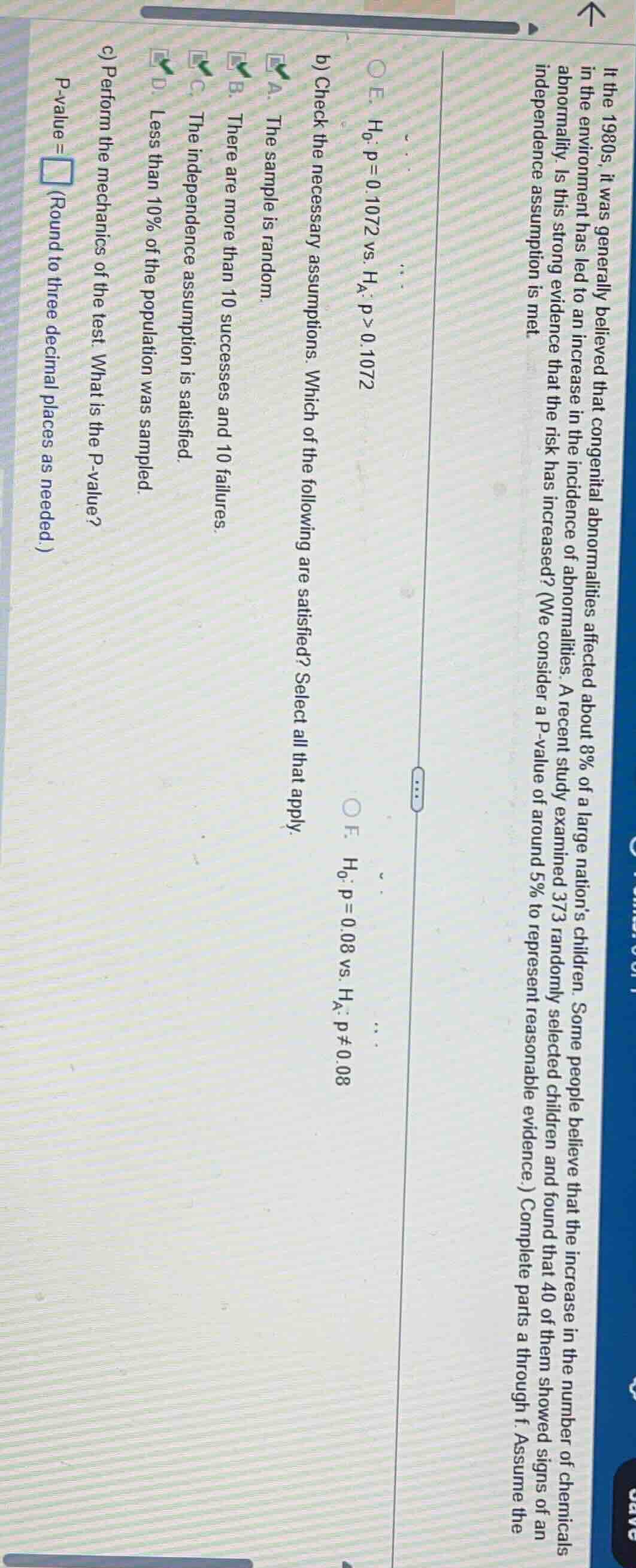
in the 1980s, it was generally believed that congenital abnormalities affected about 8% of a large nation’s children. some people believe that the increase in the number of chemicals in the environment has led to an increase in the incidence of abnormalities. is this strong evidence that the risk has increased? (we consider a p - value of around 5% to represent reasonable evidence.) a recent study examined 373 randomly selected children and found that 40 of them showed signs of an abnormality. assume the independence assumption is met.
e. $h_0: p = 0.1072$ vs. $h_a: p > 0.1072$
f. $h_0: p = 0.08$ vs. $h_a: p \
eq 0.08$
b) check the necessary assumptions. which of the following are satisfied? select all that apply.
a. the sample is random.
b. there are more than 10 successes and 10 failures.
c. the independence assumption is satisfied.
d. less than 10% of the population was sampled.
c) perform the mechanics of the test. what is the p - value?
p - value = \boxed{ } (round to three decimal places as needed.)
Step1: State hypotheses
$H_0: p = 0.08$, $H_A: p > 0.08$
Step2: Calculate sample proportion
$\hat{p} = \frac{40}{373} \approx 0.1072$
Step3: Compute test statistic
$$z = \frac{\hat{p} - p_0}{\sqrt{\frac{p_0(1-p_0)}{n}}} = \frac{0.1072 - 0.08}{\sqrt{\frac{0.08(1-0.08)}{373}}} \approx \frac{0.0272}{\sqrt{\frac{0.0736}{373}}} \approx \frac{0.0272}{0.0141} \approx 1.93$$
Step4: Find P-value
For right-tailed test, P-value = $P(Z > 1.93) = 1 - \Phi(1.93)$
Using standard normal table, $\Phi(1.93) = 0.9732$, so P-value = $1 - 0.9732 = 0.0268$

Snap & solve any problem in the app
Get step-by-step solutions on Sovi AI
Photo-based solutions with guided steps
Explore more problems and detailed explanations
Part a (Hypotheses):
F. $H_0: p = 0.08$ vs. $H_A: p > 0.08$
Part b (Assumptions):
A. The sample is random.
B. There are more than 10 successes and 10 failures.
C. The independence assumption is satisfied.
D. Less than 10% of the population was sampled.
Part c (P-value):
0.027