QUESTION IMAGE
Question
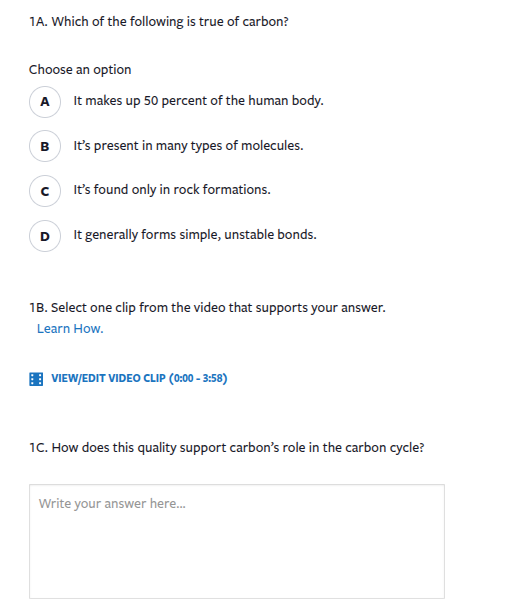
1a. which of the following is true of carbon?
choose an option
a it makes up 50 percent of the human body.
b it’s present in many types of molecules.
c it’s found only in rock formations.
d it generally forms simple, unstable bonds.
1b. select one clip from the video that supports your answer.
learn how.
view/edit video clip (0:00 - 3:58)
1c. how does this quality support carbon’s role in the carbon cycle?
write your answer here...
1A
- Option A: Carbon makes up about 18% of the human body, not 50%, so A is false.
- Option B: Carbon is a key element in organic molecules (like carbohydrates, proteins, lipids, nucleic acids) and many inorganic molecules (like CO₂), so it is present in many types of molecules. This is true.
- Option C: Carbon is found in living organisms, the atmosphere (as CO₂), oceans, and rock formations, not only in rock formations, so C is false.
- Option D: Carbon forms stable covalent bonds, especially in organic compounds, and can form complex, stable structures, so D is false.
Carbon's presence in many types of molecules means it can cycle through different reservoirs (biotic and abiotic) in the carbon cycle. For example, in the biotic reservoir, carbon is in organic molecules of living organisms (like glucose in plants, proteins in animals). When organisms respire, they release CO₂ (an inorganic carbon - containing molecule) into the atmosphere (abiotic reservoir). Plants take in this CO₂ and use it to make organic molecules during photosynthesis, moving carbon back into the biotic reservoir. Also, when organisms die and decompose, or when fossil fuels (which are carbon - rich organic molecules) are burned, carbon is released back into the atmosphere or soil. The ability of carbon to be part of diverse molecules allows it to move between the atmosphere, hydrosphere, geosphere, and biosphere, facilitating the continuous flow of carbon in the carbon cycle.

Snap & solve any problem in the app
Get step-by-step solutions on Sovi AI
Photo-based solutions with guided steps
Explore more problems and detailed explanations
B. It’s present in many types of molecules.
1B
(Note: Since the video content is not provided, a general approach is given. You would need to look for a video clip that mentions carbon being part of various molecules like organic molecules (e.g., glucose, proteins) or inorganic molecules (e.g., carbon dioxide, carbonate rocks). For example, a clip that says "Carbon is a fundamental element in molecules such as carbohydrates, proteins, and carbon dioxide" would support the answer in 1A.)