QUESTION IMAGE
Question
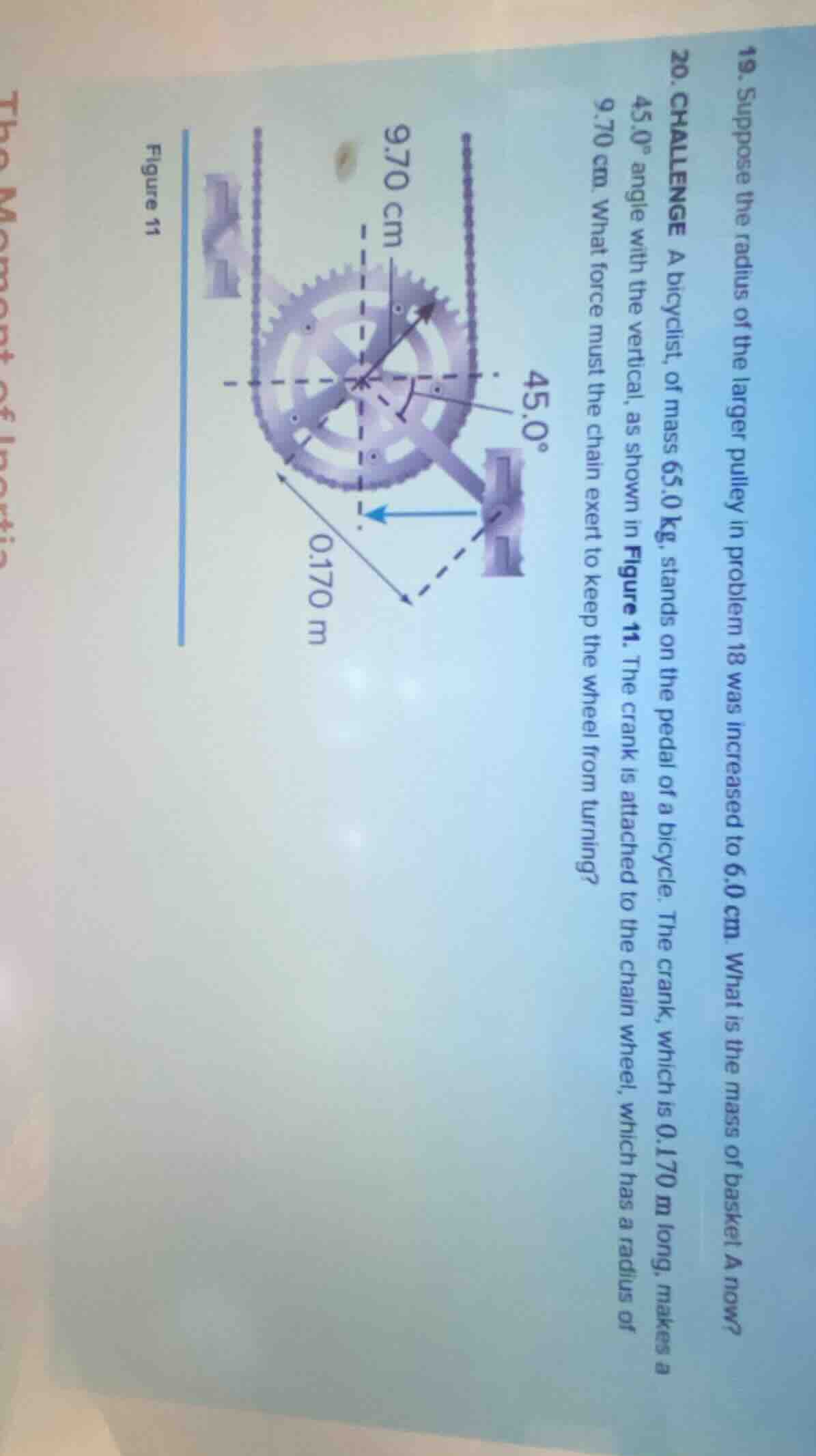
- challenge a bicyclist, of mass 65.0 kg, stands on the pedal of a bicycle. the crank, which is 0.170 m long, makes a 45.0° angle with the vertical, as shown in figure 11. the crank is attached to the chain wheel, which has a radius of 9.70 cm. what force must the chain exert to keep the wheel from turning? 19. suppose the radius of the larger pulley in problem 18 was increased to 6.0 cm. what is the mass of basket a now?
Step1: Calculate the weight of the bicyclist
The weight \( F_g \) of the bicyclist is given by \( F_g = mg \), where \( m = 65.0 \, \text{kg} \) and \( g = 9.8 \, \text{m/s}^2 \).
\( F_g = 65.0 \times 9.8 = 637 \, \text{N} \)
Step2: Determine the perpendicular distance for the bicyclist's force
The crank length is \( r = 0.170 \, \text{m} \), and the angle with the vertical is \( 45.0^\circ \). The perpendicular distance (lever arm) for the bicyclist's force about the chain - wheel center is \( d_1 = r\sin(45.0^\circ) \) (since the angle between the crank and the vertical is \( 45.0^\circ \), the component of the crank length perpendicular to the force (weight) direction is \( r\sin(45.0^\circ) \)).
\( d_1=0.170\times\sin(45.0^\circ)=0.170\times\frac{\sqrt{2}}{2}\approx0.170\times0.7071 = 0.1202 \, \text{m} \)
Step3: Determine the lever arm for the chain force
The radius of the chain - wheel is \( R = 9.70 \, \text{cm}=0.0970 \, \text{m} \). The chain force \( F \) acts tangentially to the chain - wheel, so the lever arm for the chain force about the chain - wheel center is \( d_2 = R \) (because the force is tangential, the perpendicular distance from the center to the line of action of the force is equal to the radius).
Step4: Apply the principle of moments (equilibrium)
For the wheel to be in rotational equilibrium (not turning), the moment due to the bicyclist's weight about the chain - wheel center must be equal to the moment due to the chain force about the same center.
The moment \( \tau = F\times d \). So, \( F_g\times d_1=F\times d_2 \)
We can solve for \( F \): \( F=\frac{F_g\times d_1}{d_2} \)
Substitute \( F_g = 637 \, \text{N} \), \( d_1 = 0.1202 \, \text{m} \), and \( d_2=0.0970 \, \text{m} \)
\( F=\frac{637\times0.1202}{0.0970}=\frac{76.5674}{0.0970}\approx789 \, \text{N} \)

Snap & solve any problem in the app
Get step-by-step solutions on Sovi AI
Photo-based solutions with guided steps
Explore more problems and detailed explanations
The force exerted by the chain is approximately \(\boldsymbol{789 \, \text{N}}\) (or a more precise value can be calculated as follows: if we use more precise values for \(\sin(45^\circ)\) and carry out the calculation, \(F=\frac{65\times9.8\times0.17\times\sin(45^{\circ})}{0.097}=\frac{65\times9.8\times0.17\times0.7071}{0.097}=\frac{65\times9.8\times0.1192}{0.097}=\frac{65\times1.1682}{0.097}=\frac{75.933}{0.097}\approx782.8 \, \text{N}\), and if we consider significant figures, since the given values have three significant figures, the answer is approximately \(783 \, \text{N}\) or \(7.8\times 10^{2}\, \text{N}\) or more accurately around \(780 - 790 \, \text{N}\)). The most accurate value from the calculation above (using \(g = 9.8\)) is approximately \(\boldsymbol{783 \, \text{N}}\) (or \(\boldsymbol{7.8\times10^{2}\, \text{N}}\) with two significant figures or \(\boldsymbol{780 \, \text{N}}\) with three - significant - figure approximation).