QUESTION IMAGE
Question
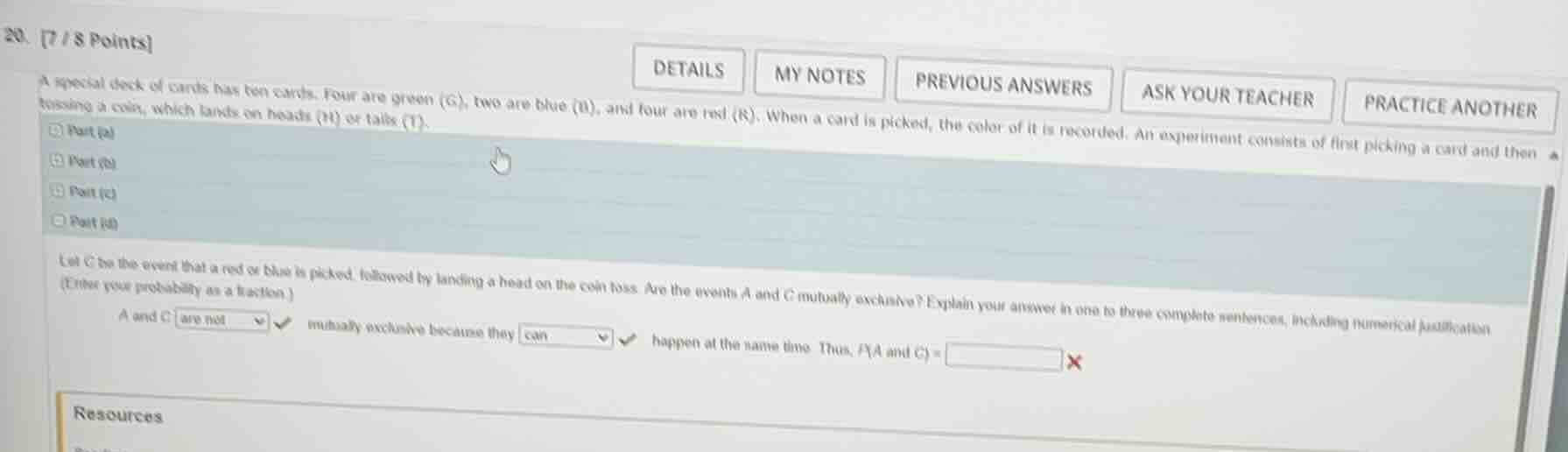
- 7 / 8 points a special deck of cards has ten cards. four are green (g), two are blue (b), and four are red (r). when a card is picked, the color of it is recorded. an experiment consists of first picking a card and then tossing a coin, which lands on heads (h) or tails (t). \\(\square\\) part (a) \\(\square\\) part (b) \\(\square\\) part (c) \\(\square\\) part (d) let c be the event that a red or blue is picked, followed by landing a head on the coin toss. are the events a and c mutually exclusive? explain your answer in one to three complete sentences, including numerical justification. (enter your probability as a fraction.) a and c \\(\boldsymbol{\text{are not}}\\) mutually exclusive because they \\(\boldsymbol{\text{can}}\\) happen at the same time. thus, \\(p(a \text{ and } c) = \square\\) \\(\boldsymbol{\times}\\)
Step1: Determine total number of cards
There are 10 cards in total (4 green + 2 blue + 4 red).
Step2: Find number of red or blue cards
Number of red (R) or blue (B) cards: \(4 + 2 = 6\).
Step3: Probability of picking red/blue and getting head
The probability of picking a red or blue card is \(\frac{6}{10}\), and the probability of getting a head (H) on the coin toss is \(\frac{1}{2}\). Since the card pick and coin toss are independent, \(P(A\cap C)=P(\text{red or blue}) \times P(\text{head})\).
So, \(P(A\cap C)=\frac{6}{10} \times \frac{1}{2}=\frac{6}{20}=\frac{3}{10}\) (simplifying the fraction: divide numerator and denominator by 2).

Snap & solve any problem in the app
Get step-by-step solutions on Sovi AI
Photo-based solutions with guided steps
Explore more problems and detailed explanations
\(\frac{3}{10}\)