QUESTION IMAGE
Question
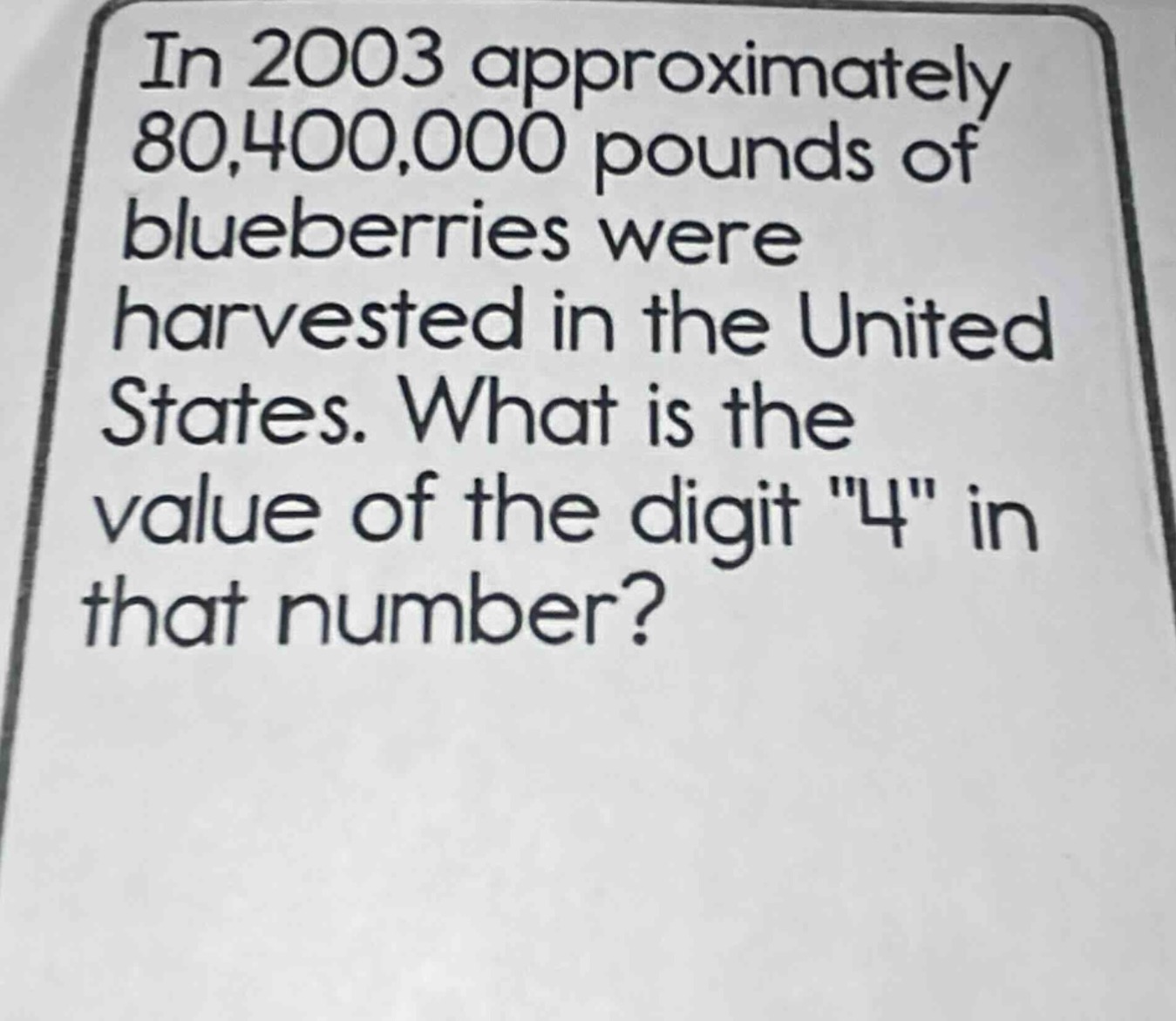
in 2003 approximately 80,400,000 pounds of blueberries were harvested in the united states. what is the value of the digit \4\ in that number?
Step1: Identify the place of digit 4
In the number \( 80,400,000 \), we start from the right and count the place values. The digits are (from right to left, starting at 0 for the rightmost digit):
- Digit 0: \( 10^0 = 1 \) (units place)
- Digit 0: \( 10^1 = 10 \) (tens place)
- Digit 0: \( 10^2 = 100 \) (hundreds place)
- Digit 0: \( 10^3 = 1000 \) (thousands place)
- Digit 0: \( 10^4 = 10000 \) (ten - thousands place)
- Digit 0: \( 10^5 = 100000 \) (hundred - thousands place)
- Digit 4: \( 10^6 = 1000000 \) (millions place? Wait, no. Wait, let's write the number in expanded form. \( 80,400,000=8\times10^7 + 0\times10^6+4\times10^6?\) Wait, no. Wait, \( 80,400,000\): Let's separate the number by commas. In the US numbering system, commas are placed after every 3 digits from the right. So \( 80,400,000\) is 80 million 400 thousand? Wait, no. Wait, \( 80,400,000 = 8\times10^7+0\times10^6 + 4\times10^6+0\times10^5+0\times10^4+0\times10^3+0\times10^2+0\times10^1+0\times10^0\)? No, that's wrong. Wait, let's count the positions correctly. The right - most digit is the ones place (\(10^0\)), then tens (\(10^1\)), hundreds (\(10^2\)), thousands (\(10^3\)), ten - thousands (\(10^4\)), hundred - thousands (\(10^5\)), millions (\(10^6\)), ten - millions (\(10^7\)), hundred - millions (\(10^8\)).
Wait, \( 80,400,000\): Let's write it as \( 8\times10^7+0\times10^6 + 4\times10^6+0\times10^5+0\times10^4+0\times10^3+0\times10^2+0\times10^1+0\times10^0\)? No, that's incorrect. Wait, the number is 80 million 400 thousand? Wait, \( 80,400,000=80\times10^6 + 400\times10^3\). Wait, no. Let's count the digits from the right. The digit 4 is in the 7th position from the right? Wait, no. Let's write the number as \( 8\ 0\ 4\ 0\ 0\ 0\ 0\ 0\) (from left to right). Wait, the left - most digit is 8 (ten - millions place, \(10^7\)), then 0 (millions place, \(10^6\)), then 4 (hundred - thousands place? No, wait, \(10^6\) is 1,000,000 (million), \(10^5\) is 100,000 (hundred - thousand), \(10^4\) is 10,000 (ten - thousand), \(10^3\) is 1,000 (thousand), \(10^2\) is 100 (hundred), \(10^1\) is 10 (ten), \(10^0\) is 1 (one).
Wait, \( 80,400,000\): Let's break it down:
- \(8\times10^7=80,000,000\)
- \(0\times10^6 = 0\)
- \(4\times10^6=4,000,000\)? No, that can't be. Wait, no. Wait, the number is 80,400,000. So the digits are:
Position (from right, starting at 0):
- Position 0: 0 (ones)
- Position 1: 0 (tens)
- Position 2: 0 (hundreds)
- Position 3: 0 (thousands)
- Position 4: 0 (ten - thousands)
- Position 5: 0 (hundred - thousands)
- Position 6: 4 (millions? No, \(10^6 = 1,000,000\). Wait, \(4\times10^6=4,000,000\), but \(80,400,000 - 80,000,000=400,000\). Oh! I made a mistake. Wait, \(80,400,000 = 80\times1,000,000+400\times1,000\). So \(80\times1,000,000 = 80,000,000\) and \(400\times1,000 = 400,000\). So the digit 4 is in the hundred - thousands place? Wait, no. Wait, \(1,000,000\) is 7 digits, \(100,000\) is 6 digits. Wait, let's write the number with place values:
- Ten - millions place: 8 (value \(8\times10,000,000 = 80,000,000\))
- Millions place: 0 (value \(0\times1,000,000=0\))
- Hundred - thousands place: 4 (value \(4\times100,000 = 400,000\))
- Ten - thousands place: 0 (value \(0\times10,000 = 0\))
- Thousands place: 0 (value \(0\times1,000 = 0\))
- Hundreds place: 0 (value \(0\times100 = 0\))
- Tens place: 0 (value \(0\times10 = 0\))
- Ones place: 0 (value \(0\times1 = 0\))
Ah! So the digit 4 is in the hundred - thousands place, and its value is \(4\times100,000=400,000\).
Step2: Calculate the value of digit 4
Since the digit 4 is in the hundr…

Snap & solve any problem in the app
Get step-by-step solutions on Sovi AI
Photo-based solutions with guided steps
Explore more problems and detailed explanations
\(400,000\)