QUESTION IMAGE
Question
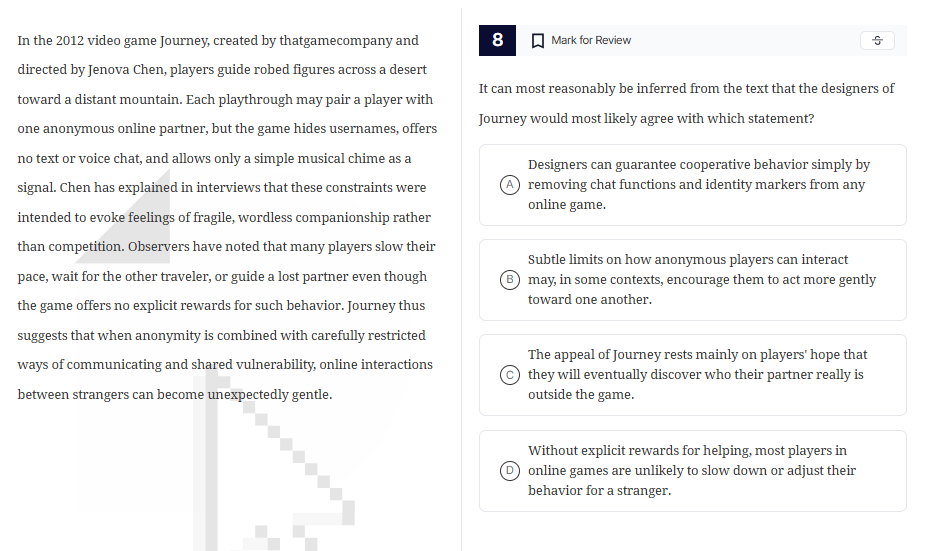
in the 2012 video game journey, created by thatgamecompany and directed by jenova chen, players guide robed figures across a desert toward a distant mountain. each playthrough may pair a player with one anonymous online partner, but the game hides usernames, offers no text or voice chat, and allows only a simple musical chime as a signal. chen has explained in interviews that these constraints were intended to evoke feelings of fragile, wordless companionship rather than competition. observers have noted that many players slow their pace, wait for the other traveler, or guide a lost partner even though the game offers no explicit rewards for such behavior. journey thus suggests that when anonymity is combined with carefully restricted ways of communicating and shared vulnerability, online interactions between strangers can become unexpectedly gentle.
8
it can most reasonably be inferred from the text that the designers of journey would most likely agree with which statement?
a designers can guarantee cooperative behavior simply by removing chat functions and identity markers from any online game.
b subtle limits on how anonymous players can interact may, in some contexts, encourage them to act more gently toward one another.
c the appeal of journey rests mainly on players hope that they will eventually discover who their partner really is outside the game.
d without explicit rewards for helping, most players in online games are unlikely to slow down or adjust their behavior for a stranger.
- For option A: The text says the constraints in "Journey" were to evoke a certain feeling, not that removing chat/identity markers in any game guarantees cooperative behavior. The "any game" is too broad, so A is incorrect.
- For option B: In "Journey", with anonymous players and restricted interaction (no chat, only a chime, hidden usernames), players acted gently (slowed pace, waited, guided). So the subtle limits on interaction encouraged gentle behavior, which matches B.
- For option C: The text focuses on the interaction and gentle behavior, not on players hoping to discover their partner's real identity. So C is incorrect.
- For option D: The text shows that in "Journey" (without explicit rewards), players still helped, so D's claim that most players wouldn't adjust behavior is wrong.

Snap & solve any problem in the app
Get step-by-step solutions on Sovi AI
Photo-based solutions with guided steps
Explore more problems and detailed explanations
B. Subtle limits on how anonymous players can interact may, in some contexts, encourage them to act more gently toward one another.