QUESTION IMAGE
Question
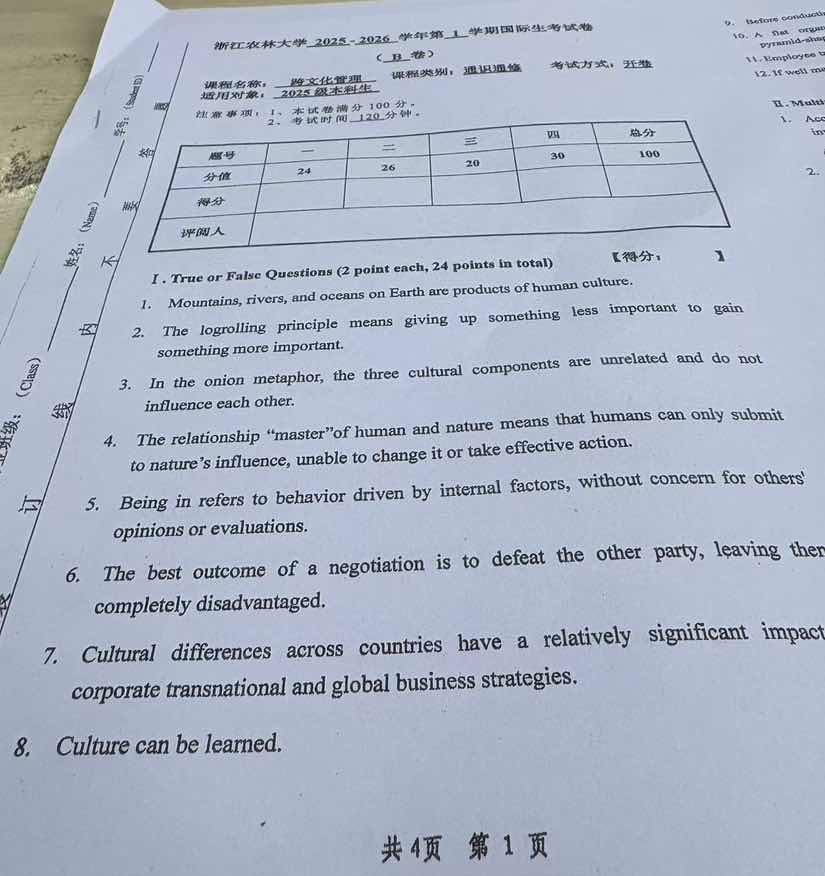
浙江农林大学 2025 - 2026 学年第 1 学期国际生考试卷(b卷)
课程名称:跨文化管理 课程类别:通识通修 考核方式:开卷
适用对象:2025级本科生
注意事项:1. 本试卷满分100分。2. 考试时间120分钟。
题号 一 二 三 四 总分
分值 24 26 20 30 100
得分
评阅人
ⅰ. true or false questions (2 point each, 24 points in total) 【得分: 】
- mountains, rivers, and oceans on earth are products of human culture.
- the logrolling principle means giving up something less important to gain something more important.
- in the onion metaphor, the three cultural components are unrelated and do not influence each other.
- the relationship \master\of human and nature means that humans can only submit to natures influence, unable to change it or take effective action.
- being in refers to behavior driven by internal factors, without concern for others opinions or evaluations.
- the best outcome of a negotiation is to defeat the other party, leaving them completely disadvantaged.
- cultural differences across countries have a relatively significant impact on corporate transnational and global business strategies.
- culture can be learned.
共4页 第1页
To solve these True or False questions related to cross - cultural management, we analyze each one based on cross - cultural management concepts:
Question 1
Mountains, rivers, and oceans are natural geographical features, not products of human culture. So the answer is False.
Question 2
The logrolling principle in negotiation (which is relevant in cross - cultural business negotiations too) is about trading concessions, where one gives up something less important to gain something more important. So the answer is True.
Question 3
In the onion metaphor of culture, the three cultural components (like values, norms, and behaviors) are interrelated and influence each other. So the statement that they are unrelated is wrong, and the answer is False.
Question 4
The "master - slave" view of human - nature relationship (where humans only submit to nature) is an outdated and incorrect view. In modern views, humans can interact with and change nature to some extent. So the answer is False.
Question 5
"Being in" behavior (driven by internal factors, without caring about others' opinions) is a concept in cross - cultural behavior analysis. This statement correctly defines it. So the answer is True.
Question 6
The best outcome of a negotiation, especially in cross - cultural contexts, is a win - win situation, not defeating the other party. So the statement is wrong, and the answer is False.
Question 7
Cultural differences between countries do have a significant impact on corporate transnational and global business strategies, as different cultures affect consumer behavior, business practices, etc. So the answer is True.
Question 8
Culture is learned through socialization, education, and interaction. So the statement that culture can be learned is correct, and the answer is True.

Snap & solve any problem in the app
Get step-by-step solutions on Sovi AI
Photo-based solutions with guided steps
Explore more problems and detailed explanations
s:
- False
- True
- False
- False
- True
- False
- True
- True