QUESTION IMAGE
Question
1/21 & 1/23 assignment
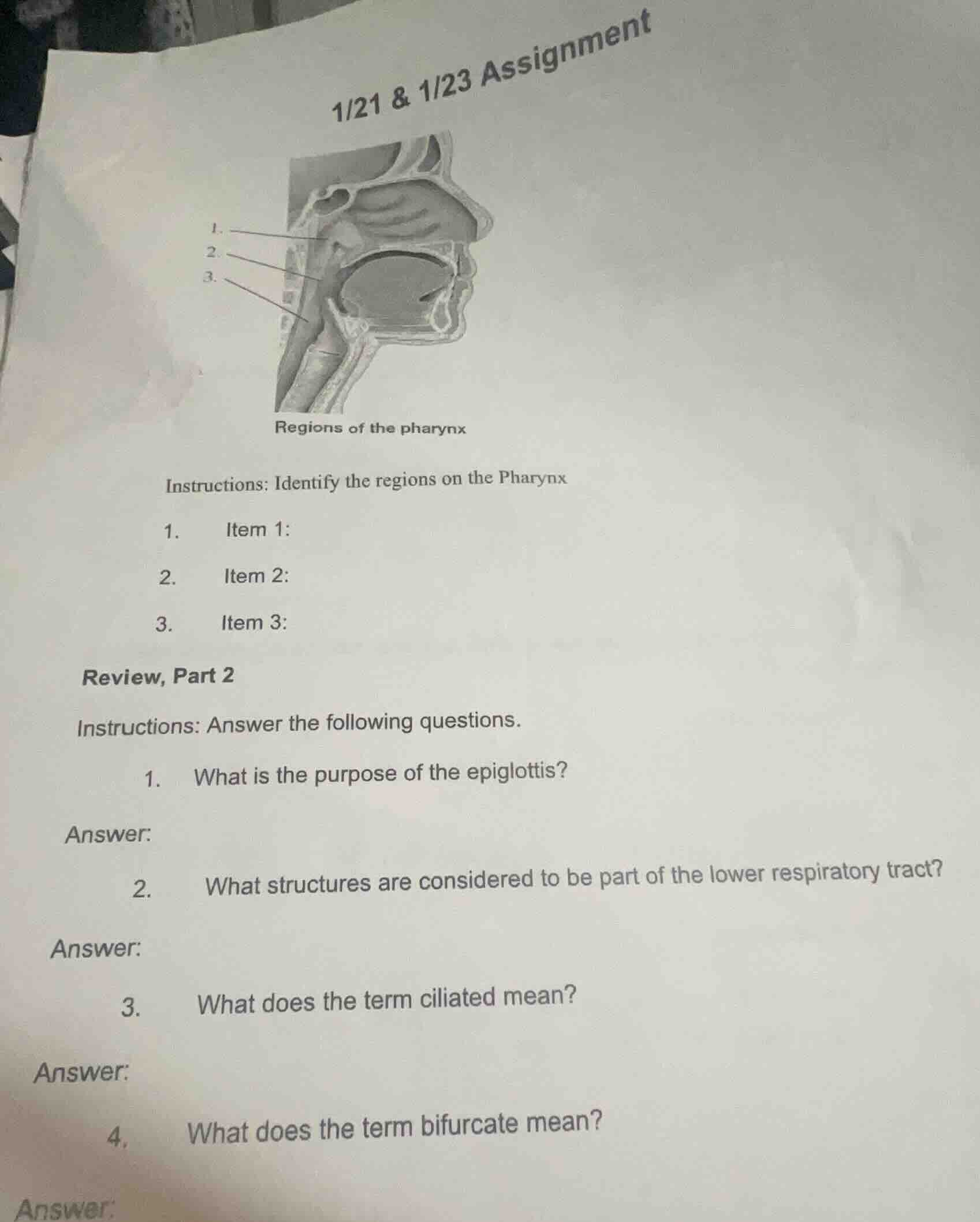
regions of the pharynx
instructions: identify the regions on the pharynx
- item 1:
- item 2:
- item 3:
review, part 2
instructions: answer the following questions.
- what is the purpose of the epiglottis?
answer:
- what structures are considered to be part of the lower respiratory tract?
answer:
- what does the term ciliated mean?
answer:
- what does the term bifurcate mean?
answer:
Brief Explanations
Pharynx Identification:
- The uppermost region of the pharynx, behind the nasal cavity, is the nasopharynx.
- The middle region, behind the oral cavity, is the oropharynx.
- The lowermost region, behind the larynx, is the laryngopharynx.
Review Part 2:
- The epiglottis is a flap of tissue that closes over the trachea during swallowing to prevent food/liquid from entering the airway.
- The lower respiratory tract includes structures below the larynx, responsible for gas exchange and air conduction deeper in the lungs.
- "Ciliated" describes cells or structures covered in hair-like projections called cilia, which move to transport substances.
- "Bifurcate" refers to the act of splitting or dividing into two branches or parts.

Snap & solve any problem in the app
Get step-by-step solutions on Sovi AI
Photo-based solutions with guided steps
Explore more problems and detailed explanations
Pharynx Regions:
- Item 1: Nasopharynx
- Item 2: Oropharynx
- Item 3: Laryngopharynx
Review Part 2:
- It closes over the trachea during swallowing to prevent food and liquid from entering the respiratory airway, directing them to the esophagus instead.
- Trachea (windpipe), bronchi, bronchioles, and alveoli (and the lungs themselves)
- Having hair-like, motile projections called cilia (typically referring to epithelial cells) that help move mucus or other substances across a surface.
- To split or divide into two separate branches or parts.