QUESTION IMAGE
Question
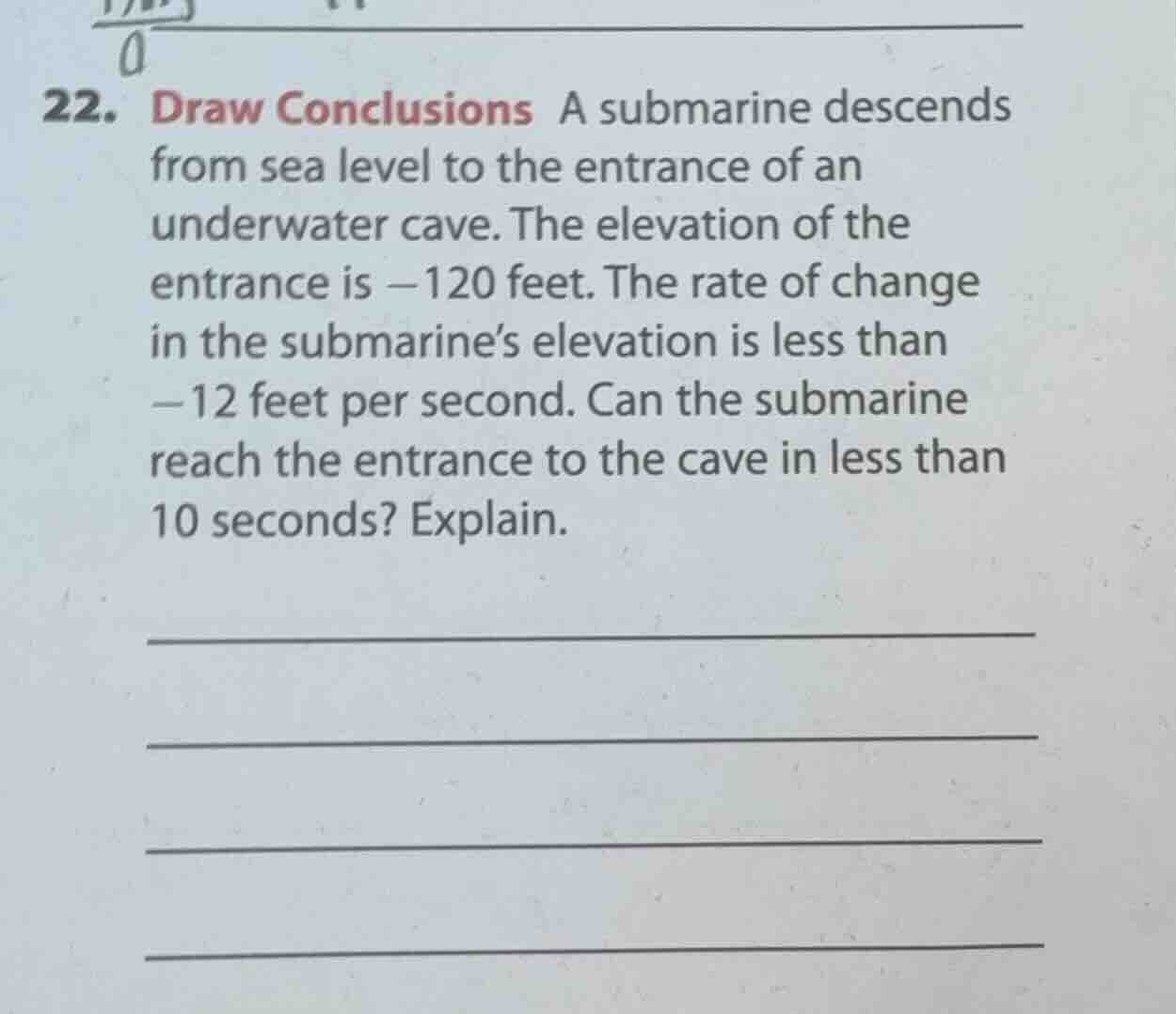
- draw conclusions a submarine descends from sea level to the entrance of an underwater cave. the elevation of the entrance is -120 feet. the rate of change in the submarine’s elevation is less than -12 feet per second. can the submarine reach the entrance to the cave in less than 10 seconds? explain.
Step1: Define variables and inequality
Let $r$ = rate of elevation change (ft/s), $t$ = time (s). We know $r < -12$, and total elevation change needed is $-120$ ft. The relationship is $r \times t = -120$, so $t = \frac{-120}{r}$.
Step2: Substitute the rate constraint
Since $r < -12$, take reciprocals (reverse inequality): $\frac{1}{r} > -\frac{1}{12}$. Multiply both sides by $-120$ (reverse inequality again):
$$t = \frac{-120}{r} < \frac{-120}{-12}$$
Step3: Calculate the threshold time
$$\frac{-120}{-12} = 10$$
So $t < 10$.

Snap & solve any problem in the app
Get step-by-step solutions on Sovi AI
Photo-based solutions with guided steps
Explore more problems and detailed explanations
Yes, the submarine can reach the cave entrance in less than 10 seconds. Since its descent rate is faster than -12 feet per second (more negative), the time required to descend 120 feet will be less than the 10 seconds it would take at exactly -12 feet per second.