QUESTION IMAGE
Question
- find the perimeter of the parallelogram.
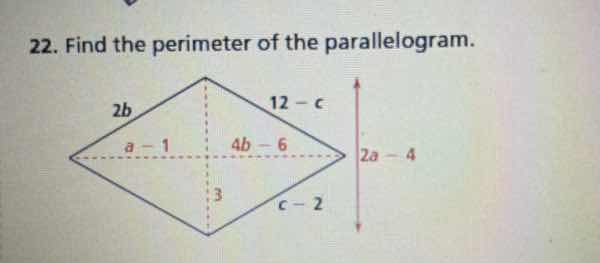
the parallelogram (a rhombus) has sides labeled 2b, 12 - c, and diagonals with segments a - 1, 4b - 6, 3, c - 2, and the vertical diagonal is 2a - 4
Step1: Solve for \(a\) using the vertical diagonal
The vertical diagonal is given by \(2a - 4\) and also as the sum of \(3\) and \(4b - 6\)? Wait, no, looking at the rhombus (a type of parallelogram, specifically a rhombus here since all sides are equal as it's a rhombus with diagonals), the vertical diagonal is \(2a - 4\), and also, the vertical segments are \(3\) and \(4b - 6\)? Wait, no, maybe the vertical diagonal is split into two parts: \(3\) and \(4b - 6\), so \(2a - 4=3 + 4b - 6\)? Wait, no, maybe first solve for \(a\) from the vertical diagonal. Wait, the vertical diagonal is \(2a - 4\), and also, looking at the right triangle? Wait, no, let's check the horizontal diagonal. Wait, the horizontal diagonal is split into \(a - 1\) and \(4b - 6\), and the other side? Wait, maybe first solve for \(a\) using the vertical side. Wait, the vertical diagonal is \(2a - 4\), and also, the length of the vertical diagonal can be related? Wait, maybe the vertical diagonal is equal to \(3+(4b - 6)\)? No, maybe better to solve for \(a\) first. Wait, the sides of the rhombus are \(2b\) and \(12 - c\), and also \(c - 2\). Wait, in a rhombus, all sides are equal, so \(2b=12 - c\) and \(2b=c - 2\)? Wait, no, \(2b = 12 - c\) and \(2b = c - 2\)? Wait, that would mean \(12 - c=c - 2\), so \(12 + 2=2c\), \(14 = 2c\), \(c = 7\). Then \(2b=12 - 7=5\), so \(b = 2.5\). But maybe first solve for \(a\). Wait, the horizontal diagonal is split into \(a - 1\) and \(4b - 6\), and the vertical diagonal is split into \(3\) and \(4b - 6\)? No, maybe the vertical diagonal is \(2a - 4\), and the two parts are \(3\) and \(4b - 6\), so \(2a - 4=3+(4b - 6)\)? Wait, no, let's look at the vertical diagonal: \(2a - 4\) is the total length, and it's composed of two segments: \(3\) and \(4b - 6\), so \(2a - 4=3 + 4b - 6\) → \(2a - 4=4b - 3\). But also, the horizontal diagonal: the two segments are \(a - 1\) and \(4b - 6\), so total horizontal diagonal is \((a - 1)+(4b - 6)=a + 4b - 7\). But maybe first solve for \(a\) from the vertical diagonal. Wait, maybe the vertical diagonal is equal to \(2a - 4\), and also, the length of the vertical diagonal can be found from the side? No, maybe better to solve for \(a\) using the equation \(2a - 4\) and the vertical segments. Wait, maybe I made a mistake. Let's start over.
In a rhombus, all sides are equal, so \(2b=12 - c\) and \(2b=c - 2\) (since all sides of a rhombus are equal). So set \(12 - c=c - 2\):
\(12 + 2=2c\)
\(14 = 2c\)
\(c = 7\)
Then \(2b=12 - 7=5\) → \(b = \frac{5}{2}=2.5\)
Now, look at the horizontal diagonal: the two segments are \(a - 1\) and \(4b - 6\). Substitute \(b = 2.5\):
\(4b - 6=4(2.5)-6=10 - 6=4\)
So the horizontal diagonal segments are \(a - 1\) and \(4\). Now, look at the vertical diagonal: the two segments are \(3\) and \(4b - 6=4\)? Wait, no, the vertical diagonal segments are \(3\) and \(4b - 6\)? Wait, \(4b - 6=4\), so vertical diagonal segments are \(3\) and \(4\), so total vertical diagonal is \(3 + 4=7\). But the vertical diagonal is also given by \(2a - 4\), so:
\(2a - 4=7\)
\(2a=11\)
\(a=\frac{11}{2}=5.5\)
Now, check the horizontal diagonal segments: \(a - 1=5.5 - 1=4.5\) and \(4b - 6=4\)? Wait, no, that can't be, because in a rhombus, the diagonals bisect each other, so the horizontal diagonal should be bisected, meaning \(a - 1=4b - 6\). Ah! That's the key. In a rhombus, the diagonals bisect each other, so the horizontal diagonal is split into two equal parts: \(a - 1\) and \(4b - 6\), so \(a - 1=4b - 6\)
We already found \(b = 2.5\) (from \(2b=12 - c\) and \(2b=c - 2\)), so sub…

Snap & solve any problem in the app
Get step-by-step solutions on Sovi AI
Photo-based solutions with guided steps
Explore more problems and detailed explanations
\(\boxed{20}\)