QUESTION IMAGE
Question
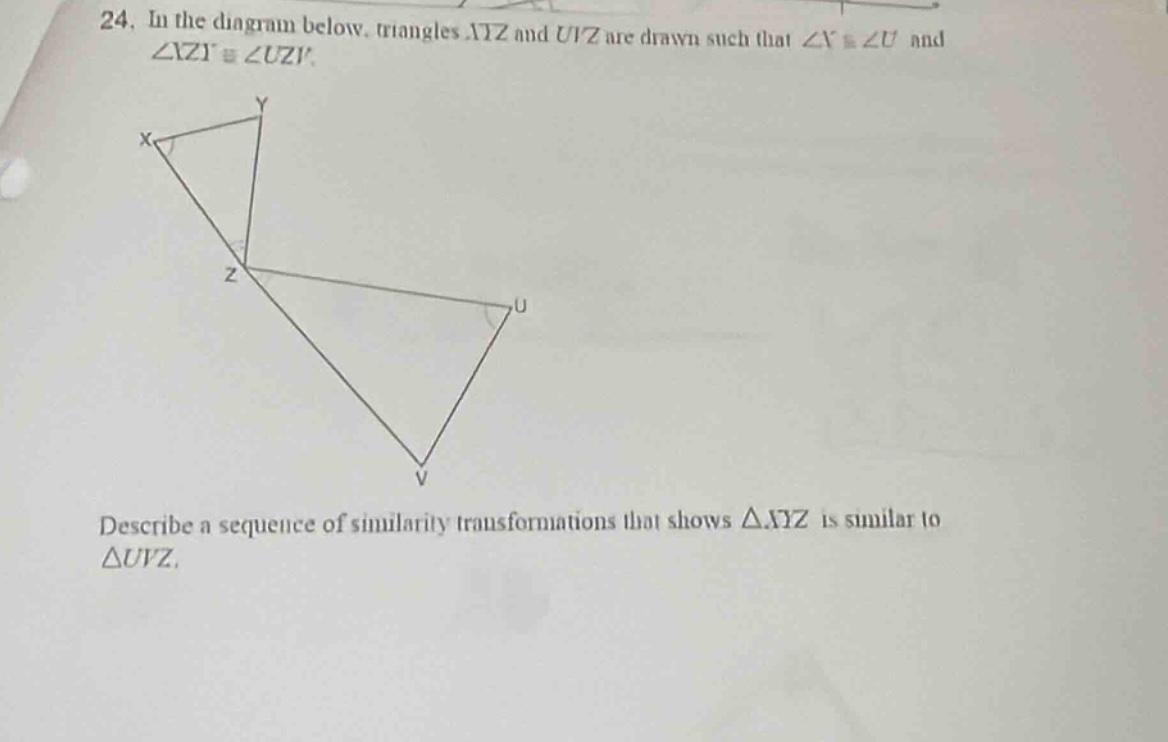
- in the diagram below, triangles xyz and uvz are drawn such that ∠y ≅ ∠u and ∠xzy ≅ ∠uvz. describe a sequence of similarity transformations that shows △xyz is similar to △uvz.
Step1: Identify Angle-Angle (AA) Similarity
We know that $\angle Y \cong \angle U$ and $\angle YZX \cong \angle UVZ$. By the AA (Angle - Angle) similarity criterion, if two angles of one triangle are congruent to two angles of another triangle, the triangles are similar. So, $\triangle XYZ \sim \triangle UVZ$ by AA similarity. Now, we need to describe a sequence of similarity transformations (rotation, reflection, translation, dilation) to map $\triangle XYZ$ to $\triangle UVZ$.
Step2: Rotation
First, we can rotate $\triangle XYZ$ about point $Z$ so that $\angle YZX$ aligns with $\angle UVZ$. The angle of rotation should be such that side $YZ$ is rotated to a position where it is in the same line (or parallel, but in this case, since the angles at $Z$ are congruent, a rotation about $Z$ will align the sides around $Z$). Let's say we rotate $\triangle XYZ$ about point $Z$ by an angle equal to the angle between $YZ$ and $VZ$ (or the angle needed to make $\angle YZX$ coincide with $\angle UVZ$). After this rotation, $\angle YZX$ and $\angle UVZ$ will be in the same position, and $\angle Y$ and $\angle U$ are already congruent.
Step3: Dilation (if needed)
After the rotation, we can perform a dilation with center at $Z$ to make the sides of $\triangle XYZ$ proportional to the sides of $\triangle UVZ$. Since the triangles are similar, there exists a scale factor $k$ such that when we dilate $\triangle XYZ$ with center $Z$ by scale factor $k$, the corresponding sides will be equal (or in proportion, but for similarity, the dilation will make the triangles congruent in shape and proportional in size, which is the definition of similar triangles). Alternatively, if the triangles are already in the correct proportion, the rotation alone (or rotation and translation) might be sufficient, but since similarity transformations include dilation, we can say: Rotate $\triangle XYZ$ about point $Z$ to align $\angle YZX$ with $\angle UVZ$, then dilate $\triangle XYZ$ with center $Z$ so that the sides are proportional to $\triangle UVZ$.

Snap & solve any problem in the app
Get step-by-step solutions on Sovi AI
Photo-based solutions with guided steps
Explore more problems and detailed explanations
One possible sequence of similarity transformations is: 1. Rotate $\triangle XYZ$ about point $Z$ such that $\angle YZX$ coincides with $\angle UVZ$ (aligning the angles at $Z$). 2. Dilate $\triangle XYZ$ with center at $Z$ by a scale factor (determined by the ratio of corresponding sides) to make $\triangle XYZ$ similar (and potentially congruent in shape with proportional sides) to $\triangle UVZ$. The key is that by the AA similarity criterion, the triangles are similar, and the rotation aligns the angles at $Z$, and dilation (or a combination of rotation and dilation) maps one triangle to the other. A more precise sequence: Rotate $\triangle XYZ$ about point $Z$ so that $\overrightarrow{ZY}$ is rotated to $\overrightarrow{ZV}$ (since $\angle YZX \cong \angle UVZ$), then dilate $\triangle XYZ$ with center $Z$ to match the size of $\triangle UVZ$ (using the ratio of sides based on the similar triangles).