QUESTION IMAGE
Question
- find gh
Step1: Identify the theorem
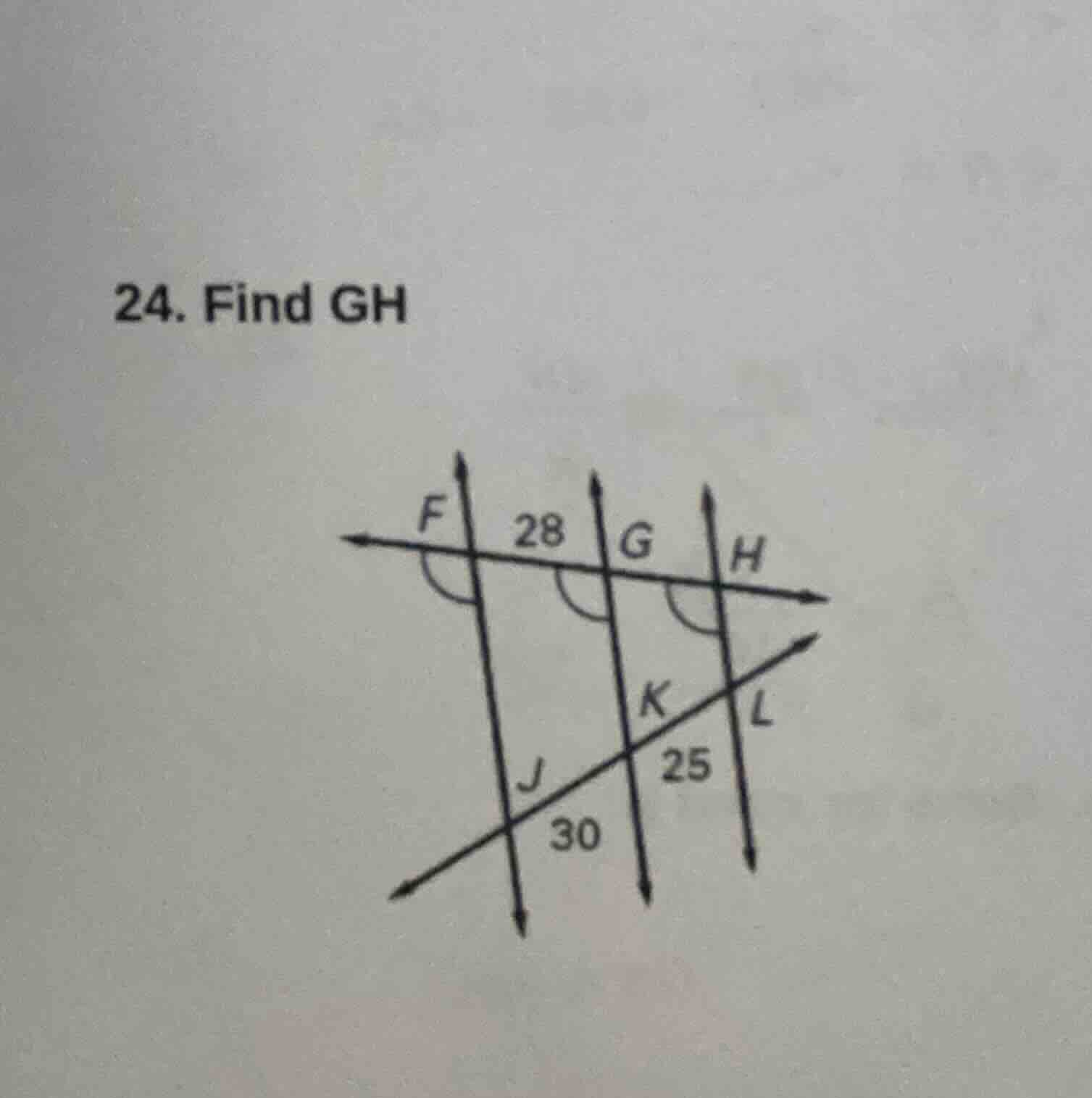
This is a problem of similar triangles or the Basic Proportionality Theorem (Thales' theorem) for parallel lines. The three vertical lines are parallel, and the transversal lines are the horizontal line and the slant line. So, the segments created on one transversal are proportional to the segments created on the other transversal.
Let \( FG = 28 \), \( JK = 30 \), \( KL = 25 \), and we need to find \( GH \).
By the Basic Proportionality Theorem, \(\frac{FG}{GH}=\frac{JK}{KL}\)
Step2: Substitute the values
We know \( FG = 28 \), \( JK = 30 \), \( KL = 25 \). Substituting these values into the proportion \(\frac{28}{GH}=\frac{30}{25}\)
Step3: Solve for \( GH \)
Cross - multiply: \( 30\times GH=28\times25 \)
First, calculate \( 28\times25 = 700 \)
Then, \( GH=\frac{700}{30}=\frac{70}{3}\approx23.33 \)? Wait, no, maybe I mixed up the segments. Wait, the correct proportion should be based on the corresponding segments. Let's re - examine the diagram. The three vertical lines are parallel, so the ratio of the lengths of the segments on the horizontal transversal (FG and GH) should be equal to the ratio of the lengths of the segments on the slant transversal (JK and KL). Wait, actually, the correct proportion is \(\frac{FG}{GH}=\frac{JK}{KL}\) is wrong. The correct proportion is \(\frac{FG}{GH}=\frac{JK}{KL}\) only if the lines are cut by the transversals in the same order. Wait, maybe the correct proportion is \(\frac{FG}{GH}=\frac{JK}{KL}\) is incorrect. Let's do it again. Let's denote \( FG = 28 \), \( JK = 30 \), \( KL = 25 \). The correct proportion for parallel lines cut by transversals is \(\frac{FG}{GH}=\frac{JK}{KL}\) is not correct. Wait, actually, the formula is \(\frac{FG}{GH}=\frac{JK}{KL}\) when the lines are parallel. Wait, cross - multiplying: \( 30\times GH = 28\times25\), \( GH=\frac{28\times25}{30}=\frac{700}{30}=\frac{70}{3}\approx23.33 \). But that seems odd. Wait, maybe the segments are \( FJ \) and \( KL \)? No, the diagram shows \( FG = 28 \), \( JK = 30 \), \( KL = 25 \). Wait, perhaps the correct proportion is \(\frac{FG}{GH}=\frac{JK}{KL}\) is wrong. Let's use the formula for parallel lines: if three or more parallel lines cut two transversals, then they divide the transversals proportionally. So, the length of the segment on the first transversal between the first and second parallel line over the length of the segment on the first transversal between the second and third parallel line is equal to the length of the segment on the second transversal between the first and second parallel line over the length of the segment on the second transversal between the second and third parallel line. So, \( \frac{FG}{GH}=\frac{JK}{KL} \) is correct. So, \( \frac{28}{GH}=\frac{30}{25} \), \( GH=\frac{28\times25}{30}=\frac{700}{30}=\frac{70}{3}\approx23.33 \). Wait, but maybe I have the segments reversed. Let's assume that the proportion is \(\frac{FG}{GH}=\frac{KL}{JK}\), then \( \frac{28}{GH}=\frac{25}{30} \), \( GH=\frac{28\times30}{25}=\frac{840}{25}=\frac{168}{5} = 33.6 \). No, that also seems odd. Wait, maybe the correct proportion is \(\frac{FG}{FH}=\frac{JK}{JL}\), where \( FH=FG + GH \) and \( JL=JK + KL=30 + 25 = 55 \). Then \(\frac{28}{28 + GH}=\frac{30}{55}\). Cross - multiply: \( 28\times55=30\times(28 + GH) \)
\( 1540=840+30GH \)
Subtract 840 from both sides: \( 30GH=1540 - 840=700 \)
\( GH=\frac{700}{30}=\frac{70}{3}\approx23.33 \). Wait, this is the same as before. But maybe the diagram is such that the three vertical lines are parallel, and the two transversals are the ho…

Snap & solve any problem in the app
Get step-by-step solutions on Sovi AI
Photo-based solutions with guided steps
Explore more problems and detailed explanations
\(\frac{70}{3}\) (or approximately \(23.33\))