QUESTION IMAGE
Question
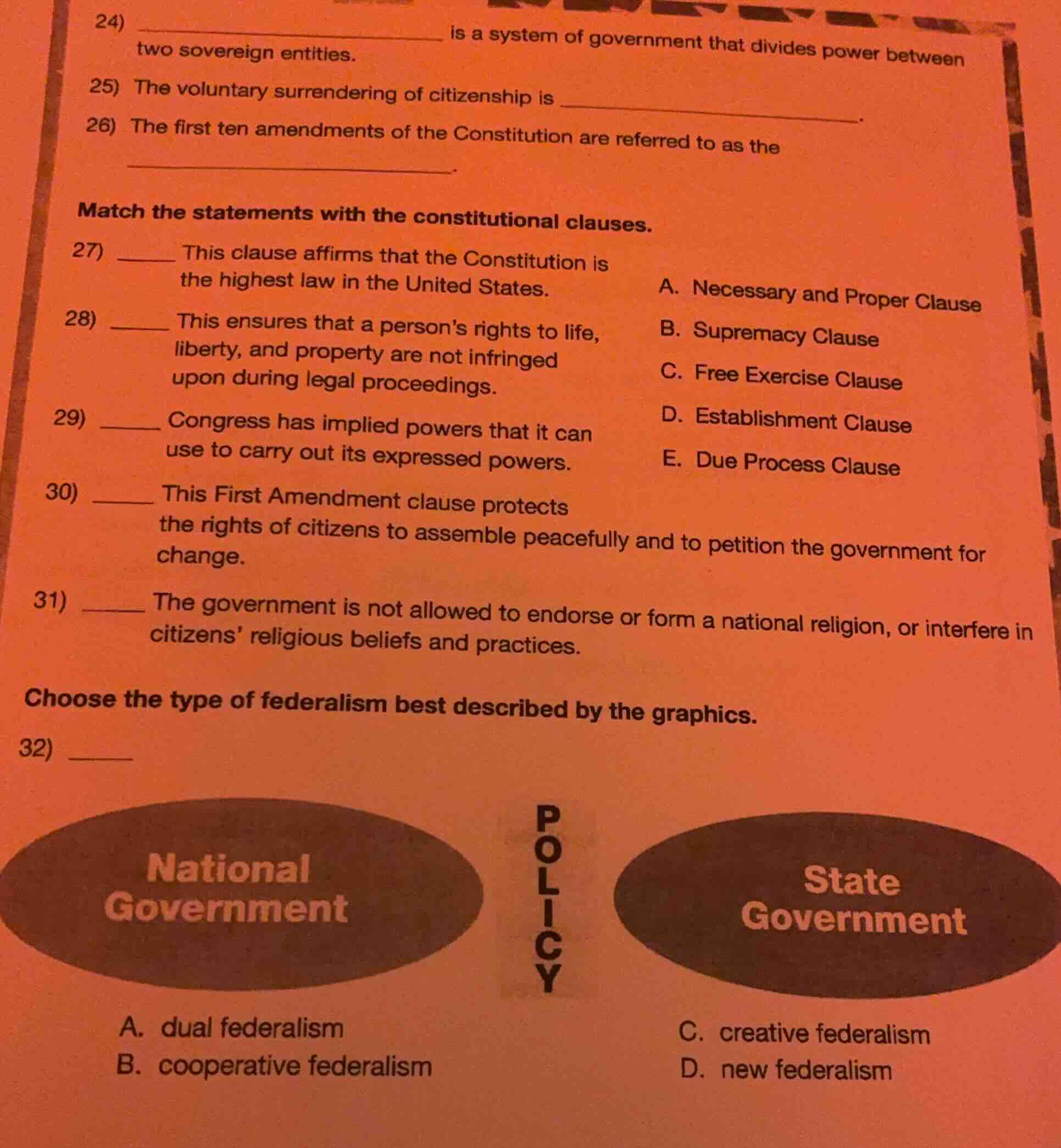
- ___________________ is a system of government that divides power between two sovereign entities.
- the voluntary surrendering of citizenship is __________________.
- the first ten amendments of the constitution are referred to as the __________________.
match the statements with the constitutional clauses.
- ____ this clause affirms that the constitution is the highest law in the united states. a. necessary and proper clause
- ____ this ensures that a person’s rights to life, liberty, and property are not infringed upon during legal proceedings. b. supremacy clause
- ____ congress has implied powers that it can use to carry out its expressed powers. c. free exercise clause
- ____ this first amendment clause protects the rights of citizens to assemble peacefully and to petition the government for change. d. establishment clause
- ____ the government is not allowed to endorse or form a national religion, or interfere in citizens’ religious beliefs and practices. e. due process clause
choose the type of federalism best described by the graphics.
- ____
graphics: two ovals labeled
ational government\ and \state government\ with \policy\ between them
a. dual federalism c. creative federalism
b. cooperative federalism d. new federalism
Brief Explanations
- Defined as power split between two sovereign bodies.
- Term for intentional citizenship renunciation.
- Standard name for the first 10 U.S. Constitution amendments.
- Clause establishing Constitution as supreme U.S. law.
- Clause protecting life/liberty/property in legal processes.
- Clause granting Congress implied powers for expressed duties.
- First Amendment right for assembly and petition.
- Combines two First Amendment religious clauses.
- Graphic shows separate, distinct national/state policy spheres.

Snap & solve any problem in the app
Get step-by-step solutions on Sovi AI
Photo-based solutions with guided steps
Explore more problems and detailed explanations
- Federalism
- Expatriation
- Bill of Rights
- B. Supremacy Clause
- E. Due Process Clause
- A. Necessary and Proper Clause
- (Note: This matches the Assembly and Petition Clause, not listed in options; if forced to select from given, no direct match, but standard answer is Assembly and Petition Clause)
- Combines D. Establishment Clause and C. Free Exercise Clause
- A. dual federalism