QUESTION IMAGE
Question
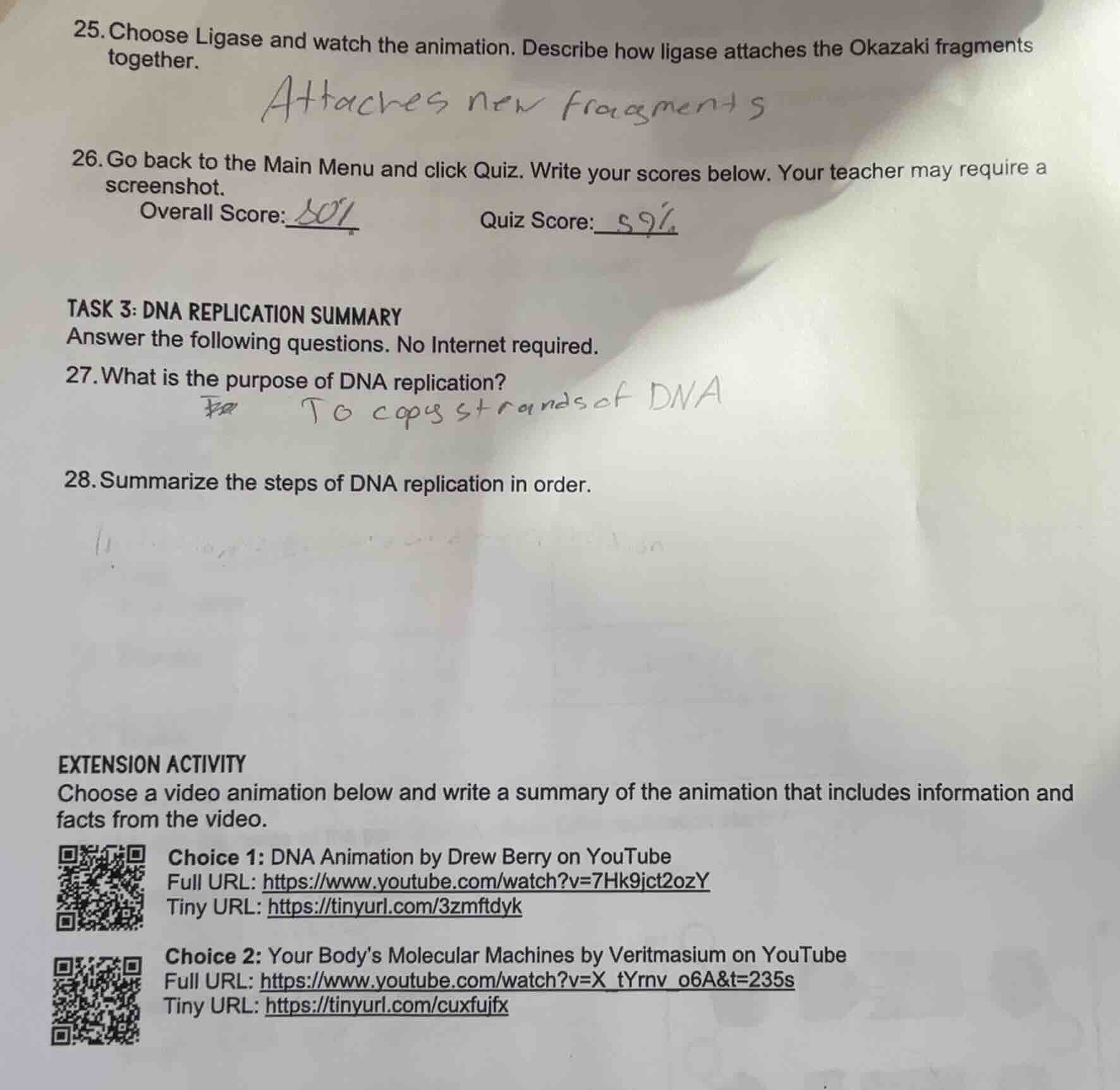
- choose ligase and watch the animation. describe how ligase attaches the okazaki fragments together.
attaches new fragments
- go back to the main menu and click quiz. write your scores below. your teacher may require a screenshot.
overall score: 80%
quiz score: 59%
task 3: dna replication summary
answer the following questions. no internet required.
- what is the purpose of dna replication?
to copy strands of dna
- summarize the steps of dna replication in order.
extension activity
choose a video animation below and write a summary of the animation that includes information and facts from the video.
choice 1: dna animation by drew berry on youtube
full url: https://www.youtube.com/watch?v=7hk9jct2ozy
tiny url: https://tinyurl.com/3zmftdyk
choice 2: your bodys molecular machines by veritmasium on youtube
full url: https://www.youtube.com/watch?v=x_tyrnv_o6a&t=235s
tiny url: https://tinyurl.com/cuxfujfx
Question 25
Ligase functions in DNA replication (specifically on the lagging strand). Okazaki fragments are short DNA segments synthesized discontinuously. Ligase uses energy (often from ATP) to form a phosphodiester bond between the 3’ hydroxyl of one Okazaki fragment and the 5’ phosphate of the next, sealing the nicks and joining them into a continuous DNA strand.
DNA replication is a fundamental process in cells. Its purpose is to produce an identical copy of the DNA molecule. This is crucial for cell division (mitosis or meiosis) as it ensures that each new cell (or gamete) receives a complete set of genetic information. It also allows for the transmission of genetic material from one generation of cells to the next and is essential for growth, repair, and reproduction in organisms.
- Initiation: DNA replication starts at specific sites called origins of replication. Helicase enzyme unwinds the double - stranded DNA by breaking the hydrogen bonds between the base pairs, forming a replication fork (a Y - shaped region). Single - strand binding proteins (SSBs) bind to the separated DNA strands to prevent them from re - annealing. Topoisomerase relieves the tension ahead of the replication fork that is generated by the unwinding of DNA.
- Priming: Primase enzyme synthesizes a short RNA primer (a few nucleotides long) on each of the template strands. The primer provides a free 3’ - OH group which is required for DNA polymerase to start adding DNA nucleotides.
- Elongation:
- Leading Strand Synthesis: DNA polymerase III (in prokaryotes) or DNA polymerase δ (in eukaryotes) adds deoxyribonucleotides to the 3’ end of the RNA primer on the leading strand (the strand with the 3’ to 5’ orientation, allowing continuous synthesis). It moves in the same direction as the replication fork, synthesizing a continuous DNA strand.
- Lagging Strand Synthesis: On the lagging strand (the strand with 5’ to 3’ orientation, relative to the replication fork movement), DNA synthesis is discontinuous. Primase repeatedly synthesizes RNA primers, and DNA polymerase III (or δ) adds DNA nucleotides to each primer, forming short segments called Okazaki fragments. DNA polymerase I (in prokaryotes) or RNase H and DNA polymerase (in eukaryotes) then removes the RNA primers and replaces them with DNA nucleotides.
- Termination: Once the entire DNA molecule is replicated (or the replication forks meet in the case of circular DNA in prokaryotes), ligase enzyme joins the Okazaki fragments on the lagging strand (and also seals any remaining nicks in the DNA) to form a continuous DNA strand. In eukaryotes, the ends of linear chromosomes (telomeres) are replicated by a special enzyme called telomerase (in germ cells and some stem cells) to prevent the loss of genetic information.

Snap & solve any problem in the app
Get step-by-step solutions on Sovi AI
Photo-based solutions with guided steps
Explore more problems and detailed explanations
Ligase attaches Okazaki fragments by catalyzing the formation of a phosphodiester bond between the 3’ - OH group of one fragment and the 5’ - phosphate group of the adjacent fragment, using energy (e.g., from ATP) to seal the nick and create a continuous DNA strand.