QUESTION IMAGE
Question
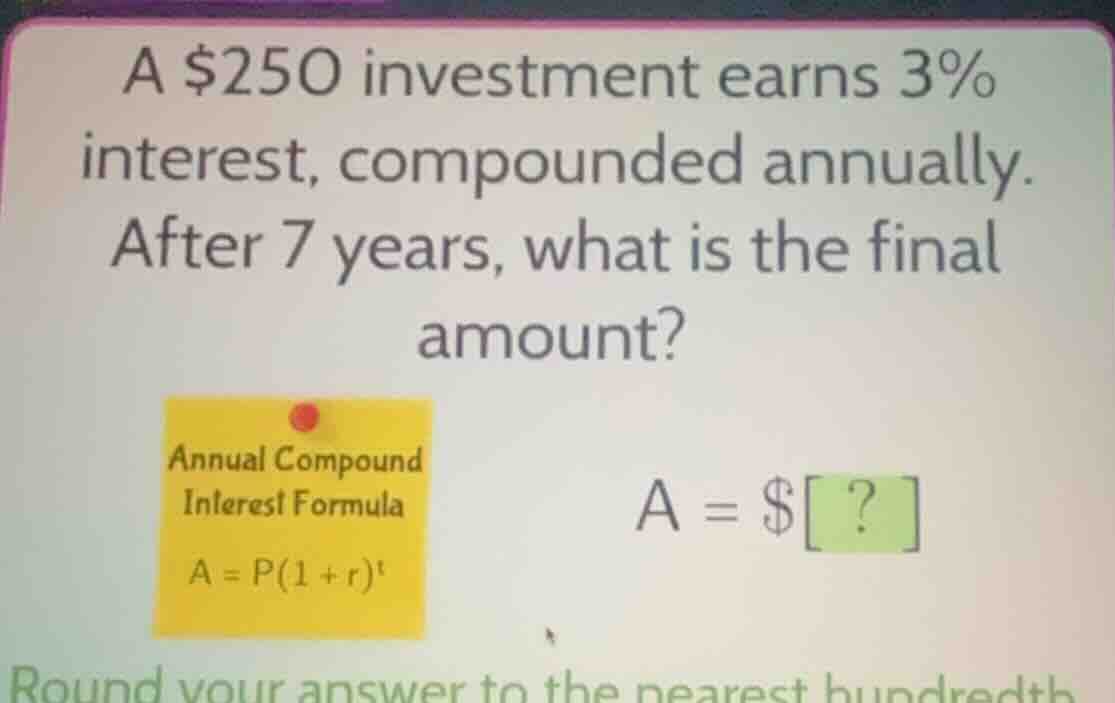
a $250 investment earns 3% interest, compounded annually. after 7 years, what is the final amount?
annual compound interest formula
a = p(1 + r)^t
a = $?
round your answer to the nearest hundredth
Step1: Identify the values
We know that the principal amount \( P = 250 \), the annual interest rate \( r = 3\%=0.03 \), and the time \( t = 7 \) years. The formula for annual compound interest is \( A = P(1 + r)^t \).
Step2: Substitute the values into the formula
Substitute \( P = 250 \), \( r = 0.03 \), and \( t = 7 \) into the formula:
\( A=250\times(1 + 0.03)^{7} \)
Step3: Calculate \( (1 + 0.03)^{7} \)
First, calculate \( 1+0.03 = 1.03 \). Then, \( 1.03^{7}\approx1.22987661 \) (using a calculator to find the 7 - th power of 1.03).
Step4: Calculate the final amount \( A \)
Multiply 250 by 1.22987661:
\( A = 250\times1.22987661=307.4691525 \)
Step5: Round to the nearest hundredth
Rounding 307.4691525 to the nearest hundredth gives 307.47.

Snap & solve any problem in the app
Get step-by-step solutions on Sovi AI
Photo-based solutions with guided steps
Explore more problems and detailed explanations
\( 307.47 \)