QUESTION IMAGE
Question
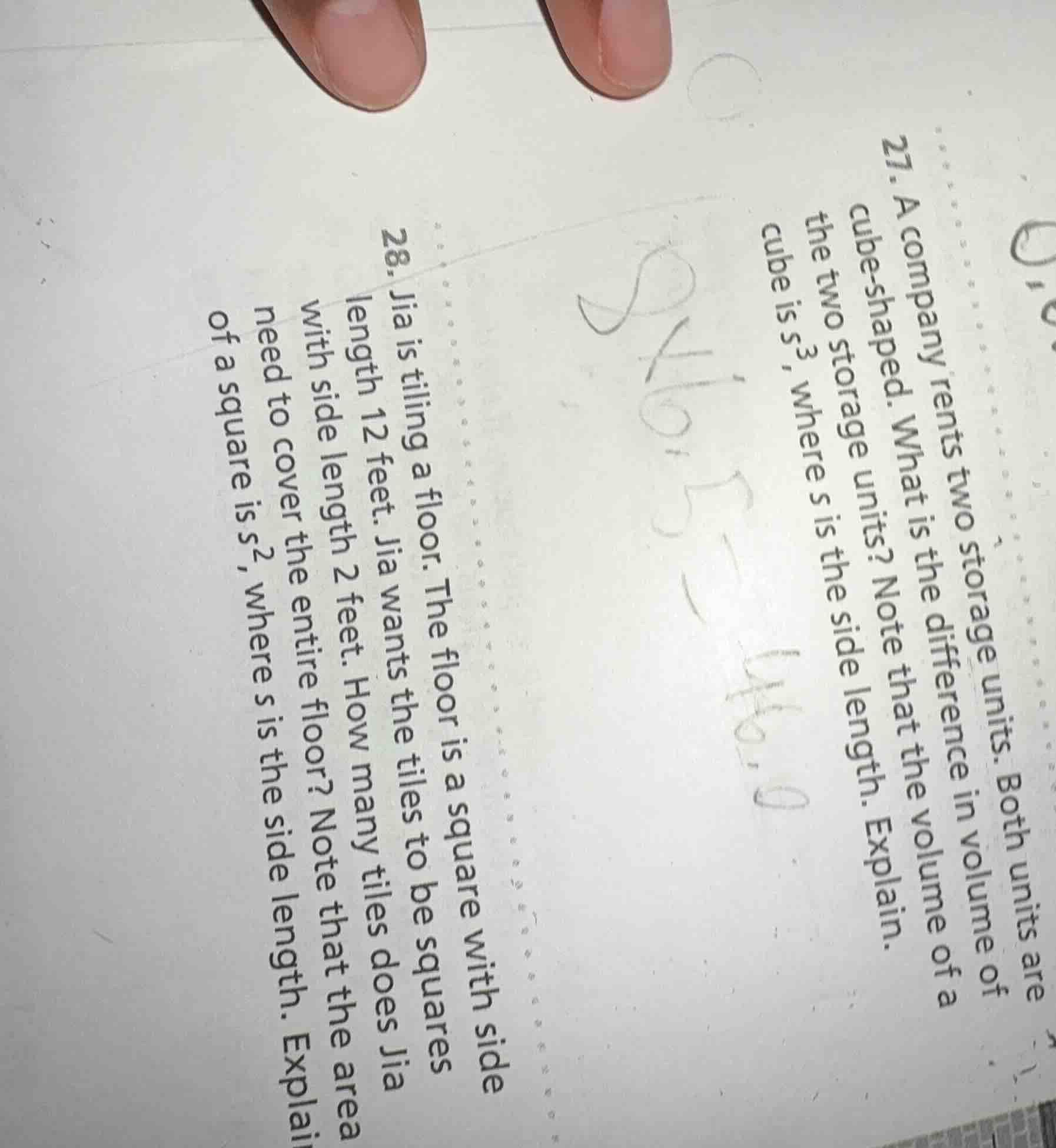
- a company rents two storage units. both units are cube - shaped. what is the difference in volume of the two storage units? note that the volume of a cube is ( s^3 ), where ( s ) is the side length. explain. 28. jia is tiling a floor. the floor is a square with side length 12 feet. jia wants the tiles to be squares with side length 2 feet. how many tiles does jia need to cover the entire floor? note that the area of a square is ( s^2 ), where ( s ) is the side length. explain.
Problem 27 (Assuming we solve this first, but let's check the visible part. Wait, the visible problem 28: Jia is tiling a floor. The floor is a square with side length 12 feet. Jia wants the tiles to be squares with side length 2 feet. How many tiles does Jia need to cover the entire floor? Note that the area of a square is \( s^2 \), where \( s \) is the side length. Explain.
Step1: Calculate floor area
The floor is a square with side \( s = 12 \) feet. Using the area formula \( A = s^2 \), we get \( A_{\text{floor}} = 12^2 = 144 \) square feet.
Step2: Calculate tile area
Each tile is a square with side \( s = 2 \) feet. Using the area formula, \( A_{\text{tile}} = 2^2 = 4 \) square feet.
Step3: Find number of tiles
To find the number of tiles, divide the floor area by the tile area: \( \text{Number of tiles} = \frac{A_{\text{floor}}}{A_{\text{tile}}} = \frac{144}{4} = 36 \).

Snap & solve any problem in the app
Get step-by-step solutions on Sovi AI
Photo-based solutions with guided steps
Explore more problems and detailed explanations
Jia needs 36 tiles.
Problem 27 (Partially visible, but let's assume the two cubes: Let's say the side lengths are \( s_1 \) and \( s_2 \), volumes \( V_1 = s_1^3 \), \( V_2 = s_2^3 \), difference \( |V_1 - V_2| \). But since the problem is partially visible, if we assume, for example, if one cube has side \( s \) and another \( s + a \), but the visible text says "A company rents two storage units. Both units are cube - shaped. What is the difference in volume of the two storage units? Note that the volume of a cube is \( s^3 \), where \( s \) is the side length. Explain."
Assuming we need more info, but since problem 28 is fully visible, we solved that. If you need problem 27, please provide the side lengths of the two cubes. For now, the solution for problem 28 is as above.