QUESTION IMAGE
Question
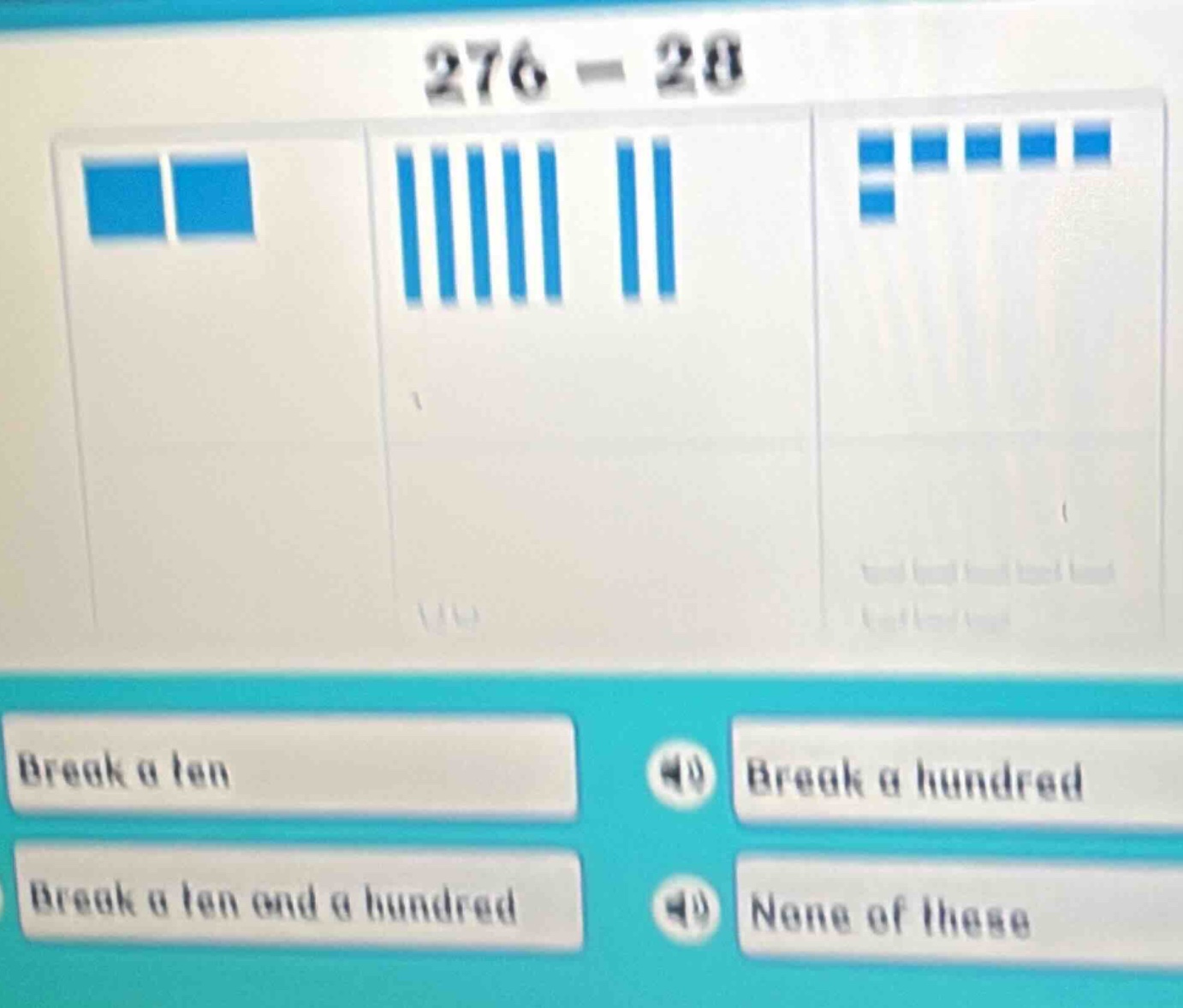
276 - 28
break a ten break a hundred
break a ten and a hundred none of these
Step1: Analyze the numbers
We have \(276 - 28\). Let's look at the digits: in \(276\), the tens place is \(7\) (representing \(7\) tens) and the ones place is \(6\). In \(28\), the ones place is \(8\). Since \(6<8\), we need to borrow from the tens place. But the tens place has \(7\) tens, so we can break a ten (convert one ten to ten ones). After breaking a ten, the ones place becomes \(6 + 10=16\), and the tens place becomes \(7 - 1 = 6\). Then we can subtract the ones: \(16-8 = 8\), and then subtract the tens: \(6 - 2=4\) (wait, no, actually \(28\) has \(2\) tens and \(8\) ones. Wait, maybe better to think about the subtraction process. But the key here is that we only need to break a ten (because we can borrow from the tens place which has enough, we don't need to break a hundred). Wait, no, wait: \(276\) is \(2\) hundreds, \(7\) tens, \(6\) ones. \(28\) is \(0\) hundreds, \(2\) tens, \(8\) ones. So when subtracting ones: \(6 - 8\) is not possible, so we borrow from the tens place. The tens place has \(7\) tens, so we take \(1\) ten (break a ten) and convert it to \(10\) ones. Now ones place is \(6 + 10 = 16\), tens place is \(7 - 1=6\). Now subtract ones: \(16 - 8 = 8\). Then subtract tens: \(6 - 2 = 4\). Then hundreds place remains \(2\). So we only needed to break a ten. Wait, but wait, is that correct? Wait, \(7\) tens is enough to borrow \(1\) ten, so we don't need to break a hundred. So the correct option is "Break a ten"? Wait, no, wait, maybe I made a mistake. Wait, \(276 - 28\): let's do the subtraction: \(276 - 28 = 248\). Let's check the steps:
- Ones place: \(6 - 8\) can't do, so borrow from tens. Tens has \(7\), so borrow \(1\) ten (break a ten), so ones become \(16\), tens become \(6\).
- Ones: \(16 - 8 = 8\)
- Tens: \(6 - 2 = 4\)
- Hundreds: \(2 - 0 = 2\)
So we only broke a ten. So the correct option is "Break a ten". Wait, but let's check the options: the options are "Break a ten", "Break a hundred", "Break a ten and a hundred", "None of these". So the correct answer is "Break a ten".
Wait, but maybe I misread the number. Wait, the number is \(276 - 28\). So yes, as above, we only need to break a ten. So the correct option is "Break a ten".
Step2: Evaluate the options
- "Break a ten": As we saw, we only needed to borrow from the tens place (break a ten) to subtract the ones place.
- "Break a hundred": We didn't need to borrow from the hundreds place because the tens place had enough tens to borrow from.
- "Break a ten and a hundred": We didn't need to break a hundred, so this is wrong.
- "None of these": Since "Break a ten" is correct, this is wrong.
So the correct option is "Break a ten".

Snap & solve any problem in the app
Get step-by-step solutions on Sovi AI
Photo-based solutions with guided steps
Explore more problems and detailed explanations
A. Break a ten